AI in Supply Chain: Implementation and Challenges Across Enterprise, Mid-Market, and Government
The AI Debate Misses How Adoption Actually Happens
The impact of artificial intelligence on the workforce seems to depend on who you’re talking to. Large corporate CEOs, employees, and mid-career professionals can all have varying degrees of concern when it comes to how AI is deployed and where the impacts are felt. Enterprise level Fortune 100 companies will rush to develop and implement the latest and greatest AI platforms to optimize their business, sometimes to their own detriment. Small and mid-size firms will feel like they’re struggling to keep pace without the capital of their larger competitors while ignoring affordable talent and assets right in front of them. And the public sector and government agencies will paper over a lot of initiatives, forming committees and making declarations while perpetually lagging behind the curve.
Supply chain has long been early adopters of technology due to the nature of the business. Much of the debate around AI supply chain implementation and challenges centers on whether automation will replace workers or simply change how supply chain teams operate. Making and moving large amounts of products across the globe is costly and requires a massive amount of capital. That capital needs to be optimized with the best talent and tools to ensure adequate production, movement, and delivery times. The question now becomes how much talent will be eliminated to accommodate AI? The answer to this query depends in large part on capital outlays and how aggressive you want to be with AI adoption.
AI is often described as a job-destroyer. In reality, it is a productivity amplifier that arrives unevenly across organizations. AI is also advancing in a very lightly regulated environment, especially in the US. This will help with accelerated adoption. For better or worse, many organizations are deploying powerful tools with limited oversight while policy makers struggle to keep pace. This creates a paradox: leaders must prepare for the worst-case scenarios even as they experiment with optimistic ones. Businesses are not racing to a single, predictable future but to a range of possibilities, from dramatic white collar disruption to steady productivity gains.
This article examines how AI adoption will cascade from large enterprises to smaller firms and public institutions. We’ll go into what that means for hiring, skill set development, and career trajectories. Understanding AI supply chain implementation and challenges requires examining how adoption unfolds across organizations with very different capital, talent, and risk tolerance.
Large Enterprises Will Test the Limits First
The bigger your budgets, the faster you will adopt enterprise-level technological advances. This goes without saying, of course. AI is no different. Larger firms lead AI adoption across supply chain in forecasting, planning, logistics optimization, procurement analytics, and control towers. The early impacts of these moves include role compression, fewer planners per dollar of revenue, and a reduced hiring velocity. In this case, yes, AI can be a job replacer. However, it is not universally applied.
AI as a job destroyer depends largely upon the size of the organization implementing the technology. Larger companies are able to invest more heavily into technology hoping to save money by cutting labor costs. Clearly, the intent is to replace human capital with technology. Thus, to afford these investments in tech and AI, cuts will need to be made. However, this comes at a risk.
A recent Wall Street Journal article echoes this sentiment. Even in highly automated environments, core business decisions still require human leadership. AI can generate analyses, draft business cases, and model scenarios, but executives remain responsible for interpretation, accountability, and persuasion. In practice, organizations often use AI to accelerate early research while relying on subject-matter experts to validate assumptions and present conclusions to stakeholders. The technology reduces preparation time, not the need for experienced decision makers.
The article cites a PWC survey of CEOs where only “12% said that AI delivered both cost and revenue benefits. More than half of the nearly 4500 CEOs polled worldwide said they have seen no significant financial benefit so far.” Many other companies mentioned in this article report that robust AI investments still required even more investment into human capital to develop and implement the tools.
Seeking competitive edges comes in many forms, but until industry standards develop, early adopters over invest too soon into unproven tech. This isn’t always the case, of course, but what we do see is that slowed adoption wins more times than not.
Businesses need people. Leaders mold the future of the company. There is also a layer of tacit knowledge that includes contextual judgment, institutional memory, and interpersonal trust which cannot be fully codified or discreetly managed with technology. Succession planning, culture building, and stakeholder alignment remain deeply human processes. Fully autonomous organizations competing without human leadership remain more theoretical than practical, particularly in complex supply chains where accountability, safety, and relationships matter.
This is why a more measured approach to tech adoption, no matter the size of your company will always win in the end.
Technology isn’t going anywhere. The question, then, is at what rate do companies invest in human vs. Technology capital as AI becomes more widespread. How does the cost of doing business shift?
And is head count reduction really necessary? What if you simply continue a slow and steady approach to team building while using AI to make your teams more efficient and productive? Perhaps that’s the move in order to avoid a higher cost of doing business from unproven AI investments that don’t pan out coupled with aggressive layoffs.
Our most recent Supply Chain Careers Podcast with AI innovator Josh Middlebrooks talks about how he and his company use AI to make their teams super-human, rather than replace headcount. This can be a prevailing sentiment for all companies, big and small. It just requires the vision and understanding of how to use AI as more of a complement and less of a replacement.
Small and Mid-Sized Firms: Leapfrogging Later
For argument’s sake, let’s say that small and mid-sized firms lack necessary capital to invest on an enterprise level with AI adoption. They may feel less compelled to budget for the personnel and hardware to keep up. But then the labor market becomes flooded with people who were laid off by the larger firms that wanted to replace them with AI.
A savvy small to mid-size firm will see this and scoop up talent that they may not have had access to in a different market. Hopefully this talent also possesses a more robust knowledge and skillset from working for larger competitors. Acquiring talent with this knowledge, working with more affordable and accessible AI tools can allow these firms to utilize tech and AI at a pace they may not have expected. Add in a few strategic hires from supply chain savvy universities like Georgia Tech, Michigan State, and the University of Arkansas, and you’re right there with the big dogs, proportionally.
These firms don’t need to be ahead of the curve. They just have to make fewer mistakes and be more consistent. By definition, smaller firms often act as fast followers rather than pioneers. They benefit from watching large enterprises absorb the costs of experimentation, failed implementations, and organizational disruption. When mature, lower-cost solutions emerge, SBs can adopt proven tools while hiring experienced talent displaced from earlier waves of automation. A lot of times this results in more efficient adoption paths with fewer false starts.

Government: A Parallel Track
Government and public sector adoption of AI is unfolding on a fundamentally different timeline than the private sector. It is driven less by competitive pressure and more by mandates around accountability, privacy, and continuity of public services. Federal agencies are already deploying AI across operational domains like weather forecasting, disaster analysis and administrative automation.
These systems are often aimed at improving resilience and stewardship rather than profit, with applications such as fraud detection, compliance automation, risk management, and supply chain monitoring increasingly embedded in mission critical programs.
At the same time, long-term adoption is constrained by a structural talent gap: agencies must recruit and retain highly specialized technical personnel while competing with private-sector salaries. This challenge is highlighted in the GSA’s guidance on Developing and Retaining AI Talent. As a result, public sector AI tends to evolve through incremental modernization that reduces backlogs, improves transparency, and augments human decision making rather than eliminating large numbers of roles. This creates a parallel adoption curve that prioritizes stability, legal compliance, and public trust over speed.
Jobs Will Evolve Before They Disappear
Not all warnings about AI’s impact on employment are unfounded. Some analysts predict significant disruption to professional services roles such as law, accounting, and auditing as automation improves. However, even pessimistic forecasts acknowledge that organizations still require oversight, ethical judgement, and client relationships. AI cannot supplant these essential functions.
AI impacts tasks first, jobs second. Planning, coordination, and reporting roles are most exposed. Judgment, leadership, and exception management increase in value.
Soft skills cannot be replicated by machines. Creativity, critical thinking, collaboration, communication and change management/leadership become key differentiators in AI-enabled companies and organizations. As routine analytical tasks are automated, value shifts toward people who can interpret results, build consensus, and guide action.

We’ve seen how business and government entities keep pace with the rise of artificial intelligence. What does that mean for the labor force?
Again, it depends on who you ask, especially according to a recent Harvard Business School (HBS) article.
Some experts on artificial intelligence are pretty doom and gloom about the workforce implications.
Professionals Must Develop the Skills AI Cannot Replicate
It’s important to remember, especially right now, that AI has to learn from something. The key takeaway for people in the work force is to give AI things to learn. Find a way to be a source of information.
Be creative.
Be a thinker.
Be an innovator.
These human capabilities should be developed intentionally. Creativity, adaptability, and entrepreneurial thinking are not static traits; they are still strengthened through practice. As more routine tasks become automated, organizations will increasingly reward individuals who can synthesize information, generate original ideas, and lead complex initiatives.
It is highly important not to be a luddite. Find a way to incorporate the use of AI into your work world. Myriad tools exist to help guide you towards creative endeavors that showcase your knowledge and ideas. Blogging, podcasts, your own substack or website. Find a way to demonstrate your own individual and unique knowledge so that the large language models can access your intellect. We’ve seen it work, first hand.
Be the thing AI learns from by practicing thought leadership in your field. If you don’t feel qualified to do that, then find a mentor and learn. Everyone can teach and everyone can learn, throughout your career. AI won’t stop you from doing so.
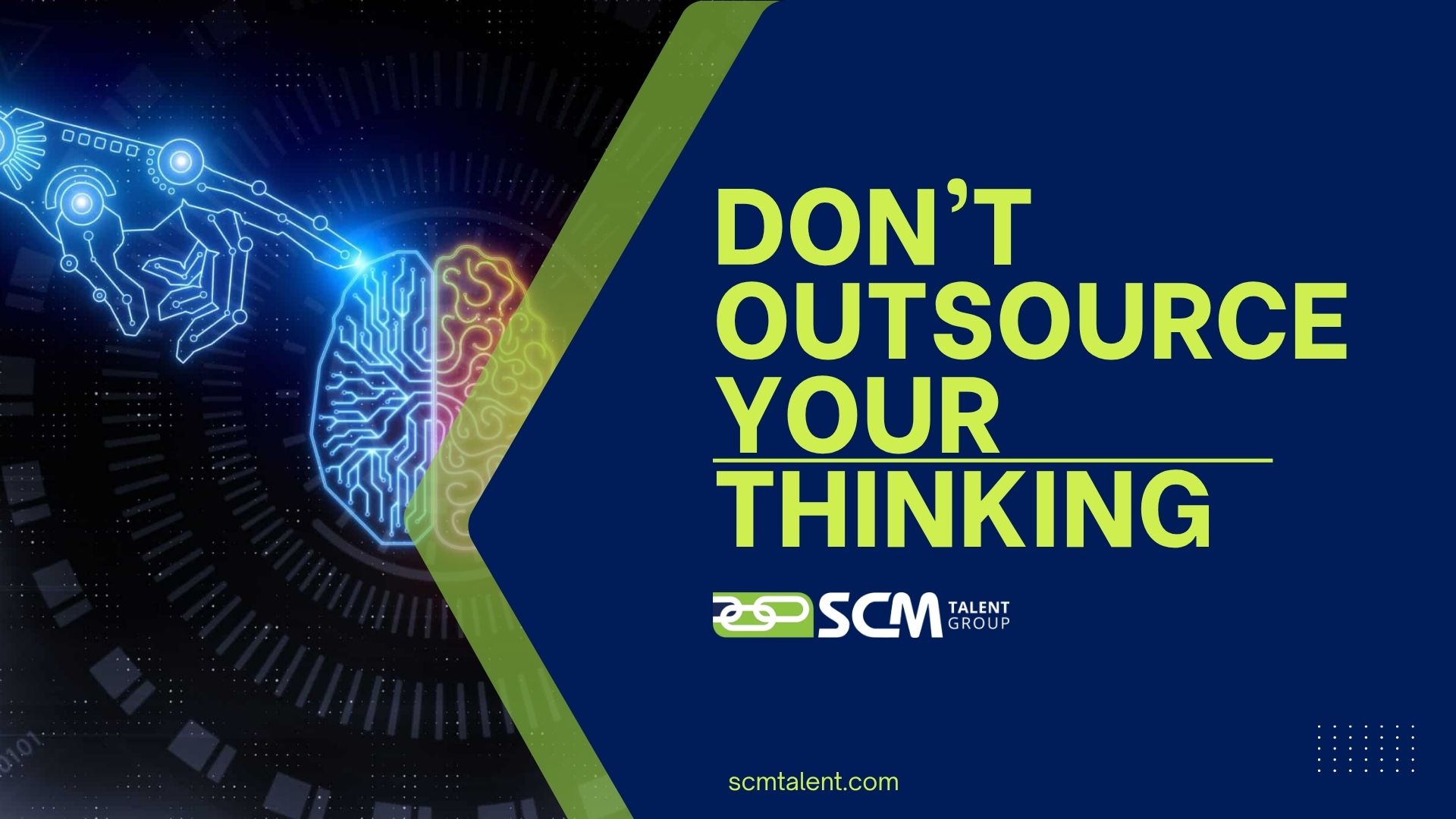
Generative systems depend on human-created knowledge. Just as media aggregators cannot exist without original journalism, AI models require a consistent stream of authentic and original content, expertise, and insight. Professionals who publish, teach, mentor, or otherwise contribute original thinking build personal brands and shape the knowledge base future systems will draw upon.
Employees: Build AI literacy and domain depth.
This is not the time to be complacent. You may very well feel comfortable in your current role, but only the proactive will advance. Upheaval favors the bold. Waiting until you’re forced to act will reduce your options and render you unreliable. Your team and your boss needs you to be anticipating changes and requests. Technology and AI will enhance your productivity but it requires you to take the initiative to determine where it fits in your role for said strategic expansion. If you can apply that same initiative for applications horizontally across the supply chain, you will accelerate your career growth and create stability for you and your role. Become indispensable. Don’t outsource your expertise to the tool while developing fluency with it. Use your insight and wisdom to translate the data into action and guide your team and others through the transitions.
Don’t let ai be a substitute for knowledge base and skillset.
Leaders: Focus on augmentation and change management.
Organizations must also continue investing in early-career talent. A workforce composed only of experienced hires is unsustainable because expertise must be developed somewhere. Entry-level employees represent the pipeline for future leaders, domain experts, and innovators. AI cannot replace the long-term process of human capability development. Be diligent about sourcing this talent. You’re best served letting experts in the supply chain realm work with you to mine these talent pools for the people that best suit your very niche and specific needs. Making the wrong hire or relying on a more generalist talent pro can set your company back months in a rapidly shifting technology landscape. Specialized AI recruiters focused on supply chain, such as SCM Talent Group, increasingly help organizations navigate this shift by identifying leaders who combine domain expertise with AI literacy and digital transformation experience.


Technology partners: Deliver low-cost, scalable AI for Small and Midsize Businesses.
Let’s talk football for a moment. The Indiana Hoosiers are national champions in large part because they had a team full of 23-25 year olds. These were highly experienced and very senior athletes, mature in their physical and mental development. Of course they had more of an advantage.
You can’t build your team with only seasoned veterans. Growth and succession planning requires a deep bench which means hiring entry level people with high ceilings. For you tech partners, you have to design tools compatible with all levels of employee and each level of business. If you’re only designing enterprise level software, you may go broke. There are more SMBs who can eventually grow into that level. Know your audience and target accordingly.
Conclusion: AI Will Reshape Supply Chain Through Uneven Adoption
AI will reshape the supply chain workforce gradually but permanently. Prepared organizations and individuals will benefit.
AI will not rewrite the supply chain workforce org chart overnight. It will reshape it unevenly and incrementally. Large enterprises will move first, testing tools, compressing spans of control, and redefining how many planners or analysts they need per dollar of revenue. Smaller firms will follow at a different pace, often absorbing experienced talent and adopting proven systems once the early experimentation settles. Public institutions will modernize within their own constraints, prioritizing compliance and continuity over speed.
The result will not look like mass elimination. It looks like reorganization. As we discussed in my latest article for Georgia Tech, there is a human edge to every single AI advance out there. It’s up to us to perceive these advances as complements, rather than replacements. Companies likely will redraw org charts in fits and starts. Some teams will shrink. Others will expand. Hiring velocity will slow in certain functions while demand grows in areas that require judgment, coordination, and change leadership. Many roles will not disappear. They will evolve. Planning will require broader oversight. Analytics will demand stronger interpretation. Leaders will expect fewer silos and more cross functional capabilities. Soft skills will become paramount as businesses try to rely more on machines that require quality inputs and monitoring in order to produce adequate and reliable outputs.
About The Author
Chris Gaffney is an Edenfield Executive-in-Residence and a Professor of the Practice in the H. Milton Stewart School of Industrial and Systems Engineering. He also serves a dual role as Managing Director of the Supply Chain and Logistics Institute (SCL) and Academic Program Director for Georgia Tech Professional Education (GTPE) . He was most recently VP of Global Strategic Supply Chain at The Coca-Cola Company. During his 25-year tenure with Coca-Cola, Chris held multiple leadership roles including President of Coca-Cola Supply, SVP Product Supply System Strategy, VP of System Transformation, and VP of Logistics for North America. Chris also served as President of the National Product Supply Group; a governing body responsible for 95% of volume produced in North America. Following his retirement from Coca-Cola in 2020, he assumed the role of Principal at ECG and partner at EDGE Supply Chain, providing advice and consulting in the Supply Chain space. Gaffney has extensive experience in Consumer Products Supply Chain, Supply Chain Strategy & Transformation, Footprint Design & Network Optimization, Supply Chain Operating Model and Capability Building and Logistics and Supply Chain Planning.