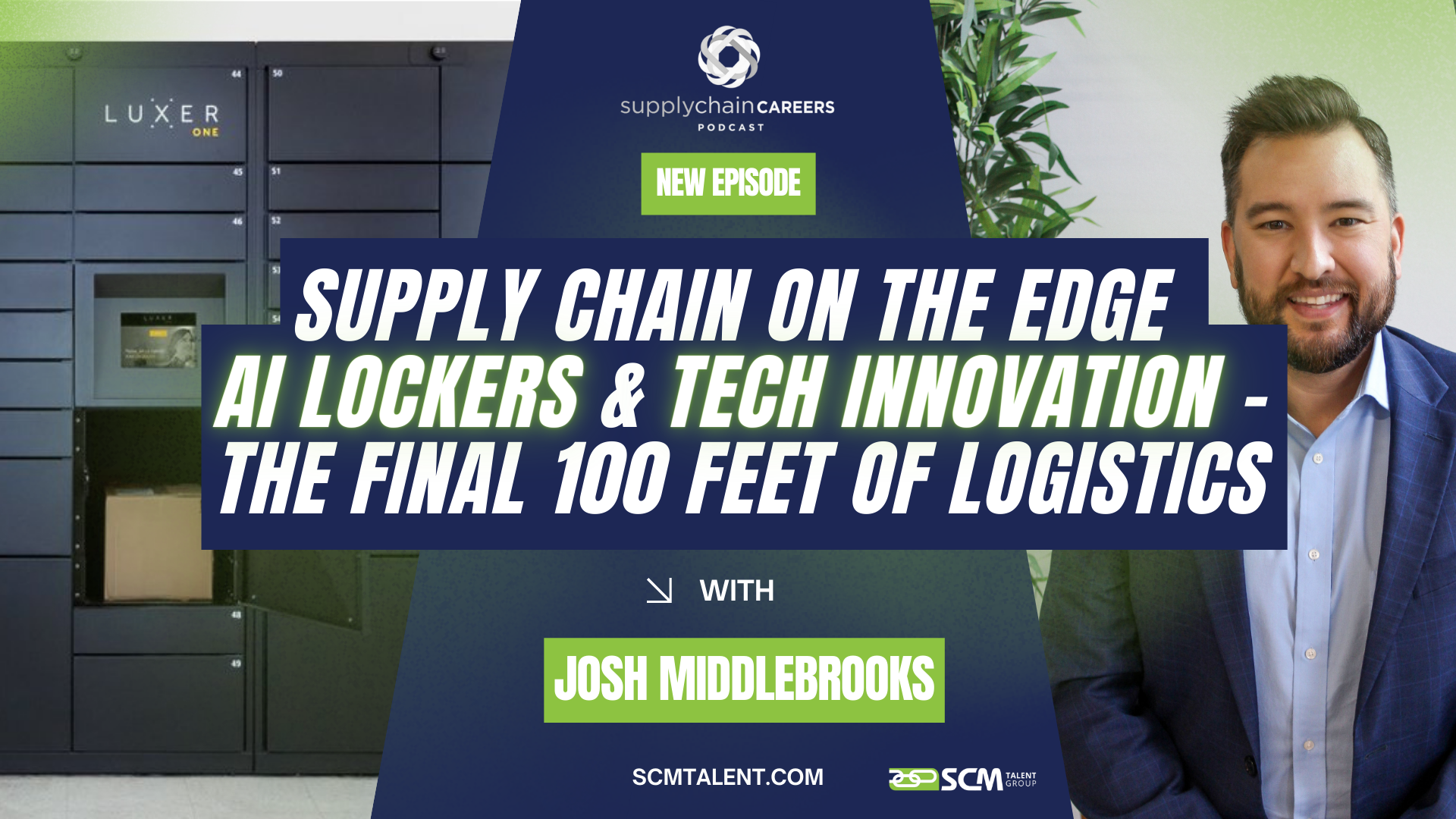
Josh Middlebrooks
Rodney Apple: [00:00:00] So Josh, welcome to the Supply Chain Careers podcast.
Josh Middlebrooks: Awesome. Thanks for having me. I’m excited to be here and talk about it.
Rodney Apple: Likewise. We’d love to start out with your career journey.
A lot of people plan to go into supply chain and a lot of most people that I’ve found fall into it. But I’d love to hear what were some of those initial inspirations that drew you into logistics, supply chain, and some of the pivotal moments that shaped your path leading up to this role you’re in now as the president of Luxeror one?
Josh Middlebrooks: Yeah, I think I fall more into the the back half of that category kind of fell into it. I was doing industrial engineering at Clemson and I had a internship at a manufacturing plant right there on the border of South Carolina and Georgia. And we were making a. Conveyor belts and rubber products.
And one of my first assignments was to go up and do the piping diagram for a basically a furnace that’s going to heat up the rubber and final [00:01:00] cure it and all of that. And I was like, this is. A fun job. But in Georgia, in the summer, South Carolina in the summer, you guys that are from there know we don’t need any extra heat.
We don’t need a 600 degree oven to to get hot. So in those moments, I was thinking about my, my career and where I wanted to go and how can I put some engineering and some process mapping and some working with people and solving some complex challenges altogether and found that supply chain was a really good fit for me.
So I started out at Manhattan Associates. It’s a boutique supply chain software firm that also has a consulting and professional services wing. Like I said I enjoy talking to people. I enjoy learning more about them and solving pain points and problems for people. So it felt a nice fit where I could put some supply chain chops, put some software chops but also connect with people and do that. So yeah, Manhattan [00:02:00] Associates was my fall into it by learning that I didn’t want to do piping diagrams and for a 600 degree oven in the middle of the Georgia summer.
Rodney Apple: That’s great. That’s fascinating. And yeah, Manhattan, a lot of our clients use Manhattan. Absolutely, especially on the warehouse management side and the kind of the gold standard for one of the gold standards. There’s others out there too. A lot of competition in that space. And then you went on and worked we, we share an employer.
So you spent some time there at Home Depot as well? At their headquarters.
Josh Middlebrooks: Yeah, absolutely. So at Manhattan, it was in the really getting started with online order fulfillment at that time and doing projects where we are weaving together. Online order fulfillment, warehouse management, transportation management visibility across the supply chain.
And really good look for at supply chains for a lot of really high profile brands. A lot of really great exposure. But ultimately, being a consultant, you are on the road serving clients. And [00:03:00] I really enjoyed that aspect of my career. I would recommend Manhattan Associates to anybody who’s starting their career.
And so I, I joined Home Depot through their leadership development program. It was a fantastic experience.
Quarterly, you’re rotating around the business learning more not just supply chain, but finance operations. The. Operations of retail 1 0 1 and how that works with merchandising and , servicing customers, , face to face. And it was just a, an exceptional experience. I met a lot of friends that we still keep in touch today.
I was just at NRF and I got tapped on the shoulder. Hey, how you doing? I’m like. I can’t believe that we’ve instantly, recognized each other as well and hey, just having that shared experience and some of those formative years in your career. I, again, invaluable, I’d recommend that program to anybody and everybody that has the opportunity.
So yeah, that was great. And [00:04:00] then moved into store operations for those for those guys at Home Depot, we were joining. Online order fulfillment marrying in the store and the store associates, and how do we make that one seamless experience for the customer if I want to check out online and have it delivered to my doorstep is just as easy as checkout online and have it delivered and to the store and picked up at the store and all of that.
So that interconnected aspect of it, which was a hot buzzword at that time.
Rodney Apple: Yeah. And was that per perhaps the genesis of where you’re at now? That’s, there’s there, there’s a little bit of parallel there, right? With absolutely the final 100 feet. I know we’re gonna get into that in a minute, which I think is just a, the fascinating area that probably a lot of people don’t think about,
Josh Middlebrooks: yeah, absolutely. So when we were doing a bunch of pilots for store operations and interconnected supply chain and all of this in retail there’s some fundamental principles and it’s hey let’s treat the customer right. Let’s do a great [00:05:00] job for them and a great service for them.
And what we saw with this, e-commerce and online ordering explosion was that. Keep in mind, this is, a decade ago, but the service desk was, basically overrun with not just returns and general questions and all the stuff that they’d traditionally been doing for the past, like 20 years, but now they have to pick up online orders.
And so we were recognizing, even back then, that there has to be a better way. There has to be, a more efficient, a more customer friendly version of picking up these online orders. So we started exploring smart lockers. And we piloted with a few different companies, but there was really one that stood out and that was Luxer one and the founder of Luxer one a Levy came in and we just really instantly hit it off and, we were workshopping instead of meeting and going through presentations and, okay, what if we did this and how might we do that?
And we ended up deploying a small pilot at Home [00:06:00] Depot using Luxer one Smart Lockers. And the rest is history there.
I was about to open up a, I remember a food truck of American food down in the Caribbean. My phone rang and it was Ark saying, Hey, I’d like for you to come work for Luxer One. It’s Hey, I moved down to the Caribbean. I’m not at Home Depot anymore. He is I get all of that. Don’t care. Let’s build something. And so I became employee number 20 at Luxer one. And fantastic journey scaling out. Multifamily last hundred feet, retail, last hundred feet for buy, online pickup in store, buy online, ship from store, all of that. It’s been an incredible journey and weird mix of chance and fate and yeah.
Mike Ogle: I’d like to dive into leadership side of things. It, it’s interesting hearing that path. That you go through where you’re going to become your very own individual contributor and leading yourself with the food [00:07:00] truck. Yeah. But you just never know where life takes you at different times and the seeds that you planted, with others, how it came back to you to get you in this position today.
So you just never know leadership wise as you go through that kind of path when you have people that work for you. We like to get into the leadership side of this. So you have led through some high growth and transformations and even the pandemic, what are some of the most valuable leadership lessons that you’ve obtained out of those experiences and how have they shaped the way that you, yourself want to lead today?
Josh Middlebrooks: . I think I had great examples along the way in my career. Had some formal mentors, had some informal mentors just saying, Hey that’s somebody that I look up to and admire. I’m going to mirror them and replicate what they’re doing. But yes, as a business leader of Luxeror one it was during [00:08:00] 2020 and I found out who I was as a leader in very short order.
So leading a company through the pandemic was it tested everything, we had previously sold the company to Asa Aloy. And just starting out with that relationship, Arik decided to step back as the leader and those guys trusted me to, to grab the baton and run with it.
We are in this situation where no one can work in person. We’re a physical, smart locker product where, all this stuff is going we’re a growing company. Those belly to belly, face-to-face interactions are invaluable. So I would say the lessons I learned really quick were really around grit and perseverance.
You gotta keep showing up, you gotta keep working hard regardless of the circumstance. You have to remain mission focused. Hey, the reason why we’re doing this and processing all of these online orders is [00:09:00] for the moments that it creates for our end users and our customers, right? They’re the ones that are getting medication for maybe their parent or school supplies for their kid on a project that’s, due the next day, right?
And so you keep the customer in mind. It’s like that’s what keeps us going and the mission keeps us going, but. When you as the leader are, showing grit and determination and perseverance and you’re the hardest working person in the room, it gives you a lot of, I think, leadership capital
to ask more of your people in a really tough and challenging time, right? You build a lot of trust when the folks on the floor are seeing you sweat. Okay? And, hey I care this -much. So who’s coming with me? And I think that people genuinely want to do great things and build out their own story and their own legacy.
And hey, what a better moment to prove [00:10:00] who you are than with a little bit of adversity. And COVID was certainly that for all of us that that kind of managed and felt our way through it. So yeah.
Mike Ogle: And just real briefly I was just gonna follow up and ask about today, especially, realizing kind of the age that we’re in with AI and tools. Is there a short way that you might be able to address the challenges of leading right now?
Josh Middlebrooks: Sure. I think. A lot of those principles still apply. But I think a lot of it’s gotta be around, are you willing to try something new? Are you willing to fail? And when I think it goes back to that leadership capital.
When you are the one testing and you’re failing and telling your people that’s okay, like that there is permission to, to fail. The only [00:11:00] real failures when you stop trying and all of that. I think it just creates a culture where we can adapt and respond rapidly through iteration, over and over again, figuring out what works for us and what’s best for us.
And I think, certainly a couple years ago when all these LLMs and robotics and all these things became like more mainstream, everybody woke up and said, okay, great. What are we doing with ai? And we were able to, see the trend coming ahead. We, have been working slowly on, on some other AI projects.
In our smart locker there’s optical character recognition, reading package labels. We built a chat bot pretty quickly. But we like to be on the front foot with everything we do. It’s okay to fail your people see that. More trust is built when you know you don’t crucify them for little failures and things like that.
And kind of roll with the punches and keep going. Stay on the front foot.
Mike Ogle: [00:12:00] Great. Thank you.
Rodney Apple: Yeah, it leads to more ideas and innovation as well.
Josh Middlebrooks: Yeah, absolutely.
Rodney Apple: Speaking of, I, I do want to circle back ’cause I think I still think a lot of people aren’t familiar in the supply chain world, those coming up and those that have been in it forever.
The, this final 100 feet of logistics final mile, the last mile has been around e-commerce, exploded that segment and, now we’re talking about these, this final feet to, to get that product to the end customer. And we know it’s heavy, like you said, e-commerce omnichannel environments.
But you’ve expanded into other, like non-traditional areas too, like universities and I would imagine large office complexes or offices where we know the. Call it the proverbial mail room is a hot mess and packages show up. And I’ve certainly seen those over the years even going back to my collegiate days.
But maybe explain it from your, from your side, what is that final 100 feet what’s that space like? And [00:13:00] then talk about Luxer one, how it plays in the space and how you’ve evolved over time.
Josh Middlebrooks: Yeah, absolutely. And I think you, you hit the nail on the head, Rodney, that. Supply chain professionals are very used to and understand conceptually hey, there’s all these packages.
They’re moving through these like RDCs. They’re moving down through hubs into spokes and all of this. But what maybe is a bit foreign is what happens in that final 100 feet of the customer value chain once the carrier. Has that online order and they’re bringing it down the line because pre COVID, pre Amazon and that wave, hey, couple orders showed up mostly at apartment buildings is a really good example.
And where Luxer one plays the most, couple orders a day showed up, the resident would walk up to the property manager and say, Hey, I’m here to pick up, my online order. And she says, great, it must be one of these three. And she hands it to you face to face, and everything was [00:14:00] great. Then Amazon really took off and suddenly every single apartment building needed to have a package management solution and a package management room.
The property managers were saying, Hey I’m overrun by this mountain of packages, and back then that was like 20 a day. Okay, 20 a day is still manageable, but they have other responsibilities that they would like to do. So we dropped in a smart locker where the carriers, Amazon, UPS, FedEx, USPS, and everybody walks up, scans the package label.
We say, great, this is for Rodney. Door pops open deposit the package, and in the background, we are sending a notification or a text or what have you saying, Hey Rodney, here’s this package. It’s in locker 17, and here’s the pickup code for it. You walk down with your app scan it, door pops open and [00:15:00] there’s your package.
So we were able to really create a nice clean package management solution that took the property manager out of it. Then you scale forward on COVID and then everyone’s ordering everything online and now you scale further. And we have some buildings that are getting 800 packages a day in downtown Chicago.
That is a meaningful amount of packages that are like Amazon truck after Amazon truck stacked up to deliver all of these packages to these mega high rises. So we really need to be able to scale and do something more with package management, in that last a hundred feet. And it starts to really look like, what those RDCs looked like back in the day when our volumes were so low.
But these days, Luxer One, this past year in 2025 did over a hundred million deliveries across our 13,000 multifamily locations that’s serving about 4 million [00:16:00] active users. A little bit more than 1% of the population. We did a little bit more than 1% of all Amazon deliveries ended up in our smart lockers.
So this final 100 feet is growing. It’s active and I think it’s really supply chain on the edge is gonna be the next big term that we’re going to see here over the next 10 years.
Rodney Apple: Supply chain on the edge. Write that down.
Mike Ogle: Yeah, just like edge computing. It’s it’s a good thing to be able to piggyback on.
That’s great, especially being able to understand the scale of where you are and it as a growing need that’s there because everybody wants to do these kinds of things. A as this particular segment of the supply chain is growing, then what career opportunities do you think are emerging in last mile and final feet logistics. What kind of skills or experiences do you recommend [00:17:00] professionals who to obtain who wanna get into that space?
Josh Middlebrooks: Yeah. I think. That there’s a bit of a maybe a mismatch between what the general public is thinking right now with AI and robotics and all of this, and what supply chain has quietly been doing for the past, 15 years.
So some of these concepts that are coming out now about like digital twins. In supply chain world, we’ve been running digital twins in the background for a decade. We, we did our first training on it when I was at Clemson, for school. There’s a lot of that stuff that’s been happening in the background.
There’s a lot of automation for package management happening in supply chain, even at Manhattan Associates when they created the wave. And now all of those LPNs are running around on robots. There’s all of the augmented reality that’s happening throughout that value chain. So if you are [00:18:00] interested as a young professional right now in this whole AI wave, I think that a career in supply chain is a great fit for you because it’s already been done and we’re learning more and doing and pushing more and more. In terms of the hard skillset, I think again that gap between public and supply chain, these LLMs came out and everyone’s thinking about a B2C solution thinking in software.
I would push folks coming out and starting their career more towards B2B solutions. And when you get into B2B, it’s not just the software, but you start getting into solving real world problems In supply chain, you need hardware, you need firmware. We’re talking about moving atoms through a supply chain.
Not just bits for software. So getting that skillset for UX design, not just for software, but UX design for hardware. And how do humans interact with robotics [00:19:00] to create some real value? I think there’s just a ton of opportunity that nobody’s talking about. With augmented jobs. With humans and robots and I, trust me, I hate the whole conversation about AI and taking jobs and doing all of that and displacing folks.
We look at AI as a, an efficiency tool to make our people superheroes at what they do. But I think in the supply chain world, you’re gonna see a lot of stuff with like exoskeletons. How do we keep our people safe? Some of these two man lifts you’re gonna see more with like inventory and cycle counting.
With drones, you’re gonna see a lot of augmented reality to make people, like you said, be super super humans. More efficient supply chain’s. A great pool to do that in hard skills. Hardware design, firmware design, and you’re gonna enjoy a fantastic career [00:20:00] in supply chain.
Rodney Apple: I agree. It’s it’s it’s amazing to see where it’s evolved to today and I just. I thought of a question when you think about competition and not just those that have this, the locker base systems I’m going back to co COVID. I was at modex and when it broke out, like literally.
And I just remember seeing quite a few robots. Of course. There was an application, and I wanna say it was coming out of Oregon and I forget the name of the company, like the, these are humanoid robots, might have been the first batch, if you will.
And the application was gonna be, they’ll, we’ll stage these in the back of the final mile truck, and they’ll get out and deliver the package, walking. To your doorstep, drop it off and bring it back. And I don’t know if and now you’re seeing all these autonomous little vehicles or robots delivering certain things, especially in the bigger metro cities like New York City.
But y your thoughts on that piece, is that more of a companion to your offering or more of a competitor? How would you view that? Do you think it’s gonna take off at all?
Josh Middlebrooks: I [00:21:00] think, when we start talking about AI and robotics, also, we should probably start with Luxeror one.
We’ve been around for 10 years and it is a purpose built robot that uses AI in different aspects of it. So I think these humanoid robots, you go to a trade show and you see them dancing. Whatever. And you’re like, oh, okay, this could be interesting. This will be interesting.
One day, right? Once we get the computer vision right, and we get the firmware right, and we get the, skill building, right? And we’re on our way. But right now, I think the real opportunity is with companies like Luxeror, one that are building these purpose built machines and interweaving it to solve a real problem.
And we just made mention, hey, if we can do things that make jobs more safe for humans less repetitive where you could get hurt right in pokey oak and all of this, these are real opportunities that exist. You got a startup today, [00:22:00] look at solving a real world problem that bridges software and hardware and that’s, they call it robotics.
Rodney Apple: It leads right into, we’re talking about talent and as someone that’s been on this, on the recruitment side of supply chain for so long I would love to hear from your perspective what, soft skills, hard skills, and then, where do you go to find people that assimilate well into your unique, this final 100 feet environment. .
Josh Middlebrooks: So when we’re talking about the last 100 feet, we’re talking about supply chain on the edge. There’s a double-edged sword here. There’s some good news, bad news. The good news is it’s new and it’s awesome and it’s cool and people want to work on it. The bad news is that no one’s ever done it before.
So there’s not a lot of folks with a ton of experience that they can come in and drop in knowledge. So we’re, in year 10 of a startup. So we are looking for folks that have those entrepreneurial characteristics that live our core values, and that’s where it really starts.
So in particular, right? [00:23:00] Some of those entrepreneurial core values are pride and ownership, be solutions driven, respond rapidly, starts there with our interview process. Making sure that our hiring managers are asking those focus questions to see Hey, where do these folks, rack and stack based on those core values?
It’s in our onboarding, it’s in our first 90 days. It’s in everything that, that we do, because like I said, there, there’s no we’re not gonna compete with some of these bigger companies in terms of pay and experience and all of this. We’re looking for people that want to create.
Future of the last hundred feet. So curious, driven, entrepreneurial people. And at the same time, we’re gonna be very unapologetic about who we are and who we look for. And if it’s a fit, great. We’re gonna make magic. If it’s not a fit, great. I wish you all the success in the world and I’ll help you find your next role.
And it’s been a formula for success for us and we’ve scaled and [00:24:00] triple digit, and this, that, and the other. So something’s working.
Mike Ogle: Yeah. I want to hit you with a couple of quick curve balls, if you don’t mind. You’re going through the process of trying to find talent. Can you name two things that tend to immediately turn you off and two things that make you go, Ooh, we may have somebody here.
Josh Middlebrooks: Sure. I would say. Oh man, the turnoffs folks that lead from the back. I would say that’s like the biggest one. So on paper, the credentials and everything is immaculate. It’s a fantastic resume and, they’ve done this and that. But how they did it is from the back.
They’re gonna sit in an office and. Maybe come up with a strategy and a playbook and it’ll take two years and this, that, and the other. And then that person also talking about I a lot in the interview, it’s we’re smart [00:25:00] enough to know that, one human alone cannot achieve, all of these things that they’re saying.
That to me is like an instant flag for us that that’s not gonna be a great fit. And then on the flip side, I think it’s like the opposite of that. People that have either led from the front there’s pictures out there on the internet of them, breaking a sweat, leading a team doing an installation launching a software go live at two in the morning when things are are lonely and you’re tired and, all these other things.
Folks that built a side project in the garage. If you’ve built a side project in the garage that you’re jazzed about you’re a fit, you’re a culture fit for us.
Mike Ogle: Yeah, that’s great. And on that whole culture and organization side of things. You’ve emphasized financial literacy and open communication with your teams. How has that transparency really influenced your team’s engagement and then the influenced the performance of the [00:26:00] company?
I think it, it’s something that’s important for a couple of reasons. First it’s finance is the language of business. At a lot of these big companies and then, when I was at different companies and working for different companies and consulting for different companies in my career, you can lose sight of the full p and l.
It’s, this is what I’m responsible for, this is what I’m gonna do, and I’m gonna manage to these three KPIs. Okay. As a startup. And as a smaller, like scrappier, more entrepreneurial company, we have to make sure that everybody’s aligned on, yeah, these may be your three KPIs, but here’s how they impact the bigger p and l.
Here’s how they impact this other team’s three KPIs. Here’s how we work together, and that p and l, that income statement is the scorecard of how we did for the year. So [00:27:00] you can also take those lessons. From a business standpoint, finance is the language of business and apply that to your personal life, right?
Like in your personal income statement with the, the paycheck that we give you, right? Like, how do you invest for the future? How do you make sure some of your fixed costs right, are manageable? How do you grow your balance sheet? And so I’ve just always thought it was important to recognize that.
We are working with adults, right? I’m not going to try to overly shield and protect and privatize like some of this information, like if we’re all in it, one team, one dream and we’re going after this this incredible worthy mission statement, right? We also have to. Remember that this is a business and there’s a ton of trust back and forth when you do something like this on this exercise to say here’s how we’re growing.
Here’s why. Here’s the projects that you’re [00:28:00] doing to drive out or drive down this cost. Here’s how we get more operationally efficient. And I think like for our people, especially those that have been around the block and our mid-career, later career, they’re like, wow, this is. This has never happened.
Like I’m it’s almost like a state secret, even though, hey, there’s gonna be a quarterly earnings call, that the CEO is going to do. But it’s we should not talk about finance, we should not talk about money. And I’m just fundamentally don’t believe that’s how you get the best out of the grownups that are working with you.
Rodney Apple: It’s important to do that and a lot of companies don’t especially privately held. I wanna get back on trends before we wrap up our show here. And obviously there’s a lot of innovation in this last mile, final mile. And as we’re talking about today, final feet you guys have certainly evolved into different areas as well.
What are you seeing in your crystal ball? In the coming years, you certainly have hit on ai and we know robotics many forms of. Of [00:29:00] the robots are coming online and is the economies of scale are in the favor of all of this coming down from the big companies that can afford it.
They’ve got the, the big open string purses. And now we’re starting to see adoptions with mid-size, smaller companies too. But we’ll love to hear just what your take is on that, in this particular space.
Josh Middlebrooks: For sure. I think, we talk about supply chain on the edge in the last a hundred feet. It’s really, we talked about AI and robotics, but keeping in mind that the customer’s in the center of everything that we do, how do we make a better customer experience? And for us, at Luxeror we’re doing a little bit of supply chain efficiency and customer experience by facilitating an asynchronous handoff.
I think that’s gonna be another big trend is that let’s respect everybody’s time and create ways that we don’t have to meet up and do our roles face to [00:30:00] face. So if I can make a software and hardware product that’s easy for carriers and supply chain folks to deliver to on their schedule, optimized with availability calls and reservations and, quick scans with OCR and all of that, and then leave it there.
Safe and secure in the smart locker, and then the customer can come, 1:00 AM 1:00 PM whenever it suits them to do the pickup. Great customer experience through the application. That’s what I think is gonna be another big trend that you’re gonna see migrate further upstream into the supply chain world as well.
This asynchronous delivery customer at the center, do it on their time, right? But also have the safety and security aspect of their stuff isn’t gonna get porched by it stolen or misplaced or, everything has to be [00:31:00] executed flawlessly for that asynchronous handoff to happen. I think that’s what you’re gonna, you’re gonna see a lot more of is asynchronous handoff and visibility throughout the entire value chain.
All the way down to the customer app.
Mike Ogle: One of the things that is a favorite of ours on the podcast from when we started this almost, five years ago, is being able to get people’s reflections and advice particularly the kinds of things that you heard along the way. You had mentioned that you picked up a lot of leadership lessons from people, how to lead and manage companies.
But we like to have the advice or things that you’ve heard from others and then things that you yourself have picked up along the way that you like to share with others.
Josh Middlebrooks: Some of the best advice that I’ve heard and tried to incorporate and try to impart on the folks that I work with really two things.
It’s. [00:32:00] There’s this struggle, I guess you would call it, between true self-confidence and genuine humility. You gotta know that you’re one person. Nothing great was ever accomplished by one person. It takes a team, it takes real relationships. It takes a real mission to, to motivate and work with a team and know that you’re part of one.
Regardless of what you do, whether you know it or not even if you’re a one man band in the garage right now, if you want to get to scale, it’s gonna take a team and teamwork and being humble enough to know that your own limitations there and how you need to work and inspire others and whenever the team does something great.
It’s never I did this and I did that. It’s, here’s what the team did and how do you spread some of that that love and that trust and that, that capital but at the same time you need to have a true self-confidence that you can do [00:33:00] great things. So if you put in the work, if you’ve failed a hundred times if you’re learning more than the average Joe, right?
Know that if you have enough grit, enough perseverance, enough willingness to fail enough willingness to look like a failure to other people to keep going and keep going. You’ll eventually stack some wins. And those wins are important for your confidence to, to take on the next bigger challenge and bigger challenge.
So it’s that healthy tension between those two, right? And making sure that you’re pushing yourself a lot of grit. Build up some confidence. And then when you get some wins under your belt, remember that a lot of other people helped you get there. A lot of it’s luck, a lot of it’s chance, a lot of it’s, whatever. So play within the game and within yourself.
And then a, another favorite of mine is especially when you’re with your career when [00:34:00] you’re faced with two decisions, you go down two paths, do the one that scares you the most. That’s where that growth is gonna come from. That’s where you’re gonna learn something about yourself. That’s when serendipity can happen and, not surprise yourself along the way and falling into a different career that you love more and you’re more passionate about. You’re better at building up that confidence and humility parallel. That’s the one where. I ended up in St. Kits. I ended up at looks for one. I ended up doing a bunch of different things that I never thought or imagined when I was just coming outta school and trying to figure out my way through my career. But I heard that advice and it’s fantastic and I still try to follow it to this day is do the one that scares you most
Rodney Apple: Josh, we’ve enjoyed having you on. Your company is on that cutting edge of supply chain, like we’ve talked about the final 100 feet, and I’m sure our audience has gotta be very intrigued about this. And where can they learn more about this particular [00:35:00] segment and your company? So what where can we find your company?
And this is we’re starting trade seasons heating up conference season. So love to hear where, what shows you’re gonna be at. And hopefully folks can come up and say, Hey, I heard you on the podcast and, would love to shake your hand and learn more about, about your company.
Josh Middlebrooks: Yeah. Yeah, so I think it starts at the website, Luxer one.com, L-U-X-E-R-O-N e.com. You can see our product offering, you can see all the different use cases that we’re doing from multifamily housing package management to retail, bopus and boss and BOS to universities and office for. Asset management and some of our public locker stuff is up there too.
So I encourage you to be there, check out some YouTube videos. Everybody’s on all the social these days. Your friendly smart locker company Luxer one is there as well on, on Instagram and TikTok and all the things. But I think LinkedIn. If you wanna reach out to me learn more about [00:36:00] Luxeror One, learn more about, careers and what we’ve got going on.
I think LinkedIn is probably the the main one, and then you can find us at a bunch of different trade shows, whether it’s NRF or NAA or Manifest or any of the last mile shows and podcasts and all of that. Absolutely excited to, to meet you guys out in the wild and tell you more.
Rodney Apple: All right. Josh, it’s been a pleasure having you on. Congrats on your success. We’re looking forward to staying in touch and seeing your company evolve. This is just to me, just when you think you see everything, and I stopped saying that in supply chain. ’cause I still continue to be amazed usually every week with something.
But this has been a wonderful discussion and we wish you well as you continue to evolve and grow your company.
Josh Middlebrooks: Okay. Thank you for having me and shout out and thank you to all the the Luxeron at home for all your hard work. I’m proud to represent you guys on podcast here.