
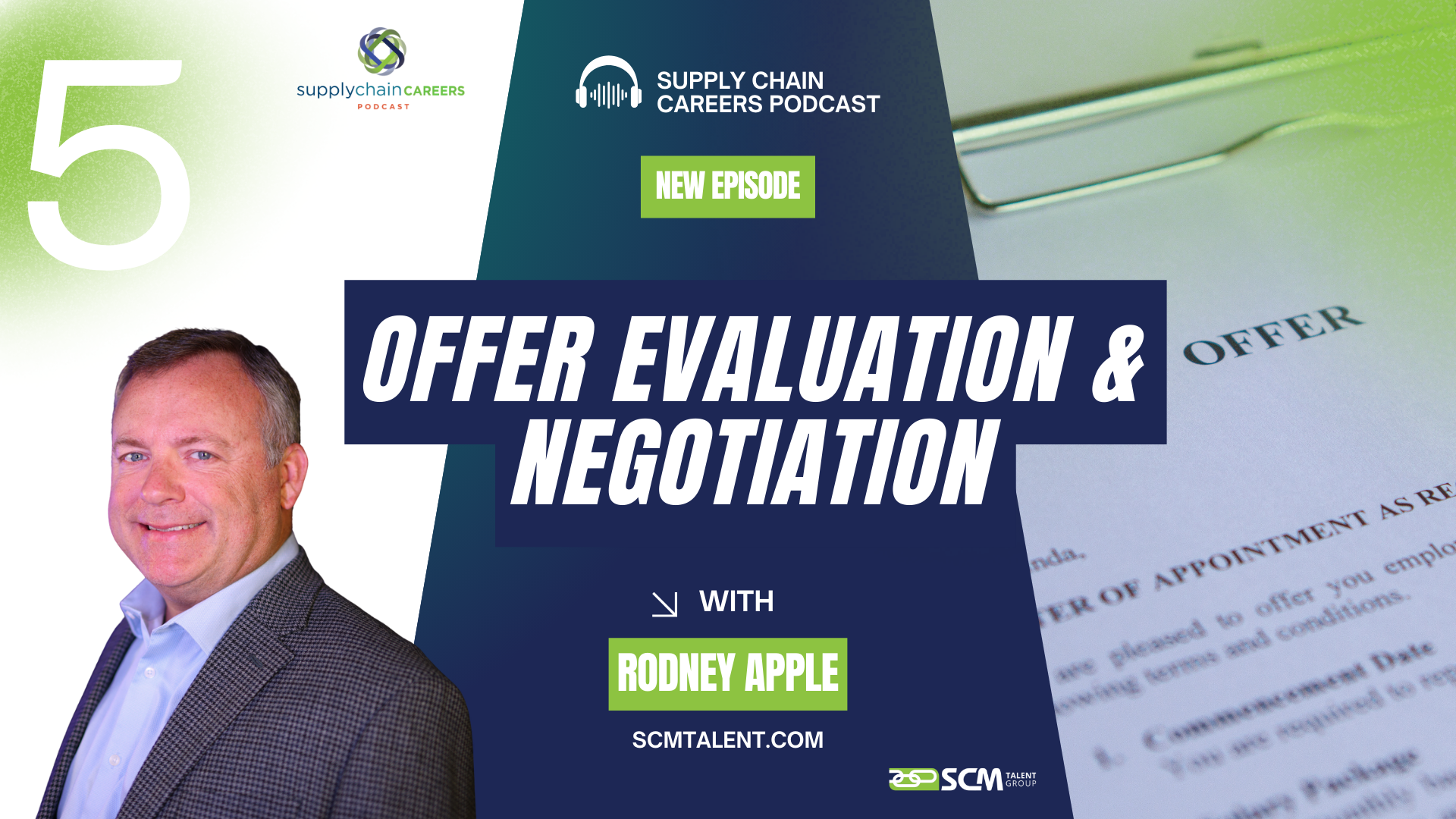
Offer Evaluation and Negotiation: Critical Guidance for Landing the Best Offer


In this episode of the Supply Chain Career Catalyst podcast, hosts Rodney Apple, Chris Gaffney, and Mike Ogle explore one of the most overlooked stages of the hiring process: evaluating job opportunities and negotiating offers. Many professionals regret career moves not because of interviews—but because they accepted roles without asking deeper, critical questions.
This discussion helps supply chain professionals understand how to assess opportunities holistically, evaluate organizational fit, and approach negotiation with clarity and confidence.

The “Unasked Questions” That Reveal Fit
Before you look at salary or benefits, you must understand the realities behind the role. The hosts introduce five categories of “unasked questions” every candidate should explore:
1. Culture & Values
How decisions are made, how leaders behave when pressure hits, and what behaviors are rewarded.
“What separates successful career movers from those who regret their decisions isn’t the answer they gave—it’s the questions they didn’t ask.”
—Chris Gaffney
2. Role Clarity
Understand how success is defined, why the role is open, and the challenges you’ll face in the first year.
3. Resources & Support
Determine whether you will have the tools, team collaboration, analytics, and development needed to succeed.
“A supply chain role without proper support is a recipe for burnout.”
4. Financial & Strategic Health
Assess whether the company is stable, how it generates revenue, and how it responds to disruption.
5. Career Path Potential
Look at internal promotion patterns, succession planning, and where past incumbents have moved next.
Candidates can uncover these insights through direct questioning, networking, LinkedIn research, and monitoring consistency across interviewers.
Evaluating the Offer Holistically
Offer evaluation goes far beyond base salary. The hosts recommend reviewing the entire package—bonus history, equity, benefits, PTO, work flexibility, relocation support, and professional development—while also assessing the role itself, the hiring manager, and the company’s culture and stability.
“Your manager is the number one predictor of career success or burnout.”
—Mike Ogle
Using a personal scorecard can help candidates stay objective and aligned with long-term goals.
Negotiation: A Professional Expectation
Negotiation should be collaborative and confident—not adversarial. The hosts recommend that candidates:
-
Express enthusiasm
-
Reinforce their value
-
Reference market data
-
Make a clear and simple ask
If salary adjustments aren’t possible, alternatives include signing bonuses, mid-year salary reviews, PTO adjustments, or enhancements to relocation packages.
“Your best opportunity for leverage is when someone has already decided they want you.”
—Chris Gaffney
Documenting all negotiated terms is essential to avoid misunderstandings later.
Tools & Resources to Support Your Decision
The episode highlights several tools helpful in benchmarking and evaluation, including Glassdoor, Levels.fyi, Paysa, and AI interview-prep platforms. These resources help supply chain professionals validate compensation and prepare for discussions.
Listen to the Full Conversation
Episode 5 equips supply chain professionals with practical frameworks and confidence-building strategies for evaluating opportunities and negotiating offers effectively.
Up next: Onboarding best practices and how to make the most of your first 90 days in a new role.
[00:00:00] Mike Ogle: Welcome to the Supply Chain Careers podcast, the only podcast for job seekers, professionals, and students who are focused on career enhancing conversations and insights across all aspects of the supply chain discipline. This podcast is made possible by SCM Talent Group, the industry leading supply chain executive search firm.
Visit SCM Talent [email protected].
[00:00:35] Rodney Apple: Welcome back to the Supply Chain Career Catalyst podcast series where we equip supply chain professionals at every level with tools, strategies, and confidence to intentionally advance their careers. I’m Rodney Apple. Joined by my co-host, Chris Gaffney and Mike Ogle.
If you’re just joining this new series, highly recommend you go back and listen to episodes one through four. It’s a linear journey where its episode one. We talk about the importance of taking time and space to reflect back on your career. That helps define your career direction as you move forward. In episode two, we talk about the myriad of supply chain career paths.
Episode three is how do you develop a sound job search strategy? And episode four is mastering the interview process. Today we’re gonna continue this journey. With episode five, we’re gonna focus on the most important and misunderstood stages of the hiring process, which is evaluating the opportunities further looking at the offer package in holistically.
Against your core goals and objectives, and then what are some of the negotiation best practices as well. So before you get into evaluating an offer or negotiating, there’s some something even more foundational, which we’re gonna call que answers to the seeking out answers to commonly unasked questions.
These are deeper overlooked questions that determine whether a job is actually the right fit for you. We’re gonna dive into questions around culture, expectations, the kind of resources that you’ll have, leadership, and the realities of success inside of the organization that you’re considering. So if you don’t have answers to these questions, it’s very difficult to evaluate the overall offer correctly and holistically.
Today we’ll cover unasked questions and then we will dive into offer evaluation and negotiation. Chris, you wanna start us out? You either one that came up with this term, the unasked questions. Yeah,
[00:02:47] Chris Gaffney: Rodney and Mike, I have a fair amount of passion about this ’cause I’ve seen this on both sides of the desk, both as the candidate and as the hiring manager.
And my framing for this is no, no matter what the level is. When a candidate is going through a process to potentially get a new role early on, they’re focused on presenting themself as the right candidate. So they’re preparing for an interview, they’re making connections with the people they’re talking to.
They’re trying to convey they’re experience in a certain way, to the point where they become a finalist and potentially the person who gets selected. The challenge is the. That’s biased on you giving information, and what I would suggest is what separates truly successful career movers for the ones who regret their decisions isn’t the answer they gave to questions.
It’s the questions that they didn’t ask. And I have been there. I have made a couple of moves in my career where I thought it would be a great opportunity, but I didn’t ask those deeper questions. Whether it was because I was eager to get the job, or I was excited to move on from what I was doing, but there were things that were going on about leadership, job expectations, resources available in the role, and in most ca or in a couple cases, very shortly after I got in, I was like, gosh, I wish I had known that would’ve influenced my decision.
So to me, that’s why this topic matters. I’ve experienced it early in my career, mid-career and late in career. So you need to answer these questions and depending on where you are, there may be different ways you get them answered. So hopefully you get underneath the hood around what is this job really beyond what’s on the job description and coming into an organization if it’s new or a different team in your existing organization.
What are the support systems for someone that set them up for success? How do you really get underneath, you know, where leadership really sits in terms of living values and how those match with your situation. I’ve also been in a number of companies, big and small, where financial resource limitations really impacted the chance of being really successful in a role.
Knowing that is important and the bottom line, all these things help you beyond saying, was this a great job opportunity for me? Great career move. Am I gonna really be set up for success? So to me, that’s the foundation for this whole concept of making sure you have answers to these questions before you accept an offer.
Mike, what do you think?
[00:05:34] Mike Ogle: Thanks Chris for putting that all into perspective, making sure that you’re really ready to get into that negotiation and evaluation of an offer, should that be coming your way. So there’s some different categories that we really need to be able to pay attention to, to make sure that we’re doing this right.
And we’ve put this together as the unasked questions into five buckets. And the first of those five buckets is all about culture and values. You’ve had an opportunity to talk with people. You’ve hopefully done your research as we’ve talked about in some of the previous episodes. So there should be some key types of things that you need to be able to think about or be able to get answers to.
Do you really understand how decisions get made there and what your part would be in that? Do you understand how the kinds of behaviors that are exhibited. How those behaviors get rewarded. What is good to do, not good to do? How does leadership show up when things get tough? And then how transparent is their communication process?
Right? Can you get an idea of what that communication process is like? Or do you need to explore a little bit further? A second category that we would dive into is do you really understand the role? Do you have clarity of that? What you’re truly being expected to do? What is success like as you go through the first stages of that typical.
Early 90 day type of evaluation or a year and beyond, do you, did you really discover why is that role open? Has there been turnover? What are two or three of the top challenges the role has to solve? Again, really understanding. What you’re going to be doing and how you’re going to be measured is gonna be incredibly important.
And then the third bucket would be resources and support for all the things that you’re expected to do. Does it seem like the resources are there? Are there things that you’re going to have to try to find or do or do they provide the kinds of tools, team? Support and such that you’re going to need to be able to be successful.
And how do those different functions collaborate, even if the resources are there? Can you see that it’s accessible and easy for you to have a role in doing that? What kind of tools? Are out there? Are they outdated? Do they need replacing? And then another one, I think resource wise that’s incredibly important for people for your role is to understand, is there an investment in your professional development that’s gonna take you to a higher level in this particular role?
Now, the fourth bucket we’d get into is the financial side, financial and strategic viability of the company, not the financial side for your compensation. We’ll talk about that in a little bit, but the financial and strategic viability of the company. What, how are they growing? How does the company actually make money, and how does your role help support how they’re making that money?
Has leadership articulated that clear strategic plan, or can you find out what’s out there and what kind of risks or disruptions might you face? Typically, and how has the company reacted to those? So all those can be very helpful to you. And to go a little bit deeper, the fifth bucket is that development side, but it’s the career path.
What do you know about how people advance within the company? Are there rotations and ways for you to be able to work with others and be able to understand how the collaborations and paths that you might be able to go through are available? Understand how many other leaders were actually promoted internally versus externally.
If you have an idea of that and what have past incumbents of this particular role gone on to do, whether it’s here or even other places, to be able to understand how you truly have evidence of development. So that’s some of the five big buckets that we’ve put together for this, and that should be very helpful for you getting through that process.
Rodney, how do we get these kinds of answers?
[00:09:44] Rodney Apple: That’s a great question. You’ve gotta ask the questions, but I think there’s a few different ways depending at at your level and the circumstances and the information that you’re going after, and obviously you’re gonna feel a bit more comfortable in your bones when you’re at that.
More senior level, mid-level, senior level. So it’s a more appropriate questions to ask just very directly, especially if you’ve got the hiring manager on. And I would say the HR partner is a good person to ask too. But you certainly like some examples, is you wanna understand how you’re gonna be measured.
What, what defines success? So how is this role measured? What does success look like? If I get through the year and I’ve accomplished A, B, and C, what are those important things where you’re gonna feel like I was successful? You can even go a step further if I really wanna blow it out of the water. What would that look like?
So. Just defining that early on can help you frame up what that job is. ’cause a lot of times it is around those key deliverables on the financial side. If you’ve got a position of managing operating budget or a p and l, and you want to understand what aspects you control versus others within the organization, decision making is important.
You want to find. Ask, what kind of autonomy do I have with decision making? Or is this a very collaborative situation where a lot of people are involved, where you have to get approvals up the ranks for, there’s gonna be times where there’s some sensitive information. We, we are looking at a, a project right now where the head of HR said There’s been six people in this role since they created it.
And to me that’s a red flag. And so if you hear some, you hear some things like that, it’s why, could you gimme an example of why. People leave. What are the common denominators that you’re hearing in an exit interview? Some qualitative questions around what makes people successful in this kind of role?
And then you can hit the opposite of that. What happens when people don’t work out? What’s the common themes there? It’s also important as you’re evaluating opportunities. Of course, you have the hiring manager, they’re gonna give you their point of view. The HR manager as well, like that example I just mentioned where there’s, where’s there’s turnover.
You may want to go a step deeper and talk to people that have either worked there or maybe have even exited the company. You can find those individuals by LinkedIn, just be doing an informational interview. You reach out and, hey, I’d love to pick your brain. I’m considering an opportunity there at this company and I just wanna see what your experience has been like.
You can also see if you could talk to people in other parts of the organization as well. Tap your network, see if you know anyone that may have ties into this company that you’re considering. Also, the non-verbal cues are really important. You wanna look for excitement, a certain energy level, consistency between interviewers.
If one person gives you an answer and you hear the direct opposite or something that’s not consistent, that could be. A bit of a yellow flag, if not a red flag. Are they enthusiastic or are they fi, are they def acting A little bit out of defense? What are the expectations or explanations? Is there consistency there?
And are you sensing chemistry between these teams? Otherwise, you can certainly look out on the internet. Glassdoor’s a great resource. Read those reviews. Don’t just look at the ratings. A lot of companies will hire PR agencies to to boost those ratings, and so read them and take ’em for a grain of salt.
People that tend to write reviews sometimes just like at a restaurant or the ones that had a bad experience, so take it with a grain of salt. You can get on LinkedIn and look at people that have exited, uh, the company and just look for those patterns. Are people staying longer than six months or a year?
Are they staying years? If you’re seeing a lot of turnover, then you know that could be an issue as well.
[00:13:29] Mike Ogle: During this short break, we recognize that this podcast is made possible by SCM Talent Group, the industry leading supply chain executive search firm. Visit SCM talent [email protected] to.
[00:13:48] Rodney Apple: Other than that in supply chain, I think it’s important to make sure that supply chain has a seat at the table. So look, there should be investments, look, read through their press releases. If it’s a public company, you can certainly look at their financials as well. Look for those third party signals.
That’s just another data point that you should be considering as you evaluate these opportunities.
[00:14:08] Chris Gaffney: Yeah, I would say this as I thought about. When we shape this episode, I’ve seen this movie from so many people, and again, I’ll speak to different levels, but if you’re a junior person and you’re moving on into your second role or your third role, and you’re looking at moving companies, usually you’ve got a reason to do that, right?
You’re not happy with where you are and or there’s some motivation for me to get to someplace else. So your inclination is, what can I do to make this happen? And I think that’s where you get your. Get your cart before the horse. And if you get down to that finalist role, you’re now emotionally excited about this could happen.
And so we, what we are advocating is you do whatever you can to get the facts. You may be very predisposed to take the role, but we still encourage you to say, make sure you’ve got a full picture of this so that you’re doing it eyes open. Okay? And I’d rather you see all these things and say, this place isn’t perfect, but I accept that and I have the facts.
I take this back to my board of advisors, if you will, and they poke holes in it and when we’re all done they say, go for it. Good, bad, or ugly. That, I think that’s the spirit of it for me. Okay. And I think to to the point that Rodney made, if you’re coming in on a search and it’s a VP role, you’ve got a lot of juice to ask a lot of these questions.
If you’re an early career person, the questions you can really ask directly are more about. What kind of training and development support you get, expectations in the role, team culture, those type of things. It’s harder for you to ask those questions about, Hey, how is this team? Imperfect. So for you, you may have to get a lot of those trickier questions done through those external sources that Rodney talked about.
You’ve gotta do the legwork on the financials. If they’re publicly held, easy thing to do, if they’re privately held or a startup, it’s trickier to do that. But that’s where you’ve gotta go through those network paths. I, we always say, ideally you would, you wanna hire somebody who’s been referenced by someone in your network.
But I think the flip side is true. If you’re gonna go to work someplace, you need to get a point of view from someone on the inside who cares about you, who says, now this place is as advertised. Come on in. Or you need to be aware of some of the things that are going on if you’re considering coming to work here.
So I think that’s the more junior perspective of it again, is I think you’re more senior, and I’ve been in senior searches where I didn’t ask some of these questions. I think you have to believe in yourself and be confident. If you’re coming in through a search partner, say, I need to get these answered.
Am I good answering these? Can you get these on the back channel from the recruiter or hr? But you still gotta touch ’em all in, in my view that that’s my 2 cents.
[00:16:58] Rodney Apple: Yeah, Chris, you’re right. And as you move further up in your career, you’ve got just, there’s just a lot more things you need to uncover mid-level.
We talked about decision making resources. What’s my cross-functional support throughout the organization? Do I have an analyst? Do I have a financial person that can help me with the, uh, with the budgets, clarifying those priorities? I’m a big fan of force ranking. What’s, what’s number one, number two, number three.
And as you move further up, the decisions. There’s less people at the top of that pyramid, and there’s a lot more stakes at this level as well. So you need to dig deep and understand the financial health of the company. I’ve got plenty of stories where people have gone in to companies and were told one thing and they start digging around and asking questions, and they find out the company is in serious financial.
Jeopardy. Where’s the company going in terms of direction? What, is there an acquisition? Are they positioning? Did they bring you in to help position the company to sell? I’ve heard that too. What are the dynamics of the board? Or are they pretty hands on, or are they digging around or micromanaging? Or are they hands off or somewhere in between?
What’s the succession planning look like? I know one day I want to move up a level. Is that person, how long are they gonna stay in that position? What is their plan? Am I gonna get roadblock down the road if, if that person has no intention of leaving anytime soon? What are the equity details? Again?
Autonomy decision making becomes more critical as you move up and then nailing down the performance of the company as well as your teams and others is understanding the health there is very important. Anything to do with or, and to get into this on the financials, you know, any kind of perks. Those are some things that you certainly want to get in writing as well.
[00:18:46] Chris Gaffney: If the only one that I would add for the more senior folks, and we have interviewed a person in our leadership series who took a very senior role with a global corporation, and what that person found after they got there was that. It was a big challenge to get them hired, and so they were walking in besides the direct person who hired them with a lack of advocacy, and even more importantly, that the person who hired them who was the CEO at the time had a vision for their space that he believed in, but that others in and around the organization who were very influential did not, and a year later, that person left.
So not only her advocacy. For her candidacy changed, but also the support for the strategy and that that’s tough. And you may say that’s difficult to know, but those are the kind of things that a year in you, that person is clearly saying, gosh, I wish I’d known that early on. ’cause if I was walking into a buzz saw, I may have been up for it, but I’d sure wanna know it.
Yeah.
[00:19:54] Rodney Apple: Yeah. I mean, these things happen. More often than not when there’s leadership changes at towards the very top or at the very top, it can completely de you could be the best person, best candidate that’s ever been in this role, but new leader comes in. Oftentimes they’re gonna bring in some of their own folks from prior companies, and we see it.
It happens all the time. Mike, you want to take us through just a, a checklist of some common questions that we think are, are good to ask, and then we’ll transition over into, I’ve got an offer, how do I evaluate it, and how do I negotiate?
[00:20:29] Mike Ogle: Yeah, absolutely. I think given what we’ve already covered so far, I want people to take a look in the show notes.
We’re gonna provide a list of questions that you should make part of your interview and offer evaluation process, and make sure that you go into whatever position you’re heading into with your eyes open enough that you can balance out what are the possible risks of things I do or do not know. And what could happen and how I would feel about it if it happened.
But you need to take a look at starting with these 10, so you’ll see these, as I said in the show notes. What does success really look like in this role? Number two, how would I be measured or how will I be measured? Number three, why is this role open? Four, what resources will I have and five, what are the biggest challenges in the first year?
Just make sure you’ve got those early expectations so that you get off to a great start and in the right direction. So number six, how do decisions actually get made? Being able to understand that process and the expectations of how that happens, and maybe even not just how it gets made, but a little bit about timing may be in there as well.
Number seven, what behaviors do get rewarded here? Number eight, what kind of turnover rate? Or examples of turnover in this group, in my team and the bosses that I have, how long people stay in those kinds of roles. Number nine, being able to understand financial stability. And then number 10, where have some past employees gone next?
All of these things should be able to help you be able to make a better decision as that offer process happens. Rodney, how do we evaluate and negotiate that job offer?
[00:22:17] Rodney Apple: Thanks Mike for covering those. This is mission critical information for as you move through the, we’ve talked about interviewing and you get closer to that finish line you’re advancing.
These are questions that often get overlooked, so I’m glad we. We added that in. And so now the fun part, you’re through the part that most people don’t like, which is interviewing. You’ve got an offer, and so how do we evaluate the offer? Especially if you’ve got multiple offers, you need to take the strategic lens and do some math, and I would say do some reflecting from a high level what’s everybody thinks.
It’s all about the salary and there’s so many more things that you need to negotiate. So let’s, let’s get into that. So compensation and benefits, again, more than just a salary. You want to start out making sure you’ve reflected on this and look back at your goals and objectives. What are the things?
Develop that list, put them in the right order too. And we’ll start out with compensation though. So you certainly want to get a foundation. Look at market data. What does PayScale say? Glassdoor salary.com. You can plug this in. I would even argue with chat GPT. You can plug it in there and it’ll source multiple sources and come back with some ranges that you can expect.
We wanna establish what is the bookends? How much should I realistically be paid in this particular market? For doing this particular work and even within this industry as well. So that’s one way to understand how the ranges work. And in the bigger companies, you’re gonna have a lot of structure. You’re gonna have job families and job functions, and then job grades.
Those are the three big factors. And smaller companies probably run a little bit more looser with their ranges, and we’re working off of a strict budget. Two big other components on the cash compensation side are gonna be your annual bonus. Most positions, most roles have something. Uh, it could range from a very discretionary.
We’ll give you some kind of bonus. You might see that for lower level rolls, where to where it gets very defined percentage, target of the range, and some of these could max out at a hundred percent of that target percentage. Let’s say it’s 20%, that’s all you’re gonna get. Other companies, if you blow it out of the water, you can exceed that 20%.
You want, you certainly wanna understand. It’s nice to have that in your offer letter. Ooh, I’ve got a 20% bonus. But another good question to ask is, what is that historical payout on average for the last, call it two to three years? How’s it weighted in terms of metrics or KPIs that I need to achieve? Or it could be a balance between individual performance versus company performance.
Sometimes you’ll just see companies throw out 50, 50 companies hits its number, there’s half your bonus, and then you’ve gotta do the rest to hit the balance. Equity. You’re in a public company, you may or may not get it. A higher your job level, the more likelihood of getting some kind of equity and a private equity type of environment.
Equity is typically given out as well for those senior positions, and sometimes it gets spread. Across the organization into your lower level position. So you just wanna understand, do I have a long-term incentive? What kind of grant is it? How many years is the vesting schedule? That’s based on options?
What’s the strike price? You’re gonna get this stuff in writing. And with the private equity company or startup, you definitely wanna make sure you get it in writing sometimes. They structure these deals around the individual. Is there some kind of exit plan? What does that horizon look like? Is it a traditional five year flip or is it gonna be a longer hold or even shorter?
Just depends on when you get into that deal cycle. Obviously benefits are very important these days. We see read, open up the news. Healthcare is always a concern, so. What do those premiums look like? You wanna make sure you understand what’s gonna come outta your pocket or outta your paycheck. Is there any kind of a match on a retirement, like a 401k plan?
What does the, my time off look like? How is that structured? Do I have to wait before I take time off? Visit a crew. Um, you may wanna make sure you understand that parental leave, some companies will do that. Maternal others will do paternal, we do both. Any other kind of wellness benefits that the company offers outside of that?
Just looking beyond what are some of the perks you certainly want to make sure you address? Is it remote? Is it hybrid? Is it five days? In the office, what does the budget look like for training and I’m looking to get certified in this or that, or is there gonna be any money for me to go do that? What about tuition reimbursement?
Will my company help me if I want to advance my education Relocation? I’ve seen that come in and from go get will help you with packing your own U-Haul. And other companies will do a full relocation package. Sometimes they’ll buy out your house. Don’t see that as often anymore, but some companies do that.
Especially at the executive level, sign on bonus and severance terms as well. You probably won’t see that at the junior level, but as you get further up into the rank, sometimes companies or candidates will negotiate an exit package. So these are some of the factors. Not all, but some of the factors that you wanna look at.
Another one too, supply chains are global. So I think just understanding the nature of the role. Am I gonna be on call? Am I gonna have to get up early or stay on late to deal with suppliers or customers overseas? So just things you need to, you know, could be important. And that’s the whole purpose of that is as you evaluate this, what is important to you, put that in some kind of an, a logical order that aligns with your goals and objectives.
[00:27:52] Chris Gaffney: It might, Rodney, I would offer you just a couple of thoughts on this, that some are subtle, like I’ve even heard in the PTO space, these companies that have unlimited PTO. Then if you talk to people there, you find nobody actually takes any vacation. So it sounds great, but nobody takes it and or people have posted vacation, but they don’t use it.
All right. Again, this gets back to some of the cultural questions Mike asked, that you’ve gotta, you gotta find that out and decide if that matters to you or not. Right now, you’re getting into serious stuff that’s here, I think. I thought what you highlighted about actual payout on bonus is important.
Over multiple years I worked, I worked for a company and I negotiated a guaranteed bonus for year one, and then someone said that was a great idea because nobody’s ever actually received a bonus otherwise. So I probably should have asked more about that. I think what you said about equity is important.
It’s, it’s, those are complex questions when you talk about vesting in strike price, but I’d wanna talk to somebody like, Hey, of your last five years options, how many are in the black? Like, how many actually got paid out? Because that, that starts to be a better in indicator of whether you can really value that or not.
I think those are, this is a good list. Back to what we said before, no matter who you are, you need to get at answering these questions. And again, as you said, as you get more senior. You can ask for lots of things, so I think we are, we’re gonna pivot into that
[00:29:17] Mike Ogle: during this short break. We recognize that this podcast is made possible by SCM Talent Group, the industry leading supply chain executive search firm.
Visit s SCM Talent [email protected].
Yeah, and I think one of the things that I tell my students all the time is when you’re early in your career. Don’t start to put so much emphasis on the money and on how fast you’re going to be able to move up through the company. You need to really look at the professional development. If you haven’t established the base, where you do get certified, where you go to conferences, where you have chances to go out and learn and interact and maybe travel to some different spots around the company to really learn how it all works.
That professional development budget side. It’s something that you don’t see go straight into your pocket, but it will throughout your career as long as you’ve established that early part. All those categories of compensation are of course just one part of what you really have to consider. So we have to think about whether the job is right for us, who are you gonna be working for, and who you’re gonna be working with, and the overall environment that you work in.
Those are all going to be some additional things that go on top of what compensation is gonna be all about. So. We’re gonna talk about having a scorecard a little bit later as well, but make sure that you’re already thinking about that. These aren’t things that just have yes or no answers, so you have to think about evaluating overall first the role.
What kind of scope are you really looking at? Are you prepared for it? Is it gonna take you to the next valuable step in your career? How complex is this role? Maybe you’re comfortable with the scope of what you’re responsible for, but how complex and demanding is the role really going to be for you? Is the company prepared?
Resources is the next category, you know? Is the company prepared to provide you with those resources and is that it’s gonna take to get to, to be successful? And then visibility and strategic importance. Do you get the feeling this role is really clearly seen within the company and has some strategic importance to the company’s success?
It’s always good to know. Sometimes you’re just a side role that doesn’t have the visibility, but how important is that to you, is something you better figure out? Before you end up making the leap. And the next, in our big categories or higher level buckets of this are how you evaluate the manager.
Because your manager is the number one predictor of career success or burnout. People often leave positions due specifically just to their supervisor as opposed to other aspects of the position they might’ve been enjoying. You know, how did they say that? They give feedback. What is their leadership style?
Have you been able to ask others about that or experience it or even ask it directly to who would be your supervisor? How long had they been in that role and where did they come from? Where are they planning on going? Do they have a demonstrated interest in developing talent and how do they plan to do it?
So after the role and your direct report manager, supervisor, the third one would be evaluate the company. Are they growing? What are their plans to continue growing, expanding? Is their supply chain stable? When you’re in the that supply chain role, what challenges have they faced and how did they deal with them?
What risks do they see coming up? Do you think that the leadership is credible? As you’re evaluating the company, hopefully you’ve met your boss’s boss and some of the executive team, or have some chance to be able to understand whether you’re gonna have faith in the records of achievement and approach, and then the culture.
We’ve talked a little bit about culture already, about how do you truly understand whether it’s a culture that will energize you, excite you, tends to match your way of thinking. It feels supportive and that it will. Be something that is great to be able to say you’ve been at as part of your career growth.
And then financial health is the last piece of evaluating the company. Here’s where you evaluate that stability of the overall company, not just the supply chain. Where have they been and where are they going? Do you have some kind of feeling for that? And Chris, if you’re trying to get into the negotiation strategy now, how do we approach that?
[00:33:51] Chris Gaffney: Yep. I think one of the things that. Resonated with me is, I think I took 13 jobs, something like that in my career, maybe 14, which sounds crazy, but moving up within companies and moving across, it does add up. And one of the things that I learned, and I saw employees from Heat Learn is your best opportunity for leverage is when someone has decided they want you.
Okay? I’ve talked to a lot of mentees about this as well. Some people are extremely bullish on this and some people are extreme, extremely bearish. But this is your opportunity. And I think doing this in a collaborative way, conveying, Hey, I have value as well, I think is really important. And I think what it really gets to in your situation is, you know, this idea of something we call.
Batna, right? B-A-T-N-A. Your best alternative to a negotiated agreement. And it really comes back to what are your other options? Okay? Let’s be clear. If you are out of a job, then you are gonna be very careful about your negotiation because if this is your opportunity and they’ve gotten to this point, you want to get it over the goal line to be back in the workforce.
So I’m very clear about that. Okay. If you have a current role in a company where you are valued, you are successful, you have a good boss, but this is something that could potentially be a step up. Your current role offers you a pretty good point of strength, right? If you negotiate in a fair way. Given that you are moving from a place where you’re valued and have a a future and the company has a reputation or whatever, that gives you the strength to ask for enough to say, Hey, it’s gotta be worth it for me to leave because your fallback is a place where you’re doing just fine.
Okay? If you have other offers on the table and they’re firm, that’s your strength. Okay? So you’ve got something else to fall back on. And if you’re in the interview process for other roles, but it hasn’t got to an offer that gives you some strength, but it’s not a truly a bird in the hand. So I do want you to think about this.
The other reality for you is what is your current financial situation, right? If you’ve got, if you’re doing paycheck to paycheck, then you need to be super careful. If you’ve been super responsible and you’ve got a lot of flexibility, and you could do a six month sabbatical if you needed to, you’re in a different place.
So I think you just need to understand. What your situation is, and then I think you need to think about now what is your target and what is your walkaway? In most cases, even for junior roles now, once you’ve got into the, beyond the big pool and you’re in, you’re going to be interviewed. Somebody is likely asked you, what is your current total comp and what are you looking to get to find out if you’re even in the ballpark?
I am going to assume that one way or another, you and the client have aligned that they have the chance to make you a reasonable offer. Okay? So from your standpoint, you need to figure out what is your ideal situation, right? If I’m gonna go move, I know they like me. I know what my strengths are, I know the good and bad.
I’ve addressed all these other qualitative, non-financial elements. I feel good about the situation. What’s your brass ring for this role? What is acceptable and what is your minimum, right? If you like it so much that you’re willing to take a push with your current comp, that’s your floor, right? If you know that in your company raises are gonna be on average two point a half percent in the next year, you’ve typically done better than that.
Your base comp’s likely to go up 3%. You know what your bonus is likely to be based on your company’s performance. That’s a good way to think about what your floor would be. That’s your do nothing. If you stay where you are, your comp’s gonna go up and you get a bonus. So you really gotta think about what your floor is.
And as I said before, this is your chance to move up relative to market, that type of thing for the role that’s out there. Understand if you’re gonna come in, ideally if they’ve got a range, you know, you should be 50% plus of that range if you’re a talented candidate. So that’s getting into what you’re acceptable.
Should be. Now, all that said, this is after you’ve gotten an offer, right? You’re gonna, you’re gonna say, thank you for the offer. I need a little bit of time to talk through it with my network, whoever that is, spouse, parents, key folks, or whatever. I’m gonna come back and I’m gonna have some questions. I wanna do the due diligence.
You wouldn’t wanna hire somebody who wasn’t diligent enough to ask all the right questions. And by the same token, I’ve used this with a lot of folks, is to say. This is a culture where we do work with suppliers, we do work with customers. We do have to negotiate contractual commercial agreements, and we want our employees to be good negotiators.
So I’m gonna demonstrate what you know, what good diligence around negotiation looks like. So you’re professional, your fact-based, you’re thankful and gracious for the offer, and you’re confident, but you’re not entitled. So that’s the framing for me. Now, Rodney, you’ve done this. I’ve done this maybe 10 times and done it well, like two, you’ve done this on behalf of candidates hundreds of times.
So what’s the real practical path to actually negotiate?
[00:39:23] Rodney Apple: Yeah, Chris, that, that’s excellent advice. So now you gotta go sit down and do this. You gotta ask the question, and I always, just to piggyback on what you said, Chris, you need to come in with some enthusiasm. You, you can’t come in sounding like a Debbie Downer.
So maintain a high degree of enthusiasm. Share your passion, your interest around the role. Always believe in articulating the value that you’re gonna bring to the organization, and you leveraging your past accomplishments that tie right back in to the objectives that they’re looking for. What are the deliverables?
What defines Dece success? So if you’ve done that before, you know you’re gonna be in a power position as opposed to where you haven’t, and this would be a first time. So just. Enthusiasm, state the value, you’re gonna go back, you’ve done all that research on the market data, you know what you’re worth. So you’re gonna reference that again, and then you’re gonna make a, a clear ask.
Keep it short and simple. Based on my, um, research and where I’ve been in the past, very excited about the opportunity and I’m hoping we could explore a base salary that’s actually closer to. X, whatever that number is. And at that point you want to stop talking. So make the ask. And then if you’re on a video call or you’re doing this in person, you’re gonna look for those, both the verbal cues and non-verbal as well.
But that’s the framework that, that you want to start with when you’re at the negotiation table. Chris, Mike, anything to add there?
[00:40:53] Chris Gaffney: I I, I have a friend who is a very experienced procurement person, and you might know this person. One of the things that he told me from a procurement perspective is you’re never done until you get a no.
Okay, so you might as well make an ask here. And as I said before, everything you said, I’m so excited about this. As we’ve gone through this offer process, I’ve gotten more fired up about it. This feels great for me. That said, I owe it to myself, my family, to do the diligence, to say, I’ve gotta represent my own candidacy.
And you can quote all the things that we’ve said here. I know from from benchmarks, the best time to negotiate is day one. So I’m gonna do my diligence very respectfully here, and I’d ask you to hear it respectfully. Okay? And be thoughtful about it, right? This is where I am in my own company. This is where I’m headed.
So I know if I don’t do anything, it’s X. So I really would feel like I need to be competitive. You might need to do more market intelligence to say, I know where comparable positions are with someone. With my level experience, I would expect base to be here. That’s probably mostly what you’re negotiating is base.
It’s very hard to negotiate the bonus and options because those are bonus and equity. Those are typically more outside of the hiring manager’s control. They can negotiate base. I always tell somebody, if you’re in a place where you’re already getting four weeks of vacation where you are, that’s like throwing the floor mats in on a new car.
You should be able to go in and say, Hey, I’ve already got four weeks of vacation where I am. You would only bring me in at two. I’d like you to make sure. You match me on my vacation. I just, I think there are things like that that are appropriate at this point. Right? You’ve gotten this far. Yeah.
[00:42:31] Rodney Apple: No, great add, and I would add, if you cannot get exactly what you’re looking for, what is the next item on the list?
An example could be. You’re trying to get five more thousand on the base and they tell you, you know, you’re gonna be getting paid higher than others than your peer group. Okay? Understand What about a sign on bonus so you could go down that path. I’ve seen people negotiate mid-year raises. So, nah, we, we can’t give you that.
What, what about if we sit down in six months, we establish two or three things I need to accomplish? What if I get those accomplished? Could you do the in, could you consider an increase then? So there’s more than one way to skin the cat? I think that’s why it’s so important to have, what’s the number one thing I’m looking for?
But if I can’t get that, what’s the second, third, fourth thing down the list that’s gonna help strengthen the overall offer package.
[00:43:27] Mike Ogle: I think in my particular case, one of the things that got shifted was there really wasn’t going. I got that first. No, as far as the actual salary was concerned. But here’s what we can do for you instead and may.
It may be a better relocation that it’s easy for them to be able to justify so that you’re not being compared against. Somebody else in the company that if you try to bump up the salary or make a change in that direction, look for other options like the list that Rodney had provided before of all the different compensation pieces, and think about shifting into some of those directions.
[00:44:03] Rodney Apple: Great stuff, Mike, and everybody wants to know too, as you’re getting asked this question about your salary expectations. How do I answer those? And there’s no right or wrong here, but it’s ideal if you can be the first person to ask. Try to do that. Get out in front of it with the recruiter on a first call.
You don’t want to go right into that. They’re gonna think all I care about. All you care about is, is the money. But towards the end of that first call, you can certainly ask that question. But if you’re asked, I think early on in the process, you’re still, you’re still evaluating the company and the role you may wanna hold off.
So I’m flexible and I’m open. Right now, I’m focused on finding the best long-term fit, a company I can grow into in, in advance. If you’re pressed based on my research, ’cause you should have already done the research to establish your minimum floor versus your ideal versus what you’d love to get. So I’m looking for a range of X to Y depending on the scope, the job location, and some other factors.
So I’m happy to explore something aligned with that range. Is that in the ballpark? You can ask that question back. Giving the exact salary you’re at now is something you wanna refrain from. ’cause some companies can use that against you. Speaking of things used against you, there are some mistakes and pitfalls that you want to avoid.
Chris, you want to talk about some of those mistakes that are common that we definitely want to avoid? Yeah, I think at this point
[00:45:30] Chris Gaffney: you’ve got the offer in hand and you’ve done the diligence on the good, the bad, and the ugly. At this point, this is where I’m saying, Hey, I at least need 48 hours. I’ve gotta do some diligence.
Then you are talking with whoever is your trusted network to make this decision. Whether it’s a spouse, parent, parents, and or that board of advisors. We’ve talked about people who would be in your corner, challenge you appropriately and walk through everything with them and, and if you’re getting all signs are good, then I think you should feel good that people feel like you’re moving in the right direction.
This is a net. Good move for you, then it’s the small things. So you’ve gotta get the unasked questions answered. You’ve gotta give yourself a little bit of time. This is the hardest time to keep emotion out of the decision, but it’s important. I think that’s, that’s really however you get help to make this as antiseptic or objective decision making process.
’cause this is a big decision. Okay. I think depending on where you are. Understanding the track record of bonus at your company and equity performance at your company if you haven versus somewhere else. I’ve worked at places where the bonus potential was a hundred, but the actual delivery was between zero and 200.
And I worked at another company where it was the same thing and the actual performance was somewhere between 80 and one 20, so one was very reliable. The other was boom versus bust. And so you need to feel really good about what were the circumstances that led to the boom. And I watched for people on that go down that path and honestly get three or four, 200% bonuses in a row.
That was a big deal, but they also accepted that there was a zero in there somewhere. But over time, that really worked well, but that this is the point where you really have to manage that. I do think at this point, really. Feeling very good about the direct manager and ideally the skip level manager.
That would be my ideal state. Like I’d follow these people into war. They’ve got a great reputation. I vetted them. They’re going places. I think that’s super important. Then I think it’s small things, just being disciplined in your C communication, if you get the offer immediately confirm, Hey, I need 48 hours.
I need till Monday morning, but come right back at ’em first thing, no later than first thing Monday morning with a response. Be thoughtful during the negotiation. That’s that whole being respectful and that type of thing. Say, Hey, this is just a step that I think is appropriate to take, but don’t go too far.
You’ve figured out what your acceptable is. Don’t be hung up if you don’t get your brass ring outta this. I think if it’s a relo, I think it’s super important. If it’s an important enough job, most people are gonna give you a relo trip if you’re married, so you and a spouse can go look at where you would live.
Schools. That’s important. Being comfortable about that. A move of a city is a big deal, particularly if you haven’t done it before. If you have a little bit about what to watch out for. And then I think the bottom line here is if you get anything beyond the base offer, make sure it’s documented. Okay. It’s a follow up.
Either it’s an addendum to the offer or the offer letter is regenerated, so that you’ve got that for future reference. Just my 2 cents on it, and Mike, I’m gonna hand it to you. As we said. Now, more than ever, there are external resources where you can dig in on some of this. What are the ones that that, that you suggest?
[00:49:01] Mike Ogle: Alright. Absolutely. Yeah. There’s some things that we definitely need to be able to consider as far as some of the tools and resources that are out there. And I’ve got seven of these in general, and we’ll put these in the show notes as well. But one of those is compensation benchmarks. Do you really have the information to, to understand what to ask for and you better think about the areas that you’re moving into as well, or where you’re coming from and going to, and how that’s going to affect you as far as what.
The impact on your family and where you think you should be pay-wise. So there’s a. There’s one called Pesa, P-A-Y-S-A, and there’s also levels FYI, to get those compensation. Ben benchmarks. And as Rodney had mentioned before, Glassdoor is very important for being able to understand some of those ranges and bonus trends and such.
So that’s going to help you as well. A third to really get into offer co comparison and tracking would be TLHQ. Yeah. And then when you’re trying to just do a little bit of exploration, AI is going to be very valuable these days and it keeps getting smarter and better at, at doing, in actual interviews with you.
So take on a role, have it take on a role, do some scripting and prompting. To be able to look at the kinds of the reactions to even evaluate your performance as you talked about these kinds of things. So whether it’s chat, GPT, Gemini, or some other form of Gen ai, take advantage of those tools because there is a lot in there that’s going to help you.
[00:50:38] Rodney Apple: Thanks, Mike and Chris. This has been a great episode and we appreciate you joining us today for episode five of the Supply Chain Career Catalyst podcast. We’ve covered two critical parts of the career journey, the unasked questions, deeper insights that you absolutely must uncover before evaluating an offer.
This can help you avoid that regrettable job move that so many people make when they fail to get comprehensive with their evaluation. And then the offer evaluation and negotiation process, understanding the value. How do you frame the ask, how do you negotiate, and how do you make smart career decisions for your future?
So if you’ve enjoyed the episode, please follow us on Apple or your favorite podcast platform, Spotify, et cetera. If you know someone that could benefit from this particular podcast or the series, please share it with your colleagues and you can also visit s scm talent.com for the full library of supply chain career resources.
We’ve got resume guides and templates, LinkedIn optimization tools. We’ve got other podcast series, and we’ve also got an updated job search strategy ebook that we’re gonna be releasing here towards the end of the year. So on the next episode, we are gonna be diving into onboarding best practices. These are all the things that you can do before you start your new job in those critical first few months on the roll.
Until then, keep advancing your supply chain career with intention and we’ll see you next time around.
[00:52:20] Mike Ogle: Thanks for listening to this episode of the Supply Chain Careers podcast. Be sure to listen to other episodes and sign up to be notified when future episodes are released as we continue to interview industry leading supply chain experts. This podcast is made possible by SCM Talent Group, the industry leading supply chain executive search firm.
Visit SCM Talent [email protected].
Need help hiring Supply Chain Leaders?
Connect with our recruiting team here at SCM Talent Group to elevate your team’s potential and secure the supply chain leadership talent your organization needs for future success!

Check Out Other Podcast Episodes:

The Career Path of a Director, Global Procurement
Brian Kennedy2025-02-11T19:21:49+00:00August 22, 2024|
Global procurement plays a critical role in today’s fast-paced, interconnected business landscape.
Reshaping The Trucking World – with NMFTA Leaders, Debbie Sparks & Joe Ohr
Rodney Apple2026-01-20T15:24:50+00:00August 15, 2024|
The trucking industry, a vital component of the global supply chain, is currently undergoing a profound transformation. This shift is driven by advances in technology, increasing emphasis on sustainability, and the growing need for enhanced cybersecurity.
Reaching The Chief Supply Chain Officer Level
Brian Kennedy2025-02-11T19:28:10+00:00August 2, 2024|
8 skills and strategies to become a Chief Supply Chain Officer. Learn about strategic thinking, leadership, financial acumen.

Podcast: A Day in the Life in Demand Planning – with Victoria Grillo
Brian Kennedy2025-02-11T19:27:05+00:00July 18, 2024|
Learn about the day in the life Demand Planning! Listen to Victoria Grillo, a seasoned Demand Planning Executive.
Building a Career in Supply Chain Automation
Rodney Apple2026-01-20T15:26:05+00:00June 27, 2024|
Discover how to build a successful career in supply chain automation. Learn about essential skills, emerging technologies, and career paths.

Women In Trucking: Transforming Career Paths
Rodney Apple2026-01-20T15:26:34+00:00June 13, 2024|
Women in Trucking is have a transformative impact in supply chain. Learn about career opportunities, diversity, and inclusion in trucking.
