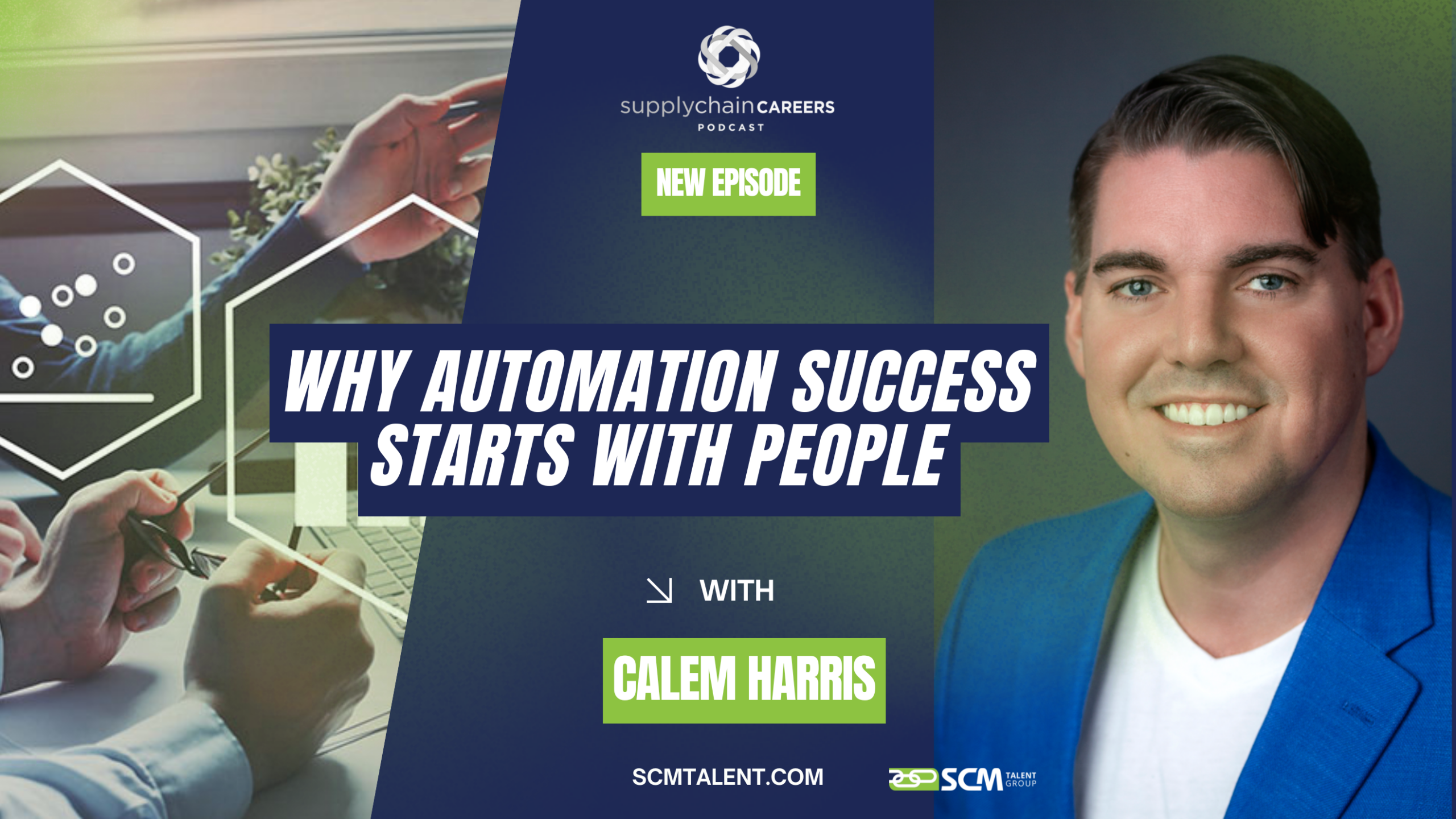
Rodney Apple: [00:00:00] Welcome back to the Supply Chain Careers podcast. We are excited to welcome Calem Harris to the show. Calem is the founder and CEO of Top Hat Engineering. Calem, welcome to the podcast.
Calem Harris: Really appreciate it, Rodney. Thank you so much for having me on, and looking forward to the conversation today.
Rodney Apple: Likewise. We’d love to go back in time. That’s how we usually start. I know you served in the Marine Corps. Thank you for your service. And this a lot of folks get into logistics and supply chain in the Marine Corps. I’d love to hear, how you started down that path, and were there any influences back in the military that may have shaped your career and how you lead people and projects and your business today?
Calem Harris: 100%. One of the key things about the military, and myself in particular, is that, everybody that signs up for the military gives it their all, right? Nobody says, “This is gonna be the easiest way for me to build a successful career is joining the military.” No, it’s quite the exact opposite.
But so you give everything [00:01:00] into that military career that you serve. So when I exited the career in the military, it’s also what was I gonna find next that I can really commit myself to, right? And it’s really hard for transitioning veterans to find what their next value is going to be, and it’s got to be something that they truly believe in just as strongly as the military.
And honestly, I found that in supply chain. And the reasons why I found that in supply chain is, A, it’s a very kind of laid back culture, right? And what I mean by laid back is it’s not like you’re wearing suits in the office all the time. You’re d- you’re able to really just dress down a little bit more and really get to the details, right?
Like, how do we absolutely execute? How do we get something accomplished together? Where either through collaboration, through automations or systems or anything like that, but everybody’s always trying to just solve a problem, right? And it’s that collaboration piece that I found very wonderful inside of the supply chain is not only do I actually enjoy my, working with my customers, I actually enjoy the end users of it just as much, [00:02:00] right?
We’re serving the backbone of the American supply chain, which runs the world, and every single operator I’ve worked with, every single warehouse supervisor that I’ve worked with, it’s just an immediate bond. There’s a, the respect, the mutual respect just because you’re there and you showed up to help solve a problem.
And that’s where what I got started in this field is my background was in my controls engineering undergrad, master’s in information management systems, where I really started getting into heavy software pieces. So it made sense for me to come into this field, was like we’re using both mechanical, electrical, control, software.
So I found this really good engineering fit, but then obviously I’m solving new problems. E- every single day you’re never encountered with the same problem, and you’re dealing with people you really en- enjoy working with. So this has been a really good fit for me.
Chris Gaffney: So
Calem, I am a industrial and systems engineer, and my first exposure to engineering was a summer engineering program in Annapolis at the academy.
So have a lot of affinity [00:03:00] and a lot of friends who went through the academy. So that’s such a foundational experience, and you’ve come a long way from Annapolis into the service and then into industry. I- if you could kinda talk us through kinda those big forks in the road that got you here as an entrepreneur in, in, in many respects a short period of time.
You’ve done a lot of things. I’d love… I think people would welcome hearing about that
Calem Harris: one of the things that, you come out of Annapolis even at the Naval Academy, is you have a high level of discipline, more than anything else. And to that, the discipline has allowed me to actually transition into that Marine Corps and Marine Corps special operations role very well, right?
Because in, in that role even I was going 31, no 34 different countries in just my six years of service, right? That’s pretty substantial, and that’s Iraq, Afghanistan, Syria, Central and South America, Africa, Eastern Europe. It’s taken me all over the place. And when you go all over the place, you’re also a little bit more [00:04:00] developed of cultures, right?
In how to actually approach people in different cultures. How you actually solve problems in different cultures, which is also really good for us in the supply chain space, right? We’re not just dealing with an American supply chain, we’re dealing with a global supply chain. It’s global sl- technology solutions.
So that’s been an enabler. But key thing is for me coming in from the M- Marine Corps into kind of this civilian experience for me, is when I exited out of the Marine Corps, I really wanted to focus on something that I felt was going to say, “This is what’s going to be the big thing next.” And that big thing next, it wasn’t just for me personally, it’s looking at the macro, right?
There’s a lot of different ways I could have gone. I chose supply chain engineering and automation because it’s complicated. It’s not easy, it’s complicated, it’s hard, but also it’s a growing industry. It’s a growing demand. Even when you look at just labor market today, we know the labor market’s not where we’d like it to be, right?
And especially from Uber drivers to all [00:05:00] these work from home positions that allow, enable people to be more in a comfortable environment. We’re just not seeing some of that talent in supply chain like we’d like to see anymore, right? So we looked at this growth model for supply chain and technology and how it can be used, and how it can help fill some of the voids that we’re seeing, and I said, “This is going to be the next step.
This is the next industry where I feel like we’re gonna see a big boom for it.” Now, I got my start actually working with Daifuku. So once I exited the military and my military career working with different technology companies, then that, I basically said, “I’m gonna be completely commercial. I wanna go to completely commercial private company.”
That’s where I actually found Wainwright Daifuku at that time. They were just going through the acquisition process. I got a start as a software consultant, which is like a software project management, and fell in love. Like- out of the gate, I started leading really good project with some big companies.
Companies that I’ve been following for years. Example would be Staples, right? It’s one of my customers at the time. And leading those [00:06:00] projects to succession. And quickly promoted because they realized I wasn’t just a one-trick pony with just software. I can do controls. I figured out how to do mechanical.
And, once you find that value statement of “I really wanna be an expert in this industry,” your boundaries don’t stop. And but there’s no gonna be no education along the way to get you to speed, right? You gotta do that independently. So that’s where I started digging in with mechanical engineers “How do you do SolidWorks?
How do you do CAD?” So I started learning that process as well. So I started designing my own solutions, right? And through my time at Daifuku, by the time I left, like I got to learn all the different disciplines, from an electricals experience to controls experiences, project management, project execution, like how our customers think about capital and how they wanna invest that into technology.
And that basically let me get to Staples. So I converted over to Staples ’cause they were one of my customers. They really liked my ideas, the drive that I had towards some of those solutions [00:07:00] development, and I got that opportunity to join the Staples. Now, Staples, for me Was a very pivotal moment, right?
Daifuku gave me the experience. They gave me a diverse customers that I could work with and diverse different solutions that I could work with. But Staples, that was my big moment to really change b- my perspective of what we were doing, right? And that perspective come from just being able to actually put on the shirt of my customer, right?
And be able to actually see what they truly needed, not out of just automated solutions, but out of software, out of data, how they were building business cases, how they were making decisions about business cases. And I built that team from zero to about a level of 60 engineers over about a five-year period.
And by the time I left, I was in charge of basically building the entire strategy for supply chain automation at Staples, building the business cases, and then I was running the team that did the implementation for the projects. [00:08:00] So it gave me the two sides of that spear, right? Now I’m not just, building solutions, I’m analyzing how well is this automated solution actually performing to that business case that I’d outlined.
So it was a really fun experience. And obviously, I think any engineering leader in this industry takes some hard beats and, there’s some lessons learned out of those hard beats, but that’s the need, right? You need to go through some of those imperfect decisions to be able to improve and be able to say, “How do I do this better next time?”
Or you figure out this didn’t actually meet our business case the way we wanted to, and so this is how I’m gonna pivot in the next period. So that was one ma- major milestone for me, was through that Staples experience, and really allowed me to transition to what we’re doing here at Top Hat today.
And I hope that answers your question, and I can get into a little bit more detail with it.
Rodney Apple: I- I’m now curious if you were part of the team when you think about business cases when Kiva Robotics entered the equation, and then we all know who purchased them, right?
Calem Harris: Was
Rodney Apple: that during your
Calem Harris: time?
Rodney Apple: That’s correct. Yeah.
Calem Harris: It was not, [00:09:00] actually. So that … So Staples was grassroots with Kiva. To … If I remem- if my memory serves correctly, that was about 2006. Kiva was still there when I was there, but we were starting to basically do replacements because I think Amazon started- … dropping the support contracts with Kiva at that time.
Rodney Apple: Yeah. Yeah. Good deal. We’d love to dive into, that moment that light bulb went off and you’re like, there’s an opportunity out here to start a business. That’s obviously taken a big gamble and very different from what you just described. So what was that pivotal moment that led you to forming Top Hat Engineering?
Calem Harris: . So my Staples career I, I basically made the decision that, moving up in Staples was going to be an opportunity for me. But the thing is, I’d be moving up in a supply chain and retail organization, and for me I’m at heart an engineer, right? And I didn’t wanna kind of pivot that into really that supply chain operations.
I really wanted to maintain a subject matter expert into engineering for supply chain. So I made that jump over to Fortna, and [00:10:00] I’d hear nothing but great things about Fortna my entire career, so I made that jump and leap of faith, and there’s a lot of people over there that I’ve worked with at Daifuku previously anyway, so there’s some great relationships.
But when I got back over to Fortna, I started to realize there was also a gap in the market. And because at Staples we were able to build our own warehouse control systems, warehouse execution systems, slotting tools, and other different capabilities, right? So when you have the ability to work on the customer side and truly understand what the customer needs, you build a better picture of okay, this is what software needs to be enabled to be able to allow all these different pieces to fall into place.
Then once I got to Fortna, I got to see no, there’s a big gap here. Meaning, there was still warehouse execution systems being built and warehouse control systems. But when you actually look at it through the lens of a warehouse supervisor or warehouse operations or whether it’s doing distribution or fulfillment, they’re still mul- ultimately [00:11:00] going through different types of applications.
Like I know one customer we’re working with specifically made a comment that said they have 20 software applications that they’re leveraging on their day-to-day operations.
How do you even justify basically an operator having to– a warehouse supervisor having to go through just 20 applications to be able to say, “You know what? Based on my experience over the last two years, I think by these data trends, we should make X decision,” right? I feel that is so antiquated in where technology is, where software can be at.
So basically, identified that we had needed to close this gap. We need to be able to help consolidate it, ’cause other industries are doing it. Finance has been doing it for a while. People talk about Monday a lot, right? Monday isn’t just a CRM tool, it’s a finance tool, it’s a sales tool, it’s a project management tool, because they’re trying…
we can make a platform that integrates very well, so you’re living in one platform that can give you the single source of truth, right? So I said, “Why don’t we have this in supply chain?” So [00:12:00] that was one major driver for me for starting Top Hat is this software gap that we have. The second piece out of it, and I’m sure you probably get- have seen some of these trends, is private equity’s pretty big in this space right now.
And I don’t think they’re making a lot of positive trends, right? At the end of the day, I s- I see some of these amazing companies changing and reflecting different core values than the company was stood up on. So we started, I started seeing some drops in just, customer service levels and customer support levels.
And do we talk about a little bit of some of the business cases not matching up, right? And I think a lot of that is because it was more of a rush to make sure that the sale occurs, rather than actually ensuring that the engineering solution accomplishes what the customer truly is wanting out of it.
And that’s another key aspect of it, is that I wanted to basically start a company that really get back to the foundation of customer’s focus first, right? That’s what we need to be bringing back and driving, because the customers are wanting that. So those [00:13:00] two values alone, software gap and also that customer service level and customer focus, that’s why I started Top Hat Engineering.
And the key focus around Top Hat Engineering, too, is I pulled almost a little bit more than half of our entire labor force has worked on the customer side. And the reasons why is that if you’re gonna remain a customer-focused organization, you need some people who’ve actually been in a customer’s shoes, just like I have, where you’re on that side and understanding it more, to be able to actually build the solutions they’re expecting and support them through the process.
Rodney Apple: How’d you name Top Hat? I just remember seeing the top hats at the MODEX conference. It’s- … drew everybody’s eyeballs to, to your booth.
Calem Harris: Great question. So one of the key things is I’m a really big I love this one painting. It’s actually called The Son of Man, but it’s where the guy’s got in a tuxedo with an apple in front of his face, right?
Rodney Apple: Yep.
Calem Harris: So I took that painting and turned it into a logo, but then realized something. In that [00:14:00] hat, the reason, one reason why I like that painting so much is the guy’s wearing a bowler hat. The bowler hat in terms typically actually reflects more the business or the working class, right? Guys are just getting it done, where the top hat was more of the aristocracy and more of your people who had money, wealth and prestige.
So we’ve called it Top Hat Engineering, but we’re still wearing a bowler hat in the logo because we’re the working man providing it to really top hat customers. That’s the way we’ve perceived it, and that’s where the name came from.
Rodney Apple: Very cool.
Calem Harris: Yeah.
Chris Gaffney: So Calem, I am a late in life entrepreneur ’cause I was more risk averse in my earlier days, and probably not that innovative.
But I have great regard for people who are willing to do this. But, in, in the world of entrepreneurship, it’s like the military, it’s like business. It’s plan versus actual, right? You can build a plan, and then you get on the field and you see what actually goes on. So I assume you were very methodical about your approach to, to launching.
But what were some things that you [00:15:00] ran into that you did not anticipate when you were gonna start the business? And then how did you adjust from those, and then what did it teach you or build to your leadership toolkit?
Calem Harris: Great question. One of the key things that I think about is I’m an engineer, I’ve never been on the sales side of things, right?
I’ve always been part of sales meetings, like designing solutions, building solutions, things like that, but I’ve never been on the forefront of sales and seen how long it takes to get through a sales cycle. That’s something I didn’t anticipate, is how long that is, right? And it’s because obviously I know being on the customer side, it just takes time.
Where between capital, making sure that it’s appro- appropriately procured and set aside to be able to fund certain projects. But there’s always that decision, right? And you always think “Oh, this is a great solution. The customer’s bought in on this solution. They’re ready to go. They’re gonna sign next week.”
That signature’s actually about five to six months away, right? And I think that’s one of the things [00:16:00] that caught me right out of the gate, is just not realizing how long a sales process takes. Another key thing about it is how important like the marketing aspects of it is in a company.
Because the company in marketing is basically s- talking about the voice of the company, the brand of the company, right? And for me it’s not … I always just thought you talk to a customer about a good solution, they’ll buy into it. But it takes a lot more work ahead of time to build confidence in the customer for you to even be able to get to that conversation, right?
They have to be able to see that you’re out there talking. They have to see that your company’s out there doing more than just a solution that you’re talking about with them. So it’s one of those p- those pieces, the sales and marketing side, I was not anticipating about a little bit more how challenging that was going to be.
As far as like the execution piece, I got a great team. Like we’re just kicking it. Every single project we’ve been ahead of schedule. We’ve had very little issues, and even the support aspect from an engineered solution, like we’re getting very little phone [00:17:00] calls because we’ve built a high availability redundancy in our systems and a lot more checks and balances.
But the, those portions of the business, the marketing and sales aspect, I don’t think I was ready for, and that’s something I can truly say as an entrepreneur
Chris Gaffney: Awesome. And if you build on that, like how have you evolved from that and/or said, “Yeah, now when I advise other people, there’s a couple things that I say when they’re thinking about this”?
Calem Harris: So the first thing I would say is obviously give yourself time. Think worst-case scenario. You can’t think optimistically. Even though once you get that confirmation from a customer of just saying “Hey, we’re gonna proceed with this,” don’t put your… Don’t cross your fingers and saying that’s gonna happen quickly.
It’s gonna take time. And you, from a finance perspective, every CEO entrepreneur needs to know finance really well. That is your main job. And y- one of the key things that I’ve even learned in this position is like I can be a great engineer, but as a CEO, I have one job, and that is [00:18:00] a fiduciary responsibility to make the best decisions for the company to ensure our longevity as a company, right?
So key things is give yourself time, give yourself buffer. Don’t be intimidated about working with investors either, right? We’ve been very fortunate that we’ve been able to actually bootstrap most of this business. I only had to raise very small amount of funds in our pre-seed round just to get us going.
But once we got going to be able to help support sales marketing initiatives and some of our investments towards our technology solutions, like these are quiet investors, right? They’re not trying to be a part of the day-to-day operations or decision-making. They just want to be able to be successful in their investment strategy, and that’s been a very great for me to learn because I was always intimidated about it.
Because once again, I didn’t want to turn into the thing that I’m trying to prevent being, but I had to be able to make sure that my company and I could be able to do and drive towards the strategic plan that each department in my [00:19:00] company wanted to achieve
Rodney Apple: Switching gears a little bit, Calem kinda right into your wheelhouse, and we touched on this before we started the podcast, but warehouse automation has certainly evolved over the years. But you’ve been on both sides of the fence from the solution provider to, to the customer.
What are executives when they hear that term warehouse automation what are they most often either misunderstanding or maybe miscalculating?
Calem Harris: I would actually say that when, where they think of warehouse automation they think massive capital ex exercises, right? And it intimidates them. I think the unknowns, it intimidates them because most executives do have a really good industrial engineering background, right? They know process, they know operations, they know data and metrics and analysis and stuff.
But when it comes to warehouse automation, I think there’s still a lot of intimidation because you’re dealing with new engineering components that they [00:20:00] may not have a lot of experience with, right? Software being one of them. Anytime the software’s brought up with a warehouse automated solution, like their mind immediately goes “I gotta call my IT guys.
What are they gonna say,” right? And it’s this intimidation factor. We’re also in this space now too where a lot of this older technology being used in communication like PROFIBUS and some of the other Modbus style communications are starting to phase out. So when I have to say you have this older warehouse, but you’re wanting to implement newer solutions, all these things have to be modified.
It intimidates them when they hear all these things. It’s not like that we’re doing anything that’s crazy. It’s or, we’re doing something that is not been tr- tried and proven already. It’s just that when they hear like we’re gonna have to change out all of these Modbus or PROFIBUS communication, we’re gonna go Ethernet, we’re gonna go to this type of new type of control system, it’s intimidating because they don’t know it.
So I think the intimidation factor around warehouse automation is still [00:21:00] there just because it’s dealing with individual engineering components they’re not fully aware of. The second piece out of it I think of it- Is will I actually get my business case accomplished through this warehouse automation?
And even though you can truly say on paper “Yes, I can accomplish this, and this is what expectation you can have of it,” I still think there’s a lot of intimidation because some executives have been burned through different trial and errors with different automation, right? And I think anybody can say in an executive position where most of those C-suite and executive vice presidents, that they ha- can have three to four year kind of careers at a company, and all it takes to get them out of those careers is one bad decisions.
So it’s one of those trust factors of they gotta have strong trust in what you’re saying is actually going to provide what you’re telling me it’s going to provide. So I think those two factors are really the key considerations when you’re talking to executives about warehouse automation, that you really have to make sure that there’s a an understanding, [00:22:00] right?
A strong understanding, a strong relationship to be able to get to that. And I can tell you very personally that there is one customer we’re working with right now that they basically interrogated us for about six months before they actually said yes to us, because they wanted to make sure in any of those conversations, if we said something that was incorrect or not aligned to what they were expecting, they were gonna pull out, right?
And we knew that. So it was a very, one of those things that just took time, and once again, we gained the confidence, but it takes that time to get that confidence.
Chris Gaffney: So I’m gonna build on this, and we did talk about this and compared our own notes that, despite the awareness that there’s a lot of risk in these and a lot of people trying to error-proof, still only half of these big projects hit the mark.
I, I’d be curious, why is that still occurring, and then what are you all doing from a solutioning standpoint so that your customers don’t experience that gap in delivery?
Calem Harris: I agree. That is a very common one. [00:23:00] And yes, to your point we talked about a little bit before we got going, and I can say that digital twins need to be used more, period.
Right? That’s it. Because a lot of companies still have this need. They s- they provide basically here’s what business case we need to accomplish. A system integrator solutions provider, they go to the drawing board, and they build basically a solution that could potentially get there, right? But when you have all these different layers of software to robotics to…
which robotics has its own software, the hardware and control system, the network pieces. There’s a lot more integration than I think most people can truly put together and actually say, “This is how it’s going to work,” without putting it into a digital twin. They do that, they provide basically this is what it’s gonna be, and then if it doesn’t meet the rates that, or throughput or whatever it may be, labor [00:24:00] savings the customer’s expecting, I think because there is no pushback to say that it can’t, right?
Because, once again, the modeling has been done by usually a solution provider. Then usually they have… the customer will take that and say, “Okay you’re telling me it’s going to accomplish this, then we’ll agree to it,” because they have no way to actually say it, right? My cautionary tell to customers is put that back on them.
Put, say, “Build me a digital twin that says it’ll actually accomplish what you can accomplish,” right? And I think we need to keep reinforcing that because these higher automated facilities, in my personal opinion, I would not allow a customer to sign a contract until I could actually say and prove it through a digital twin model that says it can be accomplished.
I want that certainty just for my customers as I’m sure my customers would want from and expect from me
Chris Gaffney: Super. I also ask you to comment on the soft side of this in terms of the people and change elements of that. How much of that is a factor for you in [00:25:00] terms of the client who’s really ready to be successful to take on a big new initiative like this?
Calem Harris: Can you elaborate on that question a little bit? Yeah, some organizations are averse to change, right? I can remember some of the early WMS implementations we did, and that was moving from analog to any technology, and frontline employees were very resistant to that.
Chris Gaffney: And in the same case, you may have leadership that n- doesn’t understand what, how they’re gonna need to evolve other aspects of their business to really make the most of automation. So I’m just curious if you’ve run into that as a detractor to people actually delivering on what they expected.
Calem Harris: Yeah, I don’t see it being a detractor. In fact, I see it the exact opposite. So for example, associates that work in op fully or really high automated systems, they love it. Honestly, our, the retention of employees that work in those is significantly higher. The more manual facilities, retention was usually around 40 to 50%, if I remember correctly.
Retention at op- more automated facilities was closer to 80 to 90% [00:26:00] retention rates. A, associates stay. And I think that’s a really big driver in the market today, is how do we get and main- retain employees that work in these environments? That’s one key strategy. They like working around automation ’cause they like to go home and brag to their husbands or their wives, and they say, “This is what we’re doing day to day?
It’s cool.” So they like that. The second aspects I think that a lot of customers are intimidated about is the maintenance piece of it. When they’re buying more automated solutions, you’re gonna have to staff up on that tech- the automation techs or maintenance supervisors and the maintenance techs pretty heavily.
And I think that’s also a little bit more risky for customers because also that’s another field in our industry where it’s hard to retain talent. It’s hard to find talent, it’s hard to retain talent. So I think that’s one of those strategies that they have to build in, because I think that’s a key piece out of this business case aspect we’re talking about that I think they’re not truly capturing when they’re running it.
They only think their ops [00:27:00] side. The maintenance side has to basically double or triple for some of these automated solutions to be successful over time
Rodney Apple: Calem, you touched on this earlier just factor in the hardware versus software dynamic and not enough companies are focusing on the software side. It’s all hardware. I’ll make a comment too. Now, I was only at MODEX one day, but just walking through, hardware, robots, machines all over the place as far as you could see.
Not a, not as much like when you look at the- … at the software companies, but what’s your perspective on, on this, and why should companies be just as concerned about, their software?
Calem Harris: Let’s go back to that previous question around the business cases, right? And being successful with high automated systems.
There’s a lot more in, in play with just, in just the software aspect too. Because if you just think about if I went out and bought a AutoStore and additional conveyor systems, and enabled some type of new solution integration, [00:28:00] right? I have now a software that could be provided by AutoStore, it could be provided by system integrator, which has to run that system.
I have to build that software layer between my WMS system to that AutoStore type of solution, right? And then I’m gonna have a WCS component that has to run the conveyor systems, and those are, those just to run the automation. That’s not talking about the operational pieces around labor, around the slotting aspect of it, right?
To ensure that I’ve got enough product coming into the system as I got coming out of the system. So the… I look at the software aspect as a key need to give people the ability to control highly automated systems. It’s an enabler. It’s not supposed to be something that’s complicated. But I feel the way that some some…
That gap that I referred to, that gap made it complicated because when they’re having to basically switch between all these different systems to be able to make adjustments, make [00:29:00] decisions, figure out if I need to actually move labor in or out to make sure that my KPIs are being hit correctly, it’s a lot more challenging for them without a really appropriate software driving that kind of integration points to be able to do that.
So yes, I wanna put a little bit more emphasis on software because of that, and that’s what we’re doing here at Top Hat, just because they need one single source of truth. They can pull data from every single one of these components and be able to make automated decisions. The thing that I look at around some of these solutions we’re implementing today is a warehouse supervisor isn’t with their employees, making sure things are being performed correctly, right?
What they’re doing is they’re sitting behind their workstations trying to figure out what data points are relevant within these software, existing software applications, and then they’re making decisions. The warehouse, the associates themselves who are inside actually performing the operations, they’re not getting that [00:30:00] attention they deserve too, right?
Is that… honestly, because the supervisors are having to basically make these big decisions from these disparate systems, and that’s concerning to me. So that’s the reasons why we wanted to put a little more focus on software is we want our supervisors to be able to be on the floor with the associates, correcting bad behavior, motivating, like even just that, motivating, talking, building relationships with their employees.
And I think that’s a big gap because they’re having to be behind screens making decisions. Software is at a point they don’t need to make decisions. Our software is making billions of calculations a minute. An operator can always make a really good decisions by extrapolating data, but they can’t consistently do it, right?
When, especially when you have a s- like our software making billions of decis- billions of decisions basically a minute, like that’s huge. It’s always going to be able to make the best decision possible given the existing trends of forecast or what they’re anticipating to come in, and versus what [00:31:00] they’ve previously done historically.
So it- the software aspect needs to be more of an important feature now analyzed when they’re considering highly automated solutions
Chris Gaffney: Caleb, a lot of folks in our audience may work… they don’t work for Amazon, right? They’re not working for a big player. They may work in a smaller, physical supply chain scale of company.
And they may say we’re… This is still not for us.” But I have seen this technology and these solutions scale down. W- what’s realistic, for our listeners in terms of, the kind of operations you’re seeing that have the opportunity to get into automation or w- where potentially in the next year or two really need to be looking at it if they hadn’t been able to justify anything to this point?
Calem Harris: I-I’ve always been… when I first got into this industry, I heard a comment that I think’s changed pretty significantly, is that a s- process is defined first, and then solution should be picked to [00:32:00] enable a process, right? I’ve been looking at this at a different lens as now we have these newer automated solutions come out and s- people are starting to results.
I don’t think that’s the case anymore. I think automated solutions are driving new processes, right? And I think the conformity of saying, “We’re gonna keep X process, but we’re going to add this solution into this process,” I think it’s a little backwards thinking. Because now we have so many, such a variety of solutions, start small, right?
Start small and say, “We’re gonna take this one solution that may be just an extra little piece of conveyor, extra little sort points or things like that, or print and applies.” Enable that first and see how that changes your process, modify your process. Tag on an extra little piece of automation, see how that changes your process, so I think about this as a growing strategy of you’re not trying to basically say, “Conform to my process and ma- give me a solution that does it.” [00:33:00] I think solutions will dictate how a new process can be enabled, and I think people start, need to start thinking in that direction. For people that have some of the smaller warehouses and they’re looking to get into this space a little bit more to either increase throughput, reduce labor, whatever it may be, is number one is enable software, right?
Because software can help you to tag in some of these newer automated solutions. If you don’t have someone within your IT organization that can help pull some information out of ERP tools, your WMS system, it’s gonna be a requirement for any automated solution, even if it’s just a simple little print and apply solution, right?
The second piece of it is look at the holistic picture of the downstream effects that can negatively be impacted. Because when… Good example is if you’ve got a really good inbound process with an inbound sortation, everything like that, but you have a process that for your outbound cycle that’s not as [00:34:00] fast, you could be feeding more work from your inbound process that therefore your outbound process isn’t gonna be able to handle, it’s a really unique balance of push and pull through automated solutions because it’s not just a solution. You’re changing your process that’s basically impacting what I refer to as like a li- living, breathing system. That’s b- that, that’s employee labor strategy, that’s your staffing strategy, that’s your inventory strategy.
So everything can be picked impacted potentially by whatever automated solution you have to pick, and I think looking at that bigger picture is the most important aspect.
Rodney Apple: I’m gonna shift gears again and get into something we haven’t talked about yet. We’ve covered hardware, software and those dynamics, but, what are your thoughts on AI? Everyone’s talking about it. Just curious what you’re seeing in terms of practical applications that are creating real value not hopeful value as it relates to the warehouse distribution operations.
And what would you see could be [00:35:00] changing for the better, for the good in the next few years? Oh, AI. Man, those are fun conversations. So A- AI, as I look at it, and obviously we, we have machine learning inside of our system as well, right? And I like to say machine learning more than anything else because that’s what AI is, right?
Calem Harris: It’s larger machine le- learning and data set models. I think, number one, there’s still security vulnerabilities that I think our customers still are very hesitant around, right? Anybody that’s at a bigger organization that has a strong IT team is pretty hesitant to actually approach even how do we get AI into supply chain technologies, because you’re dealing with customer data, and I think a lot of customers that I’ve talked to, they’re concerned about that, about the potentially impacting the customer information, PII, whatever it may be. So number one, cybersecurity is really tight right now, and I think as a result, a lot of solutions providers that incorporate AI are [00:36:00] having some pushback and hesitancy on allowing that get into their system yet, right?
But it’s on the way. I think it’s starting to get a little bit better feeling, but I think there’s still a lot of hesitancy. Secondly is I think AI has a very valuable input at different portions and levels. So for example AI and WMS systems. Huge. I can see a lot of potential into your WMS systems with AI because you’re look- it’s having to evaluate transportation rates, couriers, right?
Your inventory levels and how that’s going to be changing around your product that’s being delivered into your warehouse today. So I think AI as a whole will help expedite some of the better decisions that WMS can make. Second part of AI that I see really impacting and just recently I’ve noticed a little trend towards this, is the technical piece of being able to support systems, right?
You’re starting to see a little bit more AI. We just talked to a company just the other day. They’re building an AI system that [00:37:00] helps maintenance techs and everything else troubleshoot stuff, which expedites their training. And this AI tool looks through schematics, it looks through user manuals that’s been created.
PLC code, the same thing. It says, “This is exactly what’s wrong, and this is how you fix it. You need to be looking for this wire.” So I think AI’s in that great space. Where I find AI it will find its limitations is because we’re not look- we’re not working in just the data model It’s a three-dimensional model.
A warehouse, a fulfillment center, it’s a three-dimensional model that can’t just be taken from a picture, an AutoCAD drawing, right? And says, this is the operation. Tell me what to do better.” It i- it is a three-dimensional model with, has multiple facets in it, and I think AI has its weaknesses.
The key aspect is there still needs to be some hand-holding from that three-dimensional space of the truly perspective of how a warehouse runs to enable AI to be better inside of our industry. Which, we’re marching [00:38:00] in the lead a little bit in that space of just being able to how can I take three-dimensional and move it into AI or into the models that I’m utilizing.
But it’s still a challenge. It’s still got a long ways to go before we’re there. Another area where obviously AI’s just taken off is machine vision. You see it inside of the robotic systems and each picking and pallet picking and everything else. Vision systems w- I don’t think that market will slow down ever.
I think that’s only gonna keep getting bigger and bigger, and that’s a place where AI’s a huge foray right now.
Chris Gaffney: Yeah. I would comment that our researchers at Georgia Tech, and we’ve got some pretty far out there computer vision kind of folks, they say the exact same thing. That’s probably an underappreciated, set of use cases that can, in many cases, augment a lot of these other investments.
But anyway I think we’re tracking on that one. I am curious ’cause I grew up in a world, and I’ve worked in an analog warehouse in my days at Frito-Lay, so I have that image, lots of paper. … It, but it was hands-on, right? We [00:39:00] walked the floor all day long. You couldn’t figure anything else out if you weren’t physically talking to people and seeing what was going on.
But now we’re in a different world. So if you think about the skill set, from the supervisor up to somebody running a building, and then somebody who’s leading that function, how do you see the role change? How do you see the capabilities change for people to really be successful, in, in what’s becoming a- an automated part of the supply chain?
Calem Harris: I’ve, I see… I think one of the key things is, in answering your question is to your point, there’s been lots of spreadsheets, right? And being able to actually maneuver data and make sense of data and things like that. I start to see that dwindle over the next few years, right? With AI, with more powerful software technology, I think the platforms themselves will be making a lot more decisions independently without requiring operators or warehouse supervisors to do anything, right?
I think the software will do it on its own. I think [00:40:00] the skill sets, when I think about what needs to come in, is a strong understanding of solutions. I think people need to have more hands-on experience with solutions, right? Between AMRs, conveyor systems, goods to person solutions. They’re, the warehouse operations needs to start understanding more of the technical aspects that are occurring so they can be able to understand.
When they hear “This is what’s wrong with it,” from their maintenance tech, they have a better appreciation and understanding of how that’s going to impact them in the future in their operations as a result of it. So more stronger technical skill sets for our warehouse supervisors, and I think less data crunching.
I think that’s the difference we’re gonna see over the next few years. Another thing that I’ve seen that I think is a big play out of it is understanding the labor market and how to start doing more coaching. I think everyone got comfortable I think myself, to your point, my 2010 to 2020, that aspect [00:41:00] there was a much more le- there was less of a void in the labor market, so people got very comfortable.
And then I think around 2018, 2019, people started seeing a big void happen. COVID changed the labor market for us, I think, in this industry so heavily that I think for warehouse supervisors and everything else, they’re like, “How are we going to react to this?” So I think to your point around the leadership aspect, like we need to have a little bit more leadership focus around the associates that are working in the industry just to ensure that retention strategy is there, that coaching, that mentorship, that hands-on developing relationship.
I think that needs to come back a little bit more so it’s not just a check in, check out. I think for our longevity of our industry, we need to start going back to those focus on our, those associates as well.
Rodney Apple: Yeah, and Calem and that’s great perspective, but what about students that are pursuing degrees in supply chain?
And, I know Chris over here can chime in on this as well, but, we’re seeing less demand. I [00:42:00] think AI’s making an impact. Automation might be making an impact a little bit. But to stay relevant in a, in what has become an in- an increasingly automated world within supply chain and operations, what do you recommend students should do or pursue to make sure they’re relevant and can be qualified for these evolving roles?
Calem Harris: I don’t think industrial engineers will ever lose a job in this aspect, right? No matter what, understanding the process of supply chain, end-to-end supply chain it’s a critical skill set. And I think that no matter what and how technology changes, industrial engineers aren’t going away, right?
They’re staying there. My, my concern is in the other aspects of our industry, the other engineering disciplines. You’re starting to see AI encroach pretty heavily. Even the mechanical engineers, like now they’re getting AI incorporated in AutoCAD, right? That’s taken a lot of entry roles out.
Draftsmen used to be able to start those initial drafts and then hand it off. AI’s doing that now, [00:43:00] right? Just by simple prompts and stuff, it’s being able to create a lot of images and three-dimensional models in AutoCAD and stuff. I think some of these other engineering disciplines starting to be encroached on by AI pretty heavily, and I’m wor- I’m a little concerned about the entry level positions in them long term.
So that, that’s one key thing. If I think about from a college student perspective what also they need to understand the technical skill sets. I go back to the hands-on piece of conveyor systems to AMR systems and stuff. They need to understand these systems and how they integrate what they’re doing a little bit more intricately because that’s what’s gonna guarantee the longevity.
The, no matter how AI progresses and whatever things it pr- it injects itself into, understa- technical aspect is going to have to be maintained because at the end of the day, they purchase a solution, that solution has to be taken care of, right? And that’s not just the responsibility of maintenance.
If an, even a warehouse supervisor knows, like, when this happens, this is what the technical issue is, they can help relay [00:44:00] that information to either the solution provider or potentially fix those issues themselves, right? So we’re only gonna get more automated, we’re not gonna get less automated. I’d say more tech- more hands-on technical experience with some of these aspects, and then the second piece is the end-to-end supply chain understanding.
I think that’s a gap that’s still being missed that I think a lot of college kids need to keep their hands and eyes on
Chris Gaffney: We talked a bit through our discussion about talent needs and that type of thing, but I would like you to be, put a stamp on it. For you what is really the biggest talent gap or talent shortage that you see through, from the design all the way to implementation and execution of these solutions?
Calem Harris: When you’re talking about it from the integrator side or the customer side? Ei- either way. We just think large market where do you just see the bigger gap?
I think if we’re talking about inside of a warehouse, obviously the biggest gap is inside of outbound and [00:45:00] inbound, right? Anybody who’s put, taken packages off a truck or putting packages on a truck, man, there’s a deficit there.
I think that’s the reasons why you’re hearing so much noise around things like BerkshireGray’s automatic truck unloader the Pickle Robotic Systems, right? You’re seeing these big changes happen within UPS, FedEx, and other ones that are really in high demand, those solutions, because the labor market’s not there anymore to be able to just literally handle 70-pound packages and pick them up all day and put them down.
So that’s a humongous gap. I think another gap is on that technical experience. I think a lot of warehouse executives or, excuse me, supply chain executives have been able to get to their career without having their hands on some pretty high automated solutions. So I think there’s a technical gap at that executive level, too, right?
Because when you’re talking about different kinetic control systems or, within this solution, there’s three different software s- capabilities within it just to make it work, [00:46:00] right? And I think a lot of that goes over a lot of executives’ heads just because it’s complex, right? So I think there’s needs to be a better understanding of the technical components within these solutions.
I think that’s a big gap. And when I think about it from end-to-end project execution- … man, it is hard. The, I think the electrical piece of it, electrical, mechanical installers, I think we’re also facing some big gaps there. Controls engineers, mechanical engineers, software engineers, you’re covered, right?
Project managers, you’re covered. You’ve got some really good solutions engineers that are out there but I think when it comes to where the rubber meets the road, it’s really that hands-on labor market that we’re s- seeing the most significant gap in. I’m, but I’m really happy to see some of the focus focus shift, high schools, colleges, things like that, into more of these STEM programs, forcing people into more of trade schools.
We need that more. I even think about a couple of the trade schools that I’ve [00:47:00] been able to talk to. They’ve seen their numbers drop and drop, and it … I don’t understand that because the market needs it, right? And it’s we need to be encouraging our high school students, our college students to be looking more at some of these trade schools because we’re, they’re in high demand, and they’re in high demand everywhere.
And I can pretty much guarantee that e- even at coming out of college had they spent that four years at just learning a trade and actually getting some experience in that trade, they’re probably gonna be making more money coming out of a trade school. Just intuitively, that’s what we’re seeing.
Yeah.
Chris Gaffney: Yep, we’re definitely seeing that. And even though we’re focused on, graduating industrial engineers at the grad, undergrad and graduate level, we do a lot of workforce work around the state of Georgia. Same thing, just trying to get that message you gotta be all the way down at the school board level for a given county so that you create the right perception that these are great jobs to have and can give a lifelong career.
They can live in their own community. So I definitely think we [00:48:00] wanna amplify that message as well.
Calem Harris: And I think on that education piece I also see this weird division almost in an aspect, right? You have- Controls engineer, mechanical engineers, electrical engineers, they’re the concentration and focus within their specific discipline, right?
And then you have the industrial engineers who are really the designing the end-to-end process around some of these capabilities. But you don’t have as good balance of both, right? I think industrial and the engineers need a lot more education, training around some of these technical applications.
It doesn’t have to be… They don’t have to be a trained controls engineer, but they need to understand very intricately as to what controls engineers or the control systems are doing, what software is doing, what mechanical components have lifespans that run much drier, right? It allows those individuals to do more end-to-end solution capabilities rather than just this pie in the sky, right?
‘Cause I think we can both [00:49:00] agree that, you take somebody who has had no technical abilities yet and just tell them, “Hey, create me a solution.” They’re gonna give you the best solution possible in their mind, but in reality, implementation, execution, long-term supportability and reliability will not be incorporated into that because that technical component is missing.
Chris Gaffney: Yeah, I think that’s a great push, and then that might be something we ne- we might need to follow up on. But that’s a good-
Rodney Apple: So when we look into the future, and we’ve heard this term like lights out warehouses I think there are some of those that exist. I don’t know about the United States, but maybe somewhere overseas.
But w- what do you think the future look like when it comes to where things are going with automation, robotics and the labor portion of that as well?
Calem Harris: I don’t think it’s possible not anywhere near term. And the reasons why is because for us to get to lights out capability the ma- machine vision systems have to significantly improve, right?
And I [00:50:00] talk about that pretty heavily just because, to in order to be able to replicate the need of an operator, the capability of being able to differentiate this is one product and this is another product, it requires pretty sophisticated machine vision systems, and I just don’t think we’re there yet.
I … We’re like, we’re on the right track, but I still think we got a long ways to go. So I think that has some time to progress with it. The second aspect is I think given the market’s change from retail dominating to retail getting suppressed we’re seeing this big thing of 3PL starting to become a bigger topic, right?
Everything’s moving more towards 3PL models. You’re seeing retailers starting to switch to 3PL models. Amazon’s now a 3PL provider, right? So you’re starting to see the switch, and when you see that switch, that means you’re gonna have more variability in the products that are coming out of these warehouses, and variability’s not good for lights out, right?
You want common data sets that you can extrapolate [00:51:00] from to move it, hence why I say machine vision’s gonna be a bigger issue, right? For us to be able to get to lights out, we need stronger machine vision to be able to detect these variabilities between different type of products. So long story short, I think we got a long ways to go.
I think we got a long ways in technology. If we as a US economy want to do better at this, we need to be investing into more of this technology internally, right? And I don’t say that about just the overseas partnerships that I, even I have. I look at it as is like we have one of the biggest supply chains in the world.
We need to be coming up with some of our own technology here in the US to support.
Rodney Apple: Super.
Chris Gaffney: I get the first closing question, and it’s one of those Back to the Future movies m- movie ideas. And so if you were Calem 2010, and all of a sudden you wake up one day and you realize there’s an envelope in your pocket, and you open it up, and it’s a letter from Calem in 2026, so what are you telling yourself 15, 16 years ago based on the journey you’ve had?[00:52:00]
Calem Harris: Shut up and listen. Yeah, that, that- think about this world we live in. It is so complex. You’re not … you don’t have the same challenges every day. You don’t have the same solutions you’re incorporating. You don’t have the same problems you’re solving, right? And you’re talking about every single engineering discipline is incorporated into our field.
For you to really be a subject matter expert, you got to shut up and listen, and you have to approach the people, the subject matter experts in specific disciplines to learn more, right? So that’s what I would tell myself, is just shut up and listen. Because the mentors that I’ve had through my journey and my career have, are still with me today, and I can say that they have just changed the trajectory I was on because they gave me the guidance, feedback, and knowledge that I needed to be successful for the next project.
And then I talked to somebody else, and they’d give me more information to make me more successful in the next project, right? And then understanding your gaps in knowledge. There are so many [00:53:00] times where I know what something does, but I haven’t had experience with it yet. Let’s go talk to the people that have had lots of experience.
Just sit down with me. Let’s have a coffee. Let’s grab a beer. Let’s talk about what went well for you, what didn’t go well. What did you learn through these experiences? And I think this community does a good job about sharing certain things. The downside of it is, I think a lot of it is, like when you go to these industry trade shows, a lot of it’s more of a sales strategy, right?
I want to get on and talk about this topic to sell something. I think we need to be talking about topics is this is, across the board, this is how AMRs are being misused, right? Just giving you an example of just let’s talk about that. As industry providers, let’s really just dig into that because I think that’s what we’re missing, is like you look at system integrators or solutions providers, they’re always going to talk very positively about their applications, not about what went poor with [00:54:00] implementation, and I think we need to be talking about that a little bit more vocally with one another just so we can do a little bit better job to, once again, go back to the conversation of customers not seeing ROI. For us to give them the ROI, we need to be talking together a little bit more.
Chris Gaffney: Super. Great advice.
Thank you.
Rodney Apple: Calem, this has been fascinating very enlightening. I’ve, I certainly learned a lot from this conversation. I’m sure our audience will as well. And speaking of our audience where can they find more information about Top Hat Engineering, warehouse automation, or to connect with you directly?
Calem Harris: Appreciate you asking. Yeah, so they can go to tophatengineering.com. We also have our software, which is actually at clarity-w-wos.com. We’re on LinkedIn, we’re on YouTube, we’re on Instagram, we’re on Twitter, and we’re on Facebook. So we have multiple different ways you can find us, or you can just reach out to us directly through LinkedIn or email as well.
Rodney Apple: Awesome. Any big conferences or shows you’re headed to in the near future where folks might could meet you in [00:55:00] person?
Calem Harris: So we’ll be at Pack Expo. We’ve got a couple little MHI conferences we’ll be at. But to be very honest with you, we have such heavy growth right now in 2026 and leading into 2027, our head’s down.
Like honestly, like I go back to ex how are we going to perform well? At that, to be able to perform well means our heads are down. Let’s focus on what customers have already said yes to us at Top Hat.
Rodney Apple: Love it. Love it. Calem, thanks again for joining the Supply Chain Careers podcast today. We really appreciate you making the time.
Calem Harris: Sounds good. Thank you for having me. Appreciate it