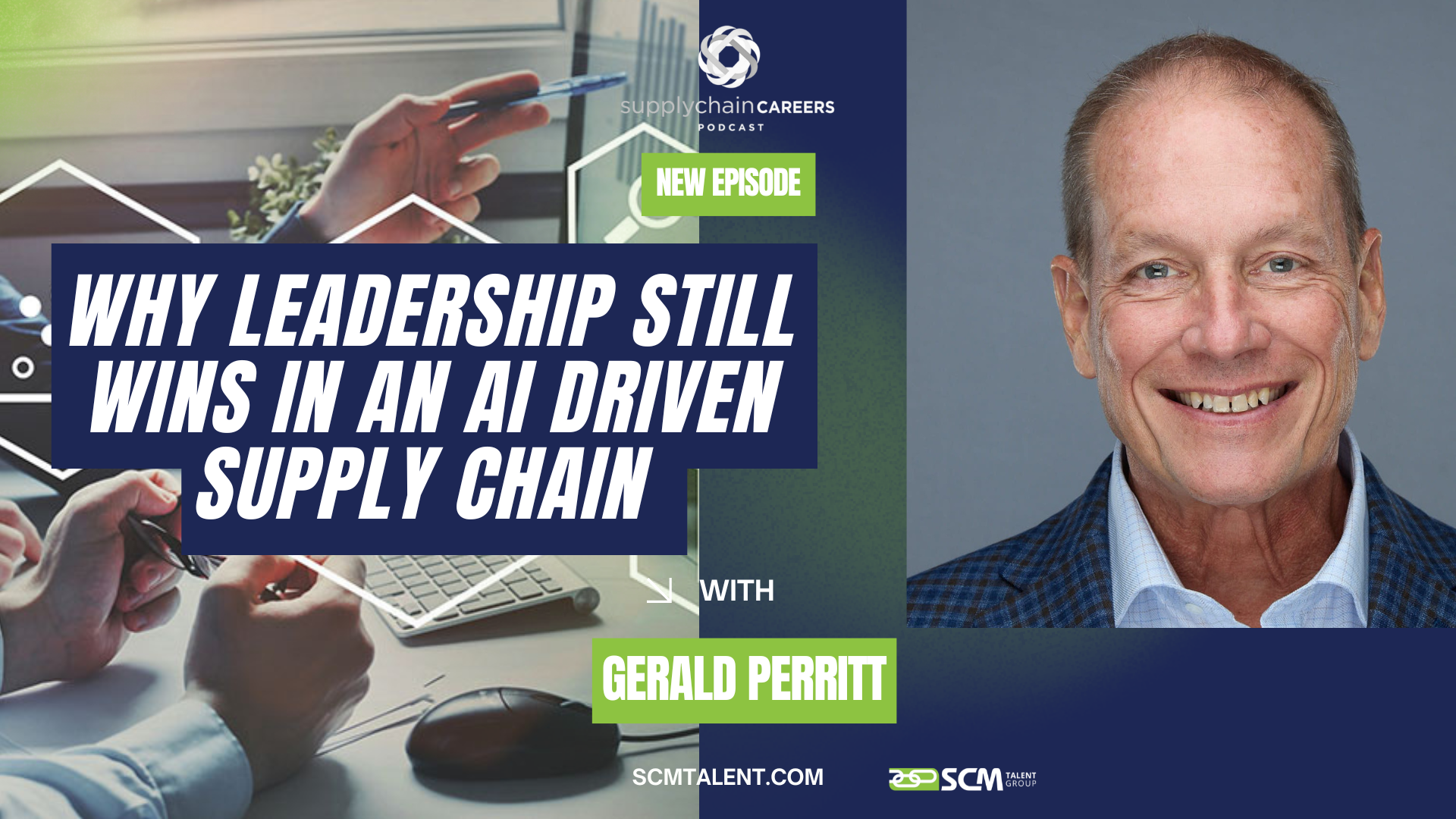
Gerald Perritt
Mike Ogle: , [00:00:00] Gerald, we’re happy to have you with us today to provide your career path and experiences. Welcome to the Supply Chain Careers podcast.
Gerald Perritt: Great to be here. And I’m, I appreciate you guys inviting me and I’m flattered and great to see you again, Mike, after a few years.
Mike Ogle: Yeah, likewise.
Gerald Perritt: And to meet you, Rodney. Yep.
Rodney Apple: Likewise Gerald.
Gerald Perritt: Yeah.
Mike Ogle: Hey, and to do a little initial look back on the career, we like to ask about some of the influences that made you even aware at all that there was this thing called supply chains or whatever it was called at the time, and led you toward pursuing a supply chain career.
Gerald Perritt: Yeah. It’s a little bit of a walk down memory lane, but I really, so going back I finished university in 1987, so I’m going way back for probably some of your listeners and or viewers. And I really fell into it. I’m a first generation college grad from the family.
[00:01:00] I, I had aspirations of going into to law enforcement or potentially military, and at some point later in, in the four year term, I just, I was less inspired in that route. Graduated university of South Carolina, always proud as you, you can see behind me. And I. I had a very good friend whose brother was working in the transportation business, the LTL less than truckload trucking business for a regional company here in south, based in South Carolina.
And we were just talking one day and he and I had met his brother before and he said, Dave, my brother thinks she would be pretty good in this business. And I said, why? He said you’ve you’ve worked hard, you’ve summer jobs and you worked through college. And it’s a tough business to be honest with you.
And so I started working here in Columbia, South Carolina on a freight dock and more just dipping my toe in the water. And then got asked to join a [00:02:00] management training program for this company. And that was pretty exciting as well. So with that I went both feet and started this LTL less than truckload trucking career, just certainly part of the supply chain.
But back in the eighties, the South Carolina didn’t even have a supply chain program or operations management program, like global supply chain and operations management program like they have today and many other universities as well. So it just wasn’t out there. Like I said, I just fell into it and I don’t know that I loved it or not, but I must have, working nights, days in the trucking industry and learned a lot about that part of the business.
But I think about leadership as well, and that really fueled me to continue doing it.
Rodney Apple: And so Gerald you’ve stayed in the, I wouldn’t say exact same space but from say the carrier side into the, to some of the larger 3PLs. So I’d love to hear how [00:03:00] you progressed into some of these big leadership roles the transitioning into board of director level.
If you could maybe take us through that journey some of the key lessons you learned along the way as you progressed.
Gerald Perritt: Yeah, I will. And I hope it sounds exciting we’ll get to it. So I, f The first company that I worked for in the LTL business was a company called Spartan Express.
And they were ultimately consumed by the FedEx companies. And during that time though I guess I was in about 10 years for that company, and typical progression in the LTL businesses management training, you do operations, you go into sales and ultimately a terminal manager. We were living in Atlanta at the time and when, during my end of my two years in that LTL sales program and just like play, I really want to.
Go right back into operations and be a terminal manager. And I had [00:04:00] met a gentleman in the engineering group in that company and we spoke the same language and they figured out I could do math somehow. And I don’t take, I literally one of ’em said you know how to do math, so figuring productivity, performance, et cetera.
So I made the decision to go in. I took, you mentioned, different twists and turns. I made the decision to go into an engineering group, and I did that for about two years. And it really was working with terminals to improve performance. And what, which you. Naturally assumed that we would be doing, and then if, and then FedEx at some point made the decision to divest that particular company and first time in my life, short, early career life that had happened.
So opportunity to determine, hey, what am I gonna do again, started interviewing with LTL companies and at the time, consolidated freightways, they’re no longer in business either. Sounds like a tough trend that I’m getting to. But they were [00:05:00] starting an engineering department and I had heard about it, applied, interviewed for that, loved it.
My three years there. However, near the end we were, I was working more on shutting down terminals than opening terminals and growth opportunities. During that time as well, we had moved to Columbia, South Carolina for family reasons. Wanted to, Atlanta’s a great place, but we wanted a smaller place to raise our family.
And family owned, third party logistics focused on contract logistics business here in Columbia, South Carolina. They were looking for a business development person. I applied, interviewed, got it. Short story. And that’s where, this engineering piece, the ability to go out in sales really helped me to a great extent.
Being comfortable to go. Being comfortable enough to go out and meet with clients, talk the details of a solution, [00:06:00] ultimately win business. Went to work for that company, it was called Standard Corporation at the time. And then two years into that I was really excited about working for a smaller company, by the way.
And then two years into that we were acquired by a global freight forwarding organization called UTI. And that was really the, I guess you could say the launching pad. For many of us. We were the largest contract logistics acquisition for that company at the time. And therefore thought to be the subject matter experts, even though we’ve, I don’t know how we compared to many others in the industry.
And yeah. But during that, I didn’t even have a passport at the time. And, but being a global company, I said to myself, and maybe a few of us did, Hey, we better go out and be ready to travel and do some things. So did that. And then what you mentioned some of the roles that I had. So I [00:07:00] was asked to go to Mexico and help sell some business to an existing client, Bosch Automotive.
We, we ran a very large auto operation for them down in Charleston, South Carolina. . Their head person was an advocate of ours and said, Hey, I want you guys to go look at this site in Mexico and potentially run it. We went down there and won the business.
our president said, Hey, you’ve got operations experience. We don’t have a lot of implementation people sitting around here. You’ve been there, you know the client. I want you two guys to go start this business up. And I never, at that point, I transitioned from business development into operations and then ultimately, not ultimately, but led our automotive group. And for UTI and in the North America region.
And then of course we were growing the business and that’s how I met some of my, some of the people I’ll reference at the Home Depot, for [00:08:00] example, running businesses for them later on. And then yeah, just I worked for some great people as well. And we think about the supply chain business.
The president that I referenced, he’s a former marine officer and supply chain as well as, doing some infantry. His name we referred to him as the Poor Bill Gates, but his name was literally Bill Gates. And he had a huge impact just, on many of us and just said, Hey, you’ve just, our growth and just try something different.
Just keep on and, try a new role and he just kept, throwing more responsibility at me and was very instrumental in me taking over for him when he retired at UTI. From there, I think you, you’ve seen my background. I loved DTI and I, and you’ll probably hear me reference culture a couple of times during our talk culture was just really familial, also [00:09:00] results oriented and that, that went away with some leadership changes around the 20 11, 20 12 timeframe.
So yeah, I started listening to recruiters at that time and after. Of a few not a few but one stop. I ended up at K Nagel leading their North American Contract Logistics organization. Again, another global supply chain company. And what led me to that really was that just more the UTI great company.
It was just changing and di didn’t feel as comfortable. And again, those things happen and then when we get those calls, we listen and I quite liked Kon and Nagel and we’ve, I put together or we put together a very good team, solid team. And then in 2019 I just mid fifties.
Felt the bug to, I’d always worked for somebody, right? Most of us have, we were, we’re always [00:10:00] working for somebody traveling. We were the two years prior to my deciding to move on, we were starting up a new building in North America every month. So we were averaging a new building for 18 months every month.
And I started losing a little hair and it hasn’t started growing back. And then from a family perspective, wanted to spend more time try to find something that I could do that, but stay in this industry because I love it. With the support of my wife, I just stepped off the boat into the deep end and went out on my own to, to create this parrot group and advisory and leadership development practice.
But again, staying primarily in this supply chain business. And yeah, on that, it was interesting, almost 40 years since this whole trucking thing started. I’m leaving church a few years ago, and a mother and her daughter, who was, I think [00:11:00] she was going to Auburn or somewhere, and she said, Hey, Mr.
Parrot’s in business, let’s find, I heard her saying, let’s go talk to him and see what he does. And so I said, yeah, I’m in the supply chain business, because that’s the easy thing now, right? People know. She said, that is cutting edge. And I just chuckled. I said, yep, I’ve been cutting these edges for about 35 years now.
And nobody knew what it was until the pandemic, but, that’s a, hopefully not a too boring story with some of those moves and why I’ve, I made those moves.
Mike Ogle: Yeah. I do want to ask one short follow up before I, I get into some of the other questions that we’re going to get into.
. So what was it like in that transition where you go from working for somebody else to learning how to manage yourself? Do you have any problems with your own management?
Gerald Perritt: At the end of 2019 is when I made that transition, and then I started this, I in, I [00:12:00] also started with a dedicated client at the time, supporting that, that owner and business with their strategy, et cetera.
And then the pandemic happened. So it, it was like, I, it’s a great question, Mike. I had to, once that client and I disengaged for obvious reasons. He just his business kind of fell off with what was happening in the world. And I think that’s where the discipline had to take place. And because I didn’t have a lot going on and I decided to spend more time on this leadership development offering, now is a great time to get up in the morning and just start writing curriculum.
And I landed on a quote that I love and I don’t, I read it recently. The, a disciplined life is a happy life. And I, so I just, I don’t know if it was just because I’d worked for the man all those years and I was in the habit of getting up and [00:13:00] taking care of this, the body and the mind and what have you.
I just, I got up like normal. Did my stuff, and I’m in the office by eight o’clock in the morning and I’m working on curriculum or, and then I was fitting in some projects as well outside because I could, and I had that time, so I’ve carried that on. It’s a, yeah, but I have, I’ve, some of my friends that are working from home still they do the whole pajamas thing and I just can’t do that.
I have to be focused and discipline. Just, maybe it’s in the DNA, so hopefully that answered your question.
Mike Ogle: It, it does. Yeah. It does. And you’d mentioned as part of your previous answer
There’s a lot of interest and experience in contract logistics and being able to make those kinds of connections where you’re providing services to others.
For those who are curious about how that part of supply chain really works, what is really different [00:14:00] about it and what makes someone much more successful in that space, both from really look at both sides of the contracts.
Gerald Perritt: I think for me, what was different about it, and I, when I, you’ll hear people in the LTL business that less than truckload business, they’ll say things like, every day you get up and it’s different.
And for me it wasn’t. It got to the point where, except for that engineering experience, every day was about the same. You have your SOP, you got trucks hitting the door, you’re unloading them. Your, I always worked in big terminals, so just 24 7 and that. So when making the transition over to contract logistics, , the exposure, especially if at the time a smaller company, the exposure to the different industry verticals, retail, automotive, pharma, aerospace than the order fulfillment world, which is quite [00:15:00] different.
It was just I get chills right now just talking about it. I know it may sound a little bit geeky, but just being able to be involved in those industries and then, yeah, I know the distribution centers and the contract logistics space, that’s one part of the supply chain, but what goes on in those four walls.
Is incredibly important. And what I would tell people is we’re not just delivering boxes. We’re delivering a need. It can be a package some kid is gonna open, it can be a Christmas present, it can be a healthcare need or some arriving at that at home open it, it’s a nebulizer or machine or what picks, or on the aerospace side parts, spare parts for airplanes or Department of defense.
So it’s just it’s really exciting. And then when you get into the guts of that business, then being able to be on the front end of a client relationship, designing the solution, how you’re gonna operate their business within the four [00:16:00] walls. And then selling it, winning the business, implementing it, running it, making money.
By the way, that’s one of the quite important in the contract logistics business. And then that. So those things I think help. P men and women be successful in that third party contract logistics environment. So making the client happy, figuring that out, making your people happy creating meaning and purpose in the workplace, quite important.
Figuring out how to do those things and making the profit margin that your company is targeting. If you can do those things, those are the things that I think that’s gonna make you successful on one side of the contract and one side being the three PL side, and then those companies that use 3PLs.
I think those men and women and I’ll use a gentleman [00:17:00] I’ll reference a couple of times. Pete Bid Naik, who was a director, senior director at Home Depot, back when we were, we being UTI, we were running some sites for Home Depot. And, I would say he represented what was successful on the user side of 3PLs transparent.
He would set clear expectations. He had a partnership mentality. I never felt like when I was working with him and others, I’m just referencing him, but we had other clients that were of the same cloth if you will, that they were always trying to get. More out of the three pl without giving, if that makes sense.
It’s just we need more cost down, yet we expect you to deliver more innovation and continuous improvement. Oftentimes the two things don’t go together. So when I say transparent setting expectations, did we have [00:18:00] difficult firm conversations back in the day? Of course we did. But the beauty of it is I think that he and others that I’ve worked with, those successful three PL managers, they valued relationship, they valued trust, they valued integrity, and they valued partnership.
And if you would’ve told Pete or me 20 years ago, Hey, one day when you guys are in your fourth quarter of your life that you’re gonna be working together, we would’ve both said, you’re crazy. Here we are. We partner on some business opportunities today and quite enjoy e each other when, we’re quite different, but we enjoy each other and yeah.
And I, I feel like we bring value to the industry. So yeah. Hopefully that answered.
Rodney Apple: Yeah. Yeah. And I, before we got on, I was checking out the [00:19:00] Parrot group and I recognized Pete and, as 25 years in the logistics supply chain recruiting world.
We’ve come across one another.
He also worked at Home Depot where I had cut my teeth 25 years ago. But I love that as a client, you’ve got that, as Mike said you know that your company offers those joint. Dual perspectives, right? I’ve got a similar story. I won’t, I’ll make it short.
Client of ours, HT Supply same thing. Jay Jay Morrison we worked with him. They were going through a transformation, and then he went up the road, I’m in Asheville. He went up the road to Kingsport to, to lead talent acquisition for what was it? Eastman Chemicals. And now he works for us.
So it’s it’s nice to have that corporate sort of shipper perspective as well as the service provider. You have been in the shoes of your client and you can, you, I think it helps with the communication and the part and the partnership and, building that trust and confidence when you’ve been on both sides of the fence.
Right.
Gerald Perritt: Yeah, it does. And if you guys don’t mind I’ll go into this [00:20:00] ’cause you just created another thought where I think in addition to Pete and I just working well together when we’re working with third party logistics companies, especially at that general manager level, and one of the key items there about client relationship management is the business review process.
And we present several case studies to this level of leadership and to have someone who sat on the other side of the table. Working with these general managers on how to improve client relationship, how, this is when I was your client, this is what I expected and this is what I think will work.
And we’ve even had participants after they’ve gone through our course a few months later, call Pete and say, Hey, I’ve got this situation with a client. Can you help me? And he’s right there to help him. So yeah it’s pretty powerful.
Rodney Apple: Absolutely. Yeah. And I guess that leads into the Parrot [00:21:00] group.
We’d love to learn more about your business. One thing that stood out is on your LinkedIn profile, you’ve got quick phrase that says the developing leaders, aligning teams, and driving impact. Could you, , share with our audience, , what those phrases mean to you, and how you leverage those, or go about, your approach with your client engagements how that leads to success and making that impact for their businesses.
Gerald Perritt: Yeah. It’s interesting. So when I started this at the beginning of 2020, we didn’t have that tagline. So the, this evolved over a few years. And again, not to give at the risk of giving Pete too many kudos here. After he and I were working together a couple of years, and he just said, I’ve sat down and after we’ve done some classes together and some engagements this is what I think we do.
We are developing leaders, we’re aligning [00:22:00] teams, and we’re driving impact. Wow. Did you come up with that on your own? And you go to chat GPT, but he came up with it on his own and he is right. And I’ll explain it by, without saying, begin with the end in mind. I think really when we engage clients, it may sound a bit hokey naive, we really do want our engagement to be a watershed moment for them.
We want, especially on the leadership development side, and we want leaders when they walk away from us, and we have several follow up activities post session. We want them being different and acting different. And we want that impact to last a long time. And I say that because some, I referenced that LTL business that first year that I was in the LTL business.
They train you like nobody’s business technical skills and interpersonal skills. You’re gonna learn the technical, but you’re also gonna learn how to lead people. [00:23:00] You’re gonna be learn how to do things in the middle of the night when you have no one else out there. You are the guy that’s leading these people.
So I, I saw that, that there was a need there in the warehouse environment and three PL and I, so just how do we create that lasting impact? Because Pete went through some of the similar training. We really want. The, these leaders behaving differently, acting differently, being better, doing better, and focusing in on those interpersonal skills.
So then you talk about aligning teams. When we have groups that are within the same company, we also want them we wanna be talking the same language. We wanna be talking again, integrity, honesty. We want them focusing in on their communication skills and, when they’re talking to each other.
Sometimes the biggest value, and you guys have probably seen it when you bring in 15, 16 people from one company, but they’re spread out across the region or even the us. [00:24:00] Tremendous value bringing them together, going through these experiences together, creating those synergies. So again, that’s where the aligning teams comes from on that end.
But also on the advisory side, we’ve, we work with some 3PLs and just doing some team assessments, and we’re also working with them to get their teams more aligned as well. And that’s just not only on, the results are again, beginning with the end in mind. We want to deliver. In order to deliver, we have to have a certain culture and we have to be speaking very much the same language to that culture.
So yeah, developing leaders, aligning those teams and driving that, that lasting impact.
Rodney Apple: That’s that’s a great space to be. And I can tell you that, just in this call it the supply chain recruiters chair more often than not, when we get these big leadership searches it comes down to wrong leader in place.
It’s not, doesn’t have the ability to do what your company is, is teaching. They’re [00:25:00] not, whether they’re not out on the floor they’re not holding people accountable. Oftentimes, they’re the ones putting out the fires instead of delegating that, or they’re focusing too much on the strategic stuff and they’re not in the business.
Balancing that is challenge. Is the challenge, right?
Gerald Perritt: Yeah. Yeah. And sometimes they’re creating those fires.
Rodney Apple: True.
Gerald Perritt: Yeah. And for your supply chain careers, people that are considering this, we have a saying, so goes the site leader, so goes the site and the site leaders, what we refer to as general managers, often they have to be very entrepreneurial. And I say you have to be the CEO of your business.
The most successful ones that I’ve worked with, they own, they have total ownership of their business and they don’t want people like us nosing around in their business because they’re running it and they don’t need it. But creating that culture, understanding the supply chain piece, the importance to their [00:26:00] client relationship, people. And that financial aspect that I referenced very important.
Mike Ogle: . That impact side of things. That last piece makes me a little curious just in how people are viewing that impact these days. What are the kinds of metrics have you seen much of a shift in, in the kinds of things that, that people get measured by?
If there are 16 of these offices, let’s say, or 16 facilities around the country, and they try to put them on a similar measurement type of system, do you see changes in that environment or are there things that you try to suggest to people that they should try to measure themselves on?
Gerald Perritt: Yeah. It, that, that is a tough one when it comes to these types of engagements that we do. And I get asked that a lot from potential. Clients that we’re working with, how are we gonna measure success? Very important. [00:27:00] And as an o the operator in me, I, I wanna see the scoreboard. So one, one of those KPIs that I think is relevant and incredibly important is employee retention. So measuring a difference between, where you were before, where you are now, is important. We haven’t had a lot of clients share that with us, but one at least on two occasions we’ve had, what they’ve shared is, Hey, we have increased our retention, we have improved productivity, and there is a financial impact to this.
Not always sharing that financial impact, but we know that site is doing better because they don’t have this churn of people. And the site leader is leading better. The frontline supervisors, who I would argue, we will ask the executives sometimes will say, who drives culture more than anyone else in the organization?[00:28:00]
The VP of ops or the CEO or owner’s gonna say I do, I’ll say sorry to inform you, but you don’t. That frontline leader does. And if we get everyone aligned, like we were talking about before, performing properly, you will impact those 20 or so hourly associates in a positive way. You’re likely gonna keep them, you’re gonna retain more of them, your performance will go up.
So I’d say retention p and l not always shared with us. And then Mike what I love, even though I don’t necessarily get those metrics, is I love the the notes we get from participants. And even, we do the surveys and you get a lot of love me kind of things. Then so we discard it to be honest with you.
But then when we get a note a few months later saying, or even a few weeks later saying, Hey, I was preparing based on our training, I knew I was gonna go into my client meeting. And then [00:29:00] one in particular was this gentleman who’s running a very large site for a very large CPG company, consumer package goods.
And you could tell he was a little stressed about it, but he worked with Pete and me during the training. He went in and had this meeting. He was, he prepared better, he had his data and facts and he sends us a note saying it was the best meeting he’d ever had with his client. And he was, they were struggling from a relationship perspective.
And we still hear from that gentleman or the supervisor that recommends us to, to maybe his or her new company and went through this training. We should talk to these guys about coming to them. I think that’s, it’s quite anecdotal, not as KPIs we like, but boy, it sure does. It does help us know that we’re doing some things the right way.
And then our most recent class, our client, the owner of this three pl, he’s already [00:30:00] circled back around to us and said, I can see it, I can see the change. It’s not in the numbers, but there we’re moving into that next level of operators and his company, huge investment as he is talking about three or four sessions to get his 12 or so operations through this process.
So yeah, I’ve, I’d love to say these. Here’s the scoreboard, but I’ve and I don’t wanna word salad you, but I think it’s a combination of the scoreboard that we can actually track, but also the testimonials and the ongoing business, if that helps.
Mike Ogle: Hey, with some of the shifts that have. Taken place over time. One of the things we’d like to get your thoughts on is where you think things are going. A few trends in technology or business practices that you see are having an influence on how people are really going to do supply chain work over the next, I don’t know, two to five years, let’s say.
Gerald Perritt: [00:31:00] Yeah. Probably the most obvious one, and you guys probably know what I’m getting ready to say, is the AI piece. That when you, when I think about the application, if we’d had this 20 years ago, and I think about, and just in the distribution center, the opportunities for dynamic slotting for, performance tracking, the analytics piece, these kinds of things. I think it’s gonna have a, and not just obviously analytics in the side of four walls of building global supply chain. And the power that I think AI is going to deliver is incredible. On the flip side, you probably have some people listening to this saying, why in the world would I wanna go into this business?
Because I used to coach kids in, in, their last phases of college and say where do you think I would fit? And I would say, gosh you ought to think about going [00:32:00] into the analytics side of the business. That’s gonna be tough. How do you differentiate yourself with a large organization when we have this tool that can do all much of the analytics for you?
So I think that’s one of the trends, but then I would also coach those people. Look, we’re, it’s all, to me, it’s a people business. It’s a complex business, likely with this technology. What have we found when we’ve introduced more technology in the market? Did things get simplified? I don’t think so.
And we’ve got all these communication devices and ways to communicate. It seems like it’s become more difficult over the years. So I think I would coach people to be more involved in the people side of the business, learn how to lead, et cetera. So I think that’ll be a trend as well. Mike, we’re gonna see AI can help you.
Prepare for a conversation with an employee or a leader or a client or a government official, whomever it may be, but [00:33:00] they can’t have it. AI can’t have the conversation. So I, I think figuring out how to use that AI in a productive way in this supply chain. The other is, of course, automation. What I’ve seen so far, still, we’re gonna, it’s interesting in the three PL world with the average hourly rate now in a warehouse is over $20 an hour in 2019, I think it was already increasing before the pandemic.
But what we saw was a 40 to 50% increase post pandemic. Most supply chains were not built on $20 an hour labor. What you’ve seen is the cost of automation actually coming down a bit, this hourly labor cost going up, I think it’s been at a nice inflection point for a few years.
Very creative ways of financing. 3PLs typically lean on their clients to, to help support this. But I see the trend [00:34:00] continuing that you’ll see more and more automation still gonna need people, but we’re gonna see more automation in the business. And then I think the other one, they’re using technology to also help manage your people and build that meaningful workplace.
’cause I’m still, culture is still incredibly important. Most of the, I’m gonna just, I don’t have the exact number. Let’s just say many of the people working in the supply chain, in the warehouse environment, some of these lower skilled jobs. It’s a hard environment and we have to lead and provide that meaning and purpose.
There’s a way to use this technology to help us do that, and monitor our people’s behaviors in a good way to support them and provide reminders and inputs just on your cell phone, if you will. And I know there’s some companies out there that are trying to develop [00:35:00] that technology.
And I think that’s being a people person. I think I am. I think that’s the right way to go to leverage the technology and create even better frontline leaders.
Rodney Apple: I was literally gonna ask that question. Because you hear ai like potentially, definitely taking people’s jobs, right?
You mentioned that. Some of the analytics can it, it can do a lot of that work. And and we’re seeing that, I know Mike can probably speak to, looking across the broader logistics, supply chain, academia, world placement
Ratios, things like that. The frontline worker roles, even at the analyst, buyer planner, et cetera
Are and there’s an abundance of talent. You asked me that 15, 20 years ago, those were roles we would struggle to fill. Now we have 125 plus universities that have supply chain logistics related programs. We’ve solved for that junior level entry, junior level and but because 20 years ago we didn’t pump enough people into the into the proverbial system.
We’re seeing the gaps in mid management and [00:36:00] above. But, AI being used to, there’s all these staffing shortages, the hourly labors putting it to use, like you just said, to help accelerate onboarding, create a better experience, that stickiness that you need to drive that culture.
High performing workforce, if you will. Yep. Yeah. Have you seen any applications on with any of your clients or just through your network?
Gerald Perritt: No. No. One, one client in particular, I know they do work with this company, but one application is called Trail Path Workforce Solutions.
Yep. If you’re familiar with them and
And I’m not
Rodney Apple: Robert, what’s his name?
Gerald Perritt: Robert Marticenko.
Rodney Apple: That’s it. Yep.
Gerald Perritt: Yep. Yeah. So I think there’s some things developing. They’ve developed it. It’s in the market now and it’s related to think of manufacturing supply chain as well, right? So it’s not just distribution centers.
We’re working in, let’s I say we, they’re working in this high volume employee [00:37:00]
Mike Ogle: right?
Gerald Perritt: Environments. Yeah. To use tools to help create this meaningful workplace.
Mike Ogle: And at this point is where I interject that Robert was a guest on our podcast. So somebody wants to go back and listen to that, but an episode then they can.
Rodney Apple: I was just making a note to just revisit and with him and see where he’s at. ‘Cause he was in the early stages of launching this, and I was fascinated. And I feel like everybody’s, this is such a big problem. And like you said, not just logistics, warehousing, but also manufacturing.
We, we hear it from our clients all the time. And so yeah. Putting purpose and meaning and into that work, and they’re just not looked at as a commodity and they’re part of the culture, they’re part of the team. Maybe invert that pyramid a bit where, they’re on top, and yeah.
And then you have AI and just using that for the, and not to take their jobs, but to enhance their jobs and create that retention that you hit on earlier
Gerald Perritt: ex. Exactly. And we, being a bottom [00:38:00] line person, you can probably tell that just do it. But then I know from experience that when the retention has improved in my operations.
The profit and loss impact, let’s just say the profit impact was signi. It was noticeable.
Rodney Apple: Yes.
Right. Yeah. People oftentimes don’t factor in that you’re, those couple dollars that you’re trying to shave
On their hourly rate. Thinking about the cost to rehire and retrain and just repeatedly doing that over, or you’re hiring a staffing company that’s just throwing people at it and, but the leadership’s not there and they don’t have purpose. They just feel just a person to come in and turn the wrench,
Gerald Perritt: yeah. And Robert and I know this particular client that he’s working with, they’ve done a lot of work in the cost of turnover arena specific to distribution center.
It is significant.
And just for a three PL owner, he said, all right, if I can. If I can take $250,000 a year of cost [00:39:00] outta my business, how many of them wouldn’t raise their hand? All right here’s the solution. It’s gonna be work by the way you’re not just gonna wave a magic wand, but here’s a potential solution.
Yeah, it’s pretty exciting.
Rodney Apple: This is a good segue. Gerald we’ve been in this, we, all of us have been in this logistics supply chain space for decades now. And, it takes a special kind of person and skillset to thrive and enjoy this career.
I’ve seen plenty of people get in and get out. And what are your thoughts on what does it take to the type of person where they get, excited, the background or maybe turn it around and say, what are the exciting things about this career?
And then, for those that aren’t sure, that kind of have one foot in, one foot out
Maybe we can help them save a few years of their life. What’s frustrated people may want to avoid pursuing a career in this space.
Gerald Perritt: I think when I think about the most successful people, and it’s in the supply chain space, not just three pl, it could be clients I’ve worked with at some pretty large companies.
It’s [00:40:00] that most of us have one thing in common. We’re problem solvers. And in this world, this complicated world we live in, it’s gotten more complex over the last several weeks. It takes people who enjoy solving problems and like tangible results that they can say. And I think, anyway, a personality trait is I can look back and say, Hey, I solved this.
Look at not from a perspective that look what I did, it’s more that I now feel good about the last three weeks of work I did because we solved something as a team guys. And I think it’s that personality trait. Another one is the, again, I’ll argue, probably I’ll be sitting on my dock fishing in 20 years saying it’s still a relationship business.
And those people who not only know how, but they enjoy communicating and not [00:41:00] just on that, that phone, okay. When I say phone, using it as a phone is great, but not just in the electronic texting and posting and all that good stuff. People that actually like being around other human beings to solve those problems, either in this environment, because, global now, we can have productive conversations and meetings.
But people that enjoy that they like to be around people also value relationships. And how important that is to solving those problems and figuring out some of these global supply chain issues that need to be figured out. And then, yeah, I think what would frustrate some of us because we’re problem solvers.
There are things that just happen outside of our control. And most, I shouldn’t say most, many of us in this industry, we want things to work just like this, right? The optimum supply chain, everything da. It doesn’t happen that way. But if we, if it’s our issue and we can [00:42:00] go back and problem solve and fix it or root cause it and fix it, but if it’s outside our control, I think that can be pretty frustrating with that personality trait.
And then the other is, look, it’s by that gentleman I referenced, bill Gates. He would say, we’re gonna work hard, we’re gonna play hard. When he said work hard, he wasn’t kidding. It was a discretionary effort. He would use that to, he would say, the people that are gonna be successful in this company and in this industry are gonna have that.
They’re gonna use that discretionary effort and it’s gonna be evident. And that’s who, when I look back, that’s who was promoted and did well and in the business and figured out a way to keep the home life happy as well. But I think the work-life balance in this industry can be a bit of a challenge.
It, and I’m just being honest, when I talk to younger people in this industry it’s tough. And I don’t know how to solve that. Yep. [00:43:00]
Mike Ogle: Yeah. Those who know how to deal with uncertainty and thrive in it.
Gerald Perritt: Ambiguity and uncertainty. Can you thrive in that environment?
Mike Ogle: Yeah.
Gerald Perritt: Yeah.
Mike Ogle: Yeah. That’s a good place to, to put that.
And, earlier you’d provided a quote maybe even a couple of occasions in some earlier responses, but one of the things we really like to be able to do with this podcast is to get some of the best supply chain career advice
Things that you remembered over the years that you’d like to share with others, and even some things that you’ve discovered yourself
That you wanna share with the audience.
Gerald Perritt: Yeah. I, one that it, and it just always comes to mind, Mike, when people ask this question Yeah. I was sitting in a work warehousing and education research council annual conference in Atlanta many years ago.
Mike Ditka, if you guys remember him, he was the keynote kicking off the session. And to me it was just interesting because I’d heard this [00:44:00] from boss’s mentors, Elijah Ray, bill Gates, others about the relationship piece, which you guys have heard. But he said in his speech, he said, don’t ever underestimate the value of relationship.
So that, that’s one I heard it from mentors. I heard it from him and it’s and you guys asked me about my business and look, without those relationships, I don’t have a business. I stepped out of the boat into the deep end. My relationships, my network was my life preserver and I’ve done well.
So I think. That’s one. And then for those tactical general managers out there I’ve told they any of the people that used to work on my team will not be surprised to hear this. Know your contract. It sounds simple. It’s called contract logistics. We referenced it. Know your contract. It’s, if you know your contract of good things, you can avoid bad things from happening often.
And the other is the, when you go back to [00:45:00] relationships, if you want a relationship with your client, deliver the tactical part of the business. Deliver the KPIs you referenced before when we were talking about how do we measure success, deliver the scoreboard on a con, on a consistent basis, that is the the stepping stone into the, into developing a solid relationship.
And I think Pete, in other clients that I’ve worked with, would say, would echo that. And then I’m a student of not only re leadership, but on the spiritual side as well. And I think some of the things that I’ve landed on recently, and I’ve even used it in some of my talks with clients is, I love this.
I don’t, your audience may think it’s a bit hooky, but people don’t buy what you do. They buy why you do it. And when it, when you’re trying to inspire a group of people, and truck drivers or warehouse workers or people in a [00:46:00] manufacturing line to be, have that meaning and purpose. It’s not what you’re doing.
It’s why you do it. It’s like we talked about before you deliver, you might be delivering some glasses to some person that desperately needs them. I don’t know. But that get, get to the why. And then the other is I referenced that and I strongly believe this, the more discipline you have in your life the happier you’re gonna be.
Now, I’ve said that, but I said it, a leadership talk. A couple of months ago, and one of the guys, he was, you would guess he’s a little on the heavy side, he said I was happy eating that donut this morning.
I said you clearly, you didn’t get up in the morning and say you weren’t gonna eat it. There’s a di That’s the discipline in saying, I’m not going to, and I don’t throughout the day. And you’ll be happy. I haven’t talked to him since, but that would be some, and it, and I think it, it all relates to leadership and to the supply chain.
Because again, think about supply chain is are we talking about [00:47:00] a disciplined process here? It better be, so
Rodney Apple: amen to that.
Gerald, you covered a lot today. A lot of fascinating topics and and some wonderful advice for our audience. But I’d love to hear a little bit more about life beyond corporate as well as, your own company.
You’ve served on some boards. You’re still on some boards, right? Yes. Obviously you’re involved with professional development with your own company, but you do this externally as well. Love to hear a little bit more about that. And, it sounds like you’re that, that passion you just talked about and purpose you enjoy doing those things ’cause you’re doing it in your business and externally.
But what else are you up to to help. Those that work in this broad supply chain community continue to their professional development.
Gerald Perritt: Yeah. Yeah. So I think so one, I’ve tried to make myself available in most situations if a person, if I get referred someone that just needs some advice, I’m there.
I’m [00:48:00] trying to, I think about those people who shaped me over time, and I have some great mentors and I have two great parents. I feel like I, I’ve won the lottery, so I’ve gotta, I’ve gotta give back. So I try to make myself available to that advisory piece. And you mentioned professional organizations being involved in those, and that’s how I met Mike.
And when we talk about relationships and networking, but also the education benefit to being in some of these organizations. It’s been profound. And I would encourage you, we were talking about advice earlier. I would encourage your listeners if they’re not involved in A-C-S-C-M-P or a work or, a SMI, I don’t wanna leave anybody out and make ’em mad, but I leaned more into work because I was a warehouse guy.
Just made more sense. And then I met pe, I met great friends, and I’m eager to go in May to the next one. And this isn’t a commercial [00:49:00] for them. I’m just, I’m more excited about going and seeing my network here, primarily in the US than anything. And and then I’m gonna sit on a panel as well. And that’s the other development part is get involved.
If you get, if you go to one of these organizations, don’t just go, but be involved and be there. Just I know Mike was, I was, and you’re, you’ll get a lot out of it. On the advisory side. Yeah. The, if I’m on a board of advisors, yeah, of course. They’re paid roles, let’s just call it what it is.
However it’s, again, I talked about getting up in the morning, having that I need meeting and purpose as well. And as much as I like this life after Kon and Noggle and I liked it, then don’t, I don’t want to, I don’t want to paint a picture that I didn’t. I, it was a great company, but as much as I like this life I still, the juices need to flow.
And that’s a way of. Of staying in touch and [00:50:00] learning and being curious but helping. And one, one of the hardest things for me to learn early on was I gave this gentleman who owns this company, this advice, and he agreed with me, this is what I, he said, I’m gonna do these things.
And six months later, he hadn’t done any of them. That was a tough transition because I was used to being at a certain level, if we agreed we were gonna do something, we did it. So that discipline part, so I expressed that to another client about, it’s like, gosh I we work, I give him advice. He doesn’t do it.
And he’s, and he said he said, Gerald, you can only do so much. He doesn’t report to you. I don’t report to you. And he said, he’s paying you, right? Yeah. He said what do you care? I was like, wow. Okay. I still care. That was good advice to me though. Not to take it personally, just move on and. Help as much as I can.
And but I do love the board work and it’s another way I mentioned being around people. So you give and you get, and one of the things I miss the [00:51:00] most is my team. And you guys know, you, you’ve been in business and you finish a hard day or you’re traveling and you go have a glass of wine and you have dinner and you just, you have that engagement.
I don’t get as much of that anymore, so this is another outlet for me to do that. So just, yeah I get as much as I give, I think I get just as much from it, just that comraderie. And I heard this quote many years ago that they were asking a football player, what do you miss much? And he’s a great football player.
He said, I miss the locker room. He said we just had fun. We were just, guys being, may, maybe not politically correct, but guys being guys and having a good time. So yeah. That’s the value of the board for me.
Rodney Apple: Absolutely. Yeah. The more you give, the more you receive.
And I think that goes back to, the, this networking that you’re talking about. You’ve threaded that throughout this conversation. I’m a big proponent of network, early network, often don’t wait till you need [00:52:00] to, like when you have a pink slip. We’re getting ready to do a podcast on that later this afternoon, that topic.
How do you deal with that? Because there’s a ton of people, unfortunately, that are dealing with that today. Yeah. Those relationships, it’s a relationship business and that’s what it comes down to is people business relationships. And the way you do that is, giving and, and that’s what it’s about, giving and receiving. It’s two ways, right? Yeah. Yeah.
Mike Ogle: Yeah, a hundred percent.
Gerald Perritt: Good.
Mike Ogle: Hey, and before we end up closing out the episode like you, could you give up the audience a little bit more background on the work of the Parrot group, how people can follow your work and keep up on your advice about supply chain careers?
Gerald Perritt: Yeah, thank you, Mike. Yeah, the, so we, we focus primarily on, on the leadership development side, as I mentioned before, interpersonal skills and our. Our excitement. We’re excited about all of it, but when we can see those lights, those eyes light up in the frontline leadership ranks [00:53:00] that’s quite powerful.
So we work with them and we’ve ventured outside the three pl space, as you would guess so that’s been fun as well. And then the, at the higher levels it’s more case study work and client management, p and l management but still those interpersonal skills. And on the advisory side, it’s not something that, that I advertise that much.
Engagements are confidential. Probably some of my clients don’t, from an ego perspective, don’t wanna know. Everyone know they’re leaning on companies to help ’em with strategy and growth, et cetera, but we do that as well. How do you find us, follow us. We’ve got the website the parrot group.com.
Very easy. Parrot is spelled differently than bird, although I’ve been called many things growing up over my 60 plus years now. And LinkedIn, easy to follow. Although I have a parrot group page, I tend to post more on, on just my individual site. So that’s the easiest way being, again a fence straddle [00:54:00] on the generational thing from baby Boomer to Gen X.
And I think I’m pretty good with the technology, but I just. I don’t do Facebook and the other stuff. So if you wanna follow us, it’ll have to be on LinkedIn and I’d enjoy it. Hey, if you have listeners, reach out to Pete and me and connect with us. We’d love to connect and and let you keep up with some of the things that we’ve got going on.
Rodney Apple: I’m gonna be connecting with you. I may, I’d love to have a place to refer, some of our clients your way that, that seem to be struggling in this area of, leadership and retention. And be happy to forward those over to you so you can help them out. I’m usually asked to help from replacing someone, but, sometimes they just need some good old fashioned coaching and leveling up,
Gerald Perritt: yeah, exactly. And I did, sorry, Rodney, you’ve, you helped me there. I did leave that out. I do some executive coaching in the space as well, so as part of that advisory, so Definitely. And I appreciate that.
Rodney Apple: Yeah.
Gerald Perritt: Yeah.
Rodney Apple: Back to networking and [00:55:00] relationships.
Gerald Perritt: Exactly.
Rodney Apple: Good example. All right we’ll end on that note. Thanks audience for listening. And thank you so much, Gerald, for joining us today on the Supply Chain Careers podcast. This is a fascinating episode, and I know our audience will get some good nuggets of wisdom out of it.
So thank you again for sharing your unique career journey and we appreciate the time.
Gerald Perritt: Yeah, great. You’re welcome. Thank you, and great to meet you, Rodney and Mike. Good to see you again. This has been awesome for me as well. Thank you.
Mike Ogle: Great.