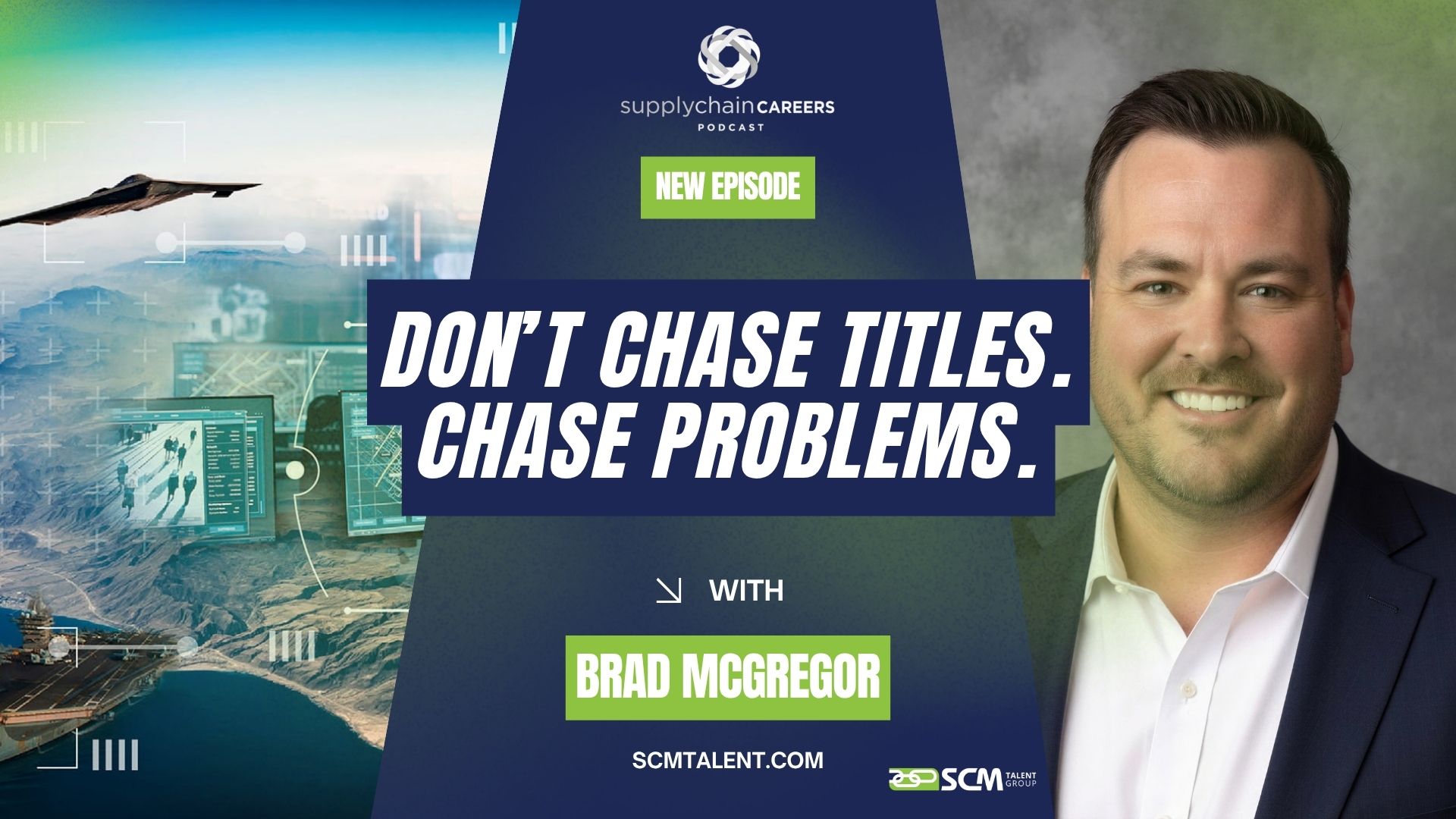
Brad McGregor
Rodney Apple: [00:00:00] So Brad, welcome to the Supply Chain Careers podcast. We’re very excited to have you on today.
Brad McGregor: Thank you. Glad to be here.
Rodney Apple: So we’d love to go back in time to the very beginning.
We know that a lot of folks in supply chain don’t really seek out the supply chain career path. Sometimes it just happens, right? But we’d love to hear, that initial what sparked that, interest and pursuit into the field of supply chain.
Brad McGregor: Yeah, of course. So I can tell you this was not a, a master plan to get into supply chain.
I entered the industry or professional industry around the turn of the century, so coming out of high school and college around 2000. Part of my internship through college was with a company called Delphi, which was a major General Motors supplier. So looking back, being able to go through an internsh- an internship with automotive in the automotive industry, it really gave me a, a good perspective on how that industry operates, not just from a supply chain perspective, but from a manufacturing perspective.
I think every supply chain leader, if they could start in the warehouse, start in the [00:01:00] floor, the production floor you know, do anything of some of the support functions it really pays dividends when you get into supply chain. So when I was in college and graduated, stayed in automotive through the crisis of 2008.
I was a production supervisor, a, a skinny little kid trying to supervise a lot of different people on a production line in the automotive industry, which, can sometimes be 40 to 50, 60 people in one department. And doing off shifts, weekends it being a very unionized facility, you could imagine some of the stresses, right?
Great example is, if I walk down a line and I see a part that may be stuck on a conveyor or something, and I go and touch it or fix it, next thing I know I get a grievance and I’m paying the entire department overtime and things like that. So you really do have to learn how to lead people in different ways a- and that’s something that, I think as leaders, there’s different leader- leadership styles that everybody tends to follow in one way or the other.
But I believe, the situations really [00:02:00] dictate which leadership style to, to use. And I think go- looking back at during that production phases when I was leading production super as a supervisor, you really have to be careful and you really have to know how to talk to different people and really gain their respect.
Respect is something that’s not, you know, given as earned. And the more you can relate to them, more empathetic you can be. The more technical competency you have, that always helps. To be able to lead people doing a certain job, you need to know that job. But I did that for several years and I’ve always had an interest in business.
I really wasn’t- excited about going to anything into finance or accounting. So I was looking to see what else was out there, and luckily at the same time the company that I was working for in automotive had a opening for a buyer position, which turned into a category management position. So I started there and absolutely loved it.
It was a kind of the business in, in the business field, but it was something different than what you really hear about in school in terms of, accounting and finance and some of the other business functions, any of the like [00:03:00] management. This was something totally different.
I was a really big student of supply chain. I try to learn as much as I can. I had a lot of good mentors back at that first job. We were a global company, so I was interacting with, all, all the areas and regions around the world. So learning how different people do different things in different countries and the way they negotiate, the styles can be different.
But looking back, that’s really when I started to develop that sourcing strategy mentality, really building really good strategies that were always based on, at that time, a category. And it really helped me learn that skill and learn how to negotiate better. And then when I went into the defense world, obviously things are a little bit different.
But looking back, learning how to manage people, be a leader that, that stuff, e- even though as, as difficult as the internship with, in a union plant could be it really shaped of who I am today and my leadership style.
Rodney Apple: Yeah. And I appreciate you sharing that perspective. And one thing I want to just circle back on because you made a extremely important [00:04:00] point, and then we’re hearing about it today just in the talent recruiting world.
Getting that experience in a plant, in a warehouse, leading associates, seeing, feeling, touching, the operations in, in different ways. We hear this common theme over and over that there’s call it newer generation of folks coming up into supply chain and academia, probably some of Mike’s students and our own Chris Gaffney too, our other, co-host.
We were hearing this denominator that a lot of folks over the years, especially the last probably 10 years, 15, have been tracking, career tracking more towards analytical roles, technology of course now AI but maybe detouring th- those roles in operations when they start out, and it comes back later I don’t wanna say to haunt them and…
but it certainly can detour or derail further upward movement as you move more into supervisory and management roles. And, having that connection point to the field, a lot of times you’re changing their work and how they, their processes, their [00:05:00] systems and, being in their shoes or knowing how they think and those perspectives can really help people to become better leaders, influencers.
The soft skills develop quicker when you put yourself into those roles. And the promotional opportunities come when you’ve been inside of operations leading them as well, ’cause that’s hard to do as you go further up, right? In a manufacturing or logistics company, if you haven’t worked in operations eventually if you wanna run the whole thing you’re gonna oversee it, right?
And that can put you behind other candidates when all things are equal. So I don’t know if you have a, anything to share on that perspective. I just wanted to call it out ’cause we keep hearing about it over and over as a concern.
Brad McGregor: Yeah, of course. And I think, if you look at supply chain our internal customers is bus- it’s the business, it’s operations, it’s production.
It’s really supporting the people that, that make the product for the end customer, for the company’s customer. So the more you really understand the other parts of the business, what a game changer, y- it gives you a really good appreciation of making sure we have parts to run our business, [00:06:00] right?
And when you start in manufacturing or start on the floor you really feel the pain of being out of parts, right? There’s nothing worse than, an unexpected changeover when you’re in a production environment, right? It costs time, it costs money. It comes sometimes forces people to work overtime to recover.
So you’re really impacting, not only the business, but people’s lives and their weekend plans sometimes, right? That’s something I always try to remember and really try to stress to the team, especially if they don’t have that experience. Sometimes the internal customers can be frustrating.
They may change your priorities or maybe give you bad data that doesn’t allow you to do supply chain, the most effective way. But at the end of the day, everybody has the same goal, right? It’s supporting the business, and I think the more you can understand the other parts of it, man, the better.
Especially when you get into leadership
Mike Ogle: Hey, and Brad you’d mentioned in the beginning, you talked about how some of the different steps along the way had helped shape you as a leader. And I wanted to ask, as you went [00:07:00] through automotive, starting with Delphi, as you went through some of the larger defense contractors, and now an emerging d- defense technology company at PowerUS, how have those environments shaped you, not just as a leader, but also as understanding your role as a team member and as an external partner?
Brad McGregor: Yeah, it’s a great question. Cutting my teeth in automotive and in that world really opened my eyes to a lot of different thing, things in supply chain that I apply today in the defense and tech industry. A, a great example is w- when we’re doing sourcing strategies all over the world and you’re negotiating with people and companies from, say Eastern, Western Europe you really learn how different regions of the country can function.
And one, this story I worked with a, a teammate that was from Lebanon, and he was probably one of the best negotiators that I’ve been around. E- even to this day I think he’s very savvy in what he does. And we were talking one day and I was asking him, how did you learn the [00:08:00] skill that, that everybody tries to, to, to do and everybody has to do at certain times in their career?”
But he was just a natural. And it wasn’t just, always getting everything he wants in every neg- negotiation. It was his style, it was how he prepared. And his story was, coming up and where they, where he was born and raised, he saw his mother go to the market every week and negotiate price on everything.
Even loaves of bread and all the household goods. And being in that world and coming from that environment, I think it really, he couldn’t help but be shaped in some way, to be a really effective negotiator. And if you look at things more on a domestic front in the US, we don’t tend to struggle that much as a young child growing up.
So that’s a skill that we usually learn in the field. But again, learning that different ways of doing things every industry supply chain has similar issues, similar challenges they’re trying to face. But at the end of the day, it’s how can we continue to learn new skills, learn new technology and new resources to figure out how we can do our job better in the future.
A- and, one [00:09:00] thing too, looking at where I came from I was very fortunate to work in, in, at several good companies in the defense industry, three of the top five largest. But that doesn’t mean, I can’t learn from other smaller companies or startups, right? Every, every company does things differently.
Even though, like I said, it, we all have similar problems, but, you tend to learn how a, a different approach or a different way to do it, a different tool you can use. And that’s really some of the best advice I got early in my career, was once that learning curve slows down, once you stop learning as much that’s when it, you really get to question is it a time to change?
Is it time to do something different? And that’s one thing, especially early in my career and mid-career, I was really focused in on one- once things got pretty comfortable, to me, I tend to like things more, challenging and I tend to get bored easy if it’s the same old routine every day.
It’s a great time to learn something new. A, a lot of that means sometimes you gotta leave the company and go to another place that’s more challenging, right? That has different issues or more, or urgent issues. And at the end [00:10:00] of the day, if you can do that it really shapes your career better and it really gives you a polished experience as you move into the later form of your career.
A, a good example, when I was at Lockheed in 2010 through 2016 the team at Lockheed Martin, we were really what I would consider a- as much as on cruise control as you can be in this industry. Had a really good staff. We recruited hard. We put a lot of focus on hiring the right people.
But after years of doing that, I got to, to the point where I need some more challenges and it actually led me to go to another company and take along some of the great things and best practices that we did at Lockheed and maybe apply it to, at the new place and vice versa.
Every, every company does things well, and they have some, some gaps and constraints in their industry that forces them to maybe do things that are not as effective. So as you go through your career, taking the good with you and making sure you can apply at the new place and add value such a good strategy.
I wish, everybody can get that advice early on because I do think it’s so important.
Mike Ogle: Yeah. I [00:11:00] wanted to ask one other thing as a follow-up. When you notice that, it seems like the kind of thing just thinking about my own career changes, over time, that it slowly creeps up and then all of a sudden you start to realize,
Brad McGregor: yeah.
Mike Ogle: Yeah.
Brad McGregor: Yeah. You’re exactly right. And one thing too, going back to the automotive versus, the defense and aerospace industry. The defense world, the end user is a war fighter, right? And I think that, that comes in as, as, to me, a lot of pride in taking care of that.
We want to make sure when our war fighters are in a position that they pull a trigger or push a button, whatever they’re using functions correctly, and it does exactly what they need to do at the right time. So I think, looking at the perspective of, why do we do what we do to me, that carries a lot of weight.
‘Cause, in, in commercial or automotive, you don’t have a part, you shut down, you maybe affect a business, you may delay a shipment. But in the aerospace and defense world, if that happens, you may be putting somebody’s life in danger or not being able [00:12:00] to, allow the military to do what they need to do at the right time.
So it’s very consequential. Yeah, that is one thing that I think I feel you just nailed it on the head, is very unique about that industry. It’s, you… Survivability. I remember when you reached out, you sent some ideas over for this podcast and a couple of quotes too, and one is like, “Commercial supply chains optimize for efficiency while defense supply chains must optimize for survive- survivability.”
Rodney Apple: That goes back to the war fighter. Any further thoughts on that and how that might impact, leaders that work in supply chain? I’m sure that’s just always on the top of the mind.
Brad McGregor: Yeah. And you really, you can’t build industrial readiness at the speed of a crisis, right?
You really gotta anticipate things really look at your sourcing strategies, poke holes in them, see where your gaps are, see where your vulnerability is. Because really in supply chain, you’re only as, as strong as your weakest link, right? A good example, a, a five cent washer can shut down a line if it’s a part that’s needed for [00:13:00] production compared to a million dollar weapon system, for example.
So you know, one thing that I really try to do is as we get more into the modern world post COVID, being resilient, building resiliency in our supply chain is top priority. And it’s something that every, every company in this industry is trying to do more of and get more into a position where we anticipate disruptions.
We can plan for it using the new technology. And that allows us to have that speed and agility that you really gotta have in this industry to be effective.
Mike Ogle: Hey, I also wanted to ask you about on the defense side and how things operate, just trying to understand, how defense supply chains can have these really long multi-year, maybe decades long product life cycles that you go through.
Heavy regulation, maybe limited sets of suppliers that you can even work with at all, or try to set up understand their capabilities and get them [00:14:00] approved in some way. What kind of leadership skills become really important when you’re in that kind of environment in working with that whole ecosystem?
Brad McGregor: Yeah. A- and to your point, a lot of these programs, they go back many decades, right? A, a good example is one of the programs I used to be responsible for was the Hydra 70 rocket. It’s something that’s been in, in the military since, the Vietnam era, late ’60s, and it’s still being used today because it’s a really good, affordable rocket that the, the US can train with and get their soldiers equipped with.
So that program again is a government-owned spec, so we don’t have ownership to change, the design and some of the functionality of the parts. So you’re talking about a, a spec that could go back decades, right? And a lot of suppliers, that were qualified 20, 30 years ago, they may be out of business, they may have already pivoted in their business, and they can’t do the same or don’t produce the same products that they did back then.
So it puts pressure on supply chain to, to see that and see [00:15:00] where, we may only have one or two suppliers qualified to do a certain scope of work. And yeah, so that’s something that y- you gotta really work with the supply chain. If you have a really good relationship, obviously you can point towards different areas where, “Hey, instead of doing this, have you ever thought about doing this?”
And then that takes us to supply chain working with maybe sometimes the government to change a spec or a requirement on a drawing, for example. So you really do gotta under- anticipate what’s your supply base and the health of that supply base in terms of the broad components that go into a decade-old weapon system.
Yeah, so that’s something that, going back to being able to continuous learn and adapt and learn new technology, sometimes it’s more on the technical side, right? It’s maybe not the, the new AI tool, but sometimes, supply chain needs to better understand how the components work in certain, programs or projects or weapon systems that we produce.
So yeah, it can be… it’s a very challenging but it’s a very real risk that we have in our industry [00:16:00] and it’s something that we continue with today, even with some of the newer stuff. It’s, it could be a challenging finding the right capabilities out there.
Rodney Apple: Time out here. And it’s really on the next question, they are sim- are similar. Do you wanna maybe take us, should we take us?
Brad McGregor: Yeah, I’m trying to think if there’s anything that… I was making a few notes at the web. Yeah, to me I think we’ve covered everything until dealing with this major shortage of a crisis maybe.
Rodney Apple: Okay. Yeah. So Mike, do you just wanna ask that one?
Brad McGregor: Give it to the people maybe? Is that-
Rodney Apple: All right, I’ll ask that one, and then Mike gets the people talent, yeah. What do you think? Okay. Okay, cool. All right. So Josh, edit that part out So when you’re dealing with a, a major shortest, short… Start over.
So Brad, [00:17:00] when you’re dealing with a, a major shortage or crisis or disruption, and we, we certainly hear about these all the time in, in the world supply chain, geopolitical issues and what’s going on in the, with, in the in Iran, right today. How do you create that sense of urgency around the crisis or the disruption without creating panic amongst the team?
And when I say panic, you start thinking about, we’re going into the battlefields. We’ve gotta, we’ve gotta protect and enable the war fighters. You don’t wanna create a panic, but you do need to have that sense of urgency to solve for those disruptions and crises.
Brad McGregor: Yeah. It could be a shortage, it could be a new crisis that, that just started.
We could wake up t- tomorrow and hear something on the news where, we got conflict going on in certain areas that may have our supply chain react in certain ways to address it. But to me as, as leaders we really have to understand that people look at us in times of crisis and when there’s possible panic on the horizon, they really look at the leader to see [00:18:00] how, he or she reacts.
So it’s always important to stay calm, stay poised. And I think it’s a fine line between panic and being very assertive and, being focused. So you can still have that sense of urgency without showing that we’re in crisis mode, for example. And anytime you can remind your staff of what we’re here for, who we support.
The, the military has been really great about even visiting suppliers visiting teams even in uniform just to show, hey, this is what you do for us and the appreciation and the gratitude. So it’s always good to remind your staff, the end goal. What are we really here for?
It’s not to make this quarter’s goals and objectives. It’s really, taking care of the, the war fighter. So again, you just work the plan, stay calm. It’s always good to have the plan, right? That’s why we, I stress so much on the sourcing strategies, right? We need to anticipate things going wrong, anticipate suppliers going out of business.
And when that does happen, we have a plan of attack. It’s not always quick, and it may not always be, maybe painful at some times, but, [00:19:00] staying the course and staying poised is the best thing
Mike Ogle: You know, piggybacking on that idea of it, it’s a skill that’s a little bit learned and it’s a little bit what you grew up with But being able to, react in a crisis.
How do you end up handle, handling change? A variety of things like that. And one of the m- big concerns that we tend to have and we like to ask about are some of the biggest talent and capability gaps that people have today. Not just the hard skills, “Can you perform this?
Do you know this particular kind of technique in supply chain?” But also those soft skills, the ones that are the, the other skills other than just simply how do you react to, or do you turn into panic and you are… Are you that kind of person? What are you seeing as far as some of those biggest talent and capability gaps that you’re seeing today, particularly within aerospace and defense?
Brad McGregor: Yeah. So in, in terms of [00:20:00] the aerospace and defense supply chain, o- one thing I would really say is you really gotta know the compliance piece of this. Understand what FAR and DFARs, all the regulation that goes in our industry. So learning that is, is a skill and it’s something that takes, you know, years to really get comfortable with.
The one thing we do have in this industry is heavy regulation, because at the end of the day, we are spending the government’s taxpayer money, and they wanna make sure that it’s being spent correctly. So that’s why the FAR, Federal Acquisition Regulations, came out in the early ’80s.
I think it was actually formed in the ’70s, but rolled out I’m thinking ’83, ’84. But that really is the guideline and rules that we have to operate by. So it’s a lot of, price analysis, cost analysis. If we’re not competing something, why? Why is it a single source? So a lot of justifications and analyt- analysts that needs to go into that.
So there’s a lot of documentation, a lot of things that the buyers have to do to be compliant, ’cause there’s a lot of audits in the government. So they come in and they check how we do things, they check our PO folders. [00:21:00] So learning the compliance piece is a very delicate skill. And I think that even focuses more on why, employee retention’s a big deal in this industry.
It’s important everywhere, but if you really take the time to develop a supply chain staff that understands compliance it can navigate through the FAR very easily and quickly that’s a really strong talent to have in this industry. Out- outside of that, of course, I always look at what we talked about earlier, learning operations being familiar with that part of the business.
And then you’ve got your emerging technology. This is something that’s always gonna be on, you know, on our horizon and something that, you know, in this industry especially, we do have to embrace a lot more, a lot quicker than other industries. I think right now, if you look across the, the broad spectrum of supply chains in various industries I’ve always seen defense being a little bit lagging in terms of embracing new technology.
And a lot of that is because, we do have a lot of risk that we gotta look at, cybersecurity- that’s a big topic in this industry. We wanna make sure that the data and information and technology that we do [00:22:00] have is protected. So there’s a lot of risk when it comes to introducing new potential software to use ’cause you don’t wanna have that leak.
But at the same time, I don’t think AI… and I tell folks all this time, I don’t think AI will take your job. I think it will take jobs of people that don’t embrace AI. So to me, one of the things I’m trying to do now with my team is everybody in our annual goals, pick one thing that’s AI related.
It could be learning, the, the basics, ChatGPT Claude, whatever it is, learn something that’s in the AI field. And I think by pushing them to embrace it, it’s really gonna prepare us to understand how to use it. Because AI is a game changer. If you look at, decades ago trying to put together research for sourcing strategies, it took, weeks and months to, to figure out all the suppliers, who operates, in what areas and what capabilities do they have.
And now you can put in one, one Claude prompt and basically get all the information you need to really start. So it’s just a matter of not really being afraid of it, but embracing it. And you wanna hire people that, have that same mentality that [00:23:00] wants to learn, where it’s not a big deal, where you have to force-feed, the new technology ’cause that, that tends to go nowhere sometimes.
But but those are the b- the biggest skills. And I think if you’re looking at this, the aerospace and defense to me, if you got somebody that understands operations that, that’s willing to learn, that’s coachable that understands some of the regulations in our industry if you put all that together that’s one really good talent that you don’t wanna lose.
And that’s something I think everybody in this industry is fighting over that kind of talent that you can retain,
Rodney Apple: yeah and here’s the supply chain recruiting guy you know, coming out. Yeah, and I’m curious too just I’m gonna expand upon the question a little bit.
But, getting people excited that are in, call it in school now, right? They’re in school, they’re getting their logistics supply chain something related, maybe IE degree. They’re looking across different industries. But how do you guys market yourself to, to the young up-and-comers that, “Hey we’re a great place to build a career, within supply chain.”
Just curious. A good opportunity for you to sell to those that are listening in the audience that [00:24:00] might be in school.
Brad McGregor: Yeah, of course. A- and I think, if you look at schools now, we- we’ve got so many. I think there’s 120 or 30 supply chain programs in the US at different universities.
Where, 20 years ago it was probably less than a dozen, I would imagine. So I think the, the word is definitely getting out. A- and if you look at supply chain in the aerospace and defense it is a really great career. You get to work on many different projects and programs that are very critical to national security.
And if you look at my personal journey, I consider myself part of the 9/11 generation, right? So a lot of my friends, went to the military after 9/11 and did that, where, I had other things going on with my internship and being in school. And then when I went to defense, I look at it as now I can give back to, to, my country in a different way, a- and I think that’s a good way to look at it, ’cause everything we do for our country and allies, especially in aerospace and defense, it could be whether or not somebody is able to do their job effectively out in the battlefield kind of thing. So it’s very critical, [00:25:00] mission critical.
So I, I think that’s a good sell to a lot of folks. But another thing, working with very, very bright people. They’re some of the brightest people that I’ve worked for, in the last 20 years. There’s some challenges that come with, you know, really smart engineers and folks that understand the technologies better than we do, of course.
But I think that’s something that, is a, a game changer where you, you can learn so much from the technical side just by listening in on certain meetings and being part of a project. To me that goes such a long way. One thing too is if you’re somebody that doesn’t like complacency or tends to get bored very easily, supply chain into defense, there’s never a dull moment.
There’s always something going on. You always have projects that are meaningful. I would say that you know- i- impact in supply chain in a business’ financials is important. If you look at a company in our industry, I think it’s, what, 60 to 70% of a company’s spend is supply chain or goes towards supply chain.
So you’re very critical to the business end. And again, I know that’s [00:26:00] every industry, but especially in the defense. We tend to use partners in the industry, in the supply base more than, than maybe manufacture things internally. So all those things, I think makes into a great career.
Rodney Apple: Yeah. And perhaps you could land somewhere like kind of the company you’re at that’s doing autonomous drone technologies, right?
Yes. That’s really cool. That’s the new way of At first, I guess it’s taking pictures and videos. Now we’ve seen it segue into being another channel for d- transportation, right? A mode of transportation. And now i- in defense, right?
Brad McGregor: Yeah. And I think a lot of times, especially the, the missile defense industry or in that market, sometimes you work on projects that may or may never be used.
Like one of the, the programs I supported was a THAAD program, which is a defense weapons system that can shoot down very hot theater type of missiles coming in. So that’s a technology that we need to have and we wanna have. So I think, again, this was 15 years ago.
But I do remember something that stood out where [00:27:00] two THAAD systems can cover the entire East and West Coast of the United States. God forbid, we hope we never have to use it, but it’s good to have that technology when it’s there. And then on the flip side, some of the new technologies within hypersonics there’s only a few things on this earth that can stand the heat of going Mach 5, and above.
So you really do get to, to look at or you get to work on things that are, very difficult, hard problems to solve but very fulfilling when you have a successful program.
Rodney Apple: That’s great perspective
Mike Ogle: Hey, Brett. And s- circling back for a moment just about this desire for being able to have things change and, maybe getting, somewhat bored with certain aspects of things and how supply chain always has plenty of change for somebody to be able to deal with.
You- some people will think about defense as being an industry where there are so many procedures and things that they need to know and channels that you go through and the time that it takes, and oh, by the [00:28:00] way, because this is something that’s been around for a long time, this is the way we’ve always done it, it can get deeply ingrained in the culture and maybe take somebody who wants that change and wanna innovate quickly.
But these rules are there for good reasons. How do you lead change without losing the discipline and who controls… Sorry, the discipline and controls that the industry needs?
Brad McGregor: Yeah, ’cause, being in, in an industry where compliance is such a big deal and if you look at, what the buyer does day in and day out, the compliance and being making sure all your forms are properly documented and stored in the right folders and making sure you- you’re doing everything compliant it can be taxing, right?
That’s a big responsibility you have to have. And then the consequences of not doing things correctly is big. So it is stressful on buyers and subcontract managers to understand, that, that element of our business. But at the same time, people are saying, “We’ve always done it that way.”
That, that’s really a, a hard thing to [00:29:00] hear sometimes as a, a new leader. But I do, I do realize, like that saying, experience teaches you what worked yesterday, learning something new helps you to question whether it’ll work tomorrow. That m- that mentality is so critical, right?
We try to hire people with that same mentality that wants to learn, that, that always has a stretch project going on in the background, really pushing themselves to, to get out, either learn a new skill, a new technology, a new resource that can help them be better supply chain professionals. So it’s really, supporting that.
A lot of times buyers and subcontract managers they’re putting out fires constantly, right? And it’s one thing as leaders in this industry, we’ve got to make sure that we’re doing everything to develop that talent that makes them feel that we’re investing in them to grow and develop as a supply chain professional.
And a lot of times if you have either a, a healthy training budget or a healthy plan to develop people and you’re focusing on learning, it’s contagious, right? You have one person that may be super motivated, and before you know it, the person that you didn’t think was super motivated may be wanting to do [00:30:00] something similar or take on a new project or go get another degree or whatever the case may be.
But that’s, that, having that mentality of knowing the world changes every day and we got to be adaptive. Leading change management is another skill that leaders, we really got to focus in on and making sure that we embrace change and make sure it’s not always a bad thing.
‘Cause sometimes, especially when you introduce new te- technology, that change can be, more times than not welcoming in a lot of ways,
Rodney Apple: Yeah, that’s a perfect segue too Brad, with you, mentioned technology. We talked about AI, and, we’re seeing big advancements in analytics and agentic AI and autonomous systems and things like that.
We, and we’ve had a lot of discussion about this lately on our podcast and just in general with folks that work in supply chain. But, there’s the, there’s this, critical thinking impact, negative impact with AI, so we talk about that. But I- but in, y- going back to your earlier point in, in your industry, defense and aerospace, life and death decisions.
And just love to hear your [00:31:00] perspective. I don’t think we’ve gotten to a place where the maturity is there, but, at some point AI, is making some decisions or aiding with big decisions. But you also have to have that, okay, human side, when it comes to judgment, especially when decisions are critical, could involve a war fighter and things like that.
Any, any perspective to share on that delicate balance, that yin and yang when it comes to, AI impacted decisions autonomous decisions versus human judgment?
Brad McGregor: Yeah. The, the new company I work for now, Pyrras is really founded by several people, but one of them is a, an AI expert. He has several AI companies that, that do a lot of great things in the p- the philanthropy world.
So I think having that support internally is a game changer, too. Especially when I talk about a lot of companies in the defense world, they’re reluctant at first to embrace something new just because of the risk that, our data may be shared or something like that happening.
But being at a place where that’s really encouraged and the resources are there to continue to work through the new technology to allow it to impact [00:32:00] supply chain is such a blessing to have, right? And that’s something that not every company has a luxury of, I know that. But at the end of the day, a lot of the stuff, there’s not a, a significant cost to, to do this stuff, right?
We look at some of the Claudes and ChatGPTs, it’s not a huge cost to, to get into the bot to learn how to navigate through especially in the research area. And then on the flip side, the bots are becoming very important in our roles. We’ve seen a lot of projects that’s taken over the task of PO administration, right?
So it allows the buyer and subcontract administrator to go off and do the human things like build relationships, visit suppliers. A lot of suppliers that are poor performing, you can’t PowerPoint them to death or throw a spreadsheet that will fix it, right? You gotta go there, meet the people, walk the floor.
So any time you can free up buyers that are doing what we consider, non-value added tasks like, data entry, things like that to me, that’s where we see the biggest benefits right now is doing that. And again, [00:33:00] that’s something that, like I said earlier, AI is not going to replace your job.
It’s only going to replace those who don’t embrace it. It’s important for us to learn this new technology and how to use it whether it be, internal if we have resources or… Can y’all hear that dog? Can you take a quick break and put him in the room real quick and I’ll start over?
Mike Ogle: Okay.
Rodney Apple: Oh I was on mute.
And Josh edit this part out as well
When’s school ba- start back, Mike? Are you back in yet?
Mike Ogle: Monday. Next Monday. So I’m trying to, figure out the lessons learned from my big change I made in the spring And incorporate all that into my work.
Rodney Apple: Yeah. Lots
Mike Ogle: of plans. So it’s yeah, it’s taken me a whole lot more time just to adjust from the changes that I made in the spring.
Brad McGregor: All [00:34:00] right. Sorry about that.
Rodney Apple: All right, Josh, we’re back. Take whatever, three.
Brad McGregor: Yeah. What where’d we leave off the question was again?
Rodney Apple: Yeah, I think Mike’s up next with a follow-up, a related question to what I just asked.
Mike Ogle: Oh, yeah, but I, we didn’t really get that completely answered, did we, on the AI and advanced analytics side of things?
Or did we? And human judgment.
Rodney Apple: I think we did. I think we did, yeah.
Mike Ogle: Is it covered? Okay.
Brad McGregor: Yeah, I think it ended off with freeing up buyers to do the human elements of things. So I think that’s-
Rodney Apple: Yeah …
Brad McGregor: a good stop. Yeah.
Rodney Apple: Yeah. Okay. And I was probably Yeah, here’s the question can we talk about this?
But, at what point, are the machine… I don’t want to talk about Terminator, but that’s a good analogy. At what point are the, are those advancements in drones and robotics and things like that, translating into air, space defense where, AI has got some autonomy with decision-making and then versus human judgment.
That might be a little bit of a stretch to go there but it is a cool topic.
Brad McGregor: Yeah. [00:35:00] Yeah. A- and I think, using AI effectively is something that every supply chain professional in this industry has to learn how to do. And it could be anywhere from, again, going researching suppliers that has a certain capability.
It could be introducing a bot that allows communication with the supplier after a progr- or after a purchase order or contract is awarded. We’ve seen some really good technology come out in that space where bots can actually have conversations. Like in the past, if you issue a PO to a supplier, you have to reach out, do the making sure they accepted the PO accordingly, making sure there’s no exceptions.
And then as it get closer to delivery dates, a lot of times we touch base to make sure that they’re still on schedule and that kind of thing. And a lot of the technology now that we’re seeing it has bots that can really communicate, which in the past it may have had some generic statements or, different programs to basically do yes or no answers in some ways.
But just having that communication. A good example, we had a supplier that first of all, they never received a PO [00:36:00] correctly and they were asking questions, and the bot actually caught it before, it was got to the delivery day and the, the production folks were throwing their arms in the air saying, “Where’s my parts?”
We actually found out that we had an issue well in advance of that. And the, the bot was able to communicate, this PO was awarded here. It was this c- this type of contract type. This was the amount, and this was the delivery date that was agreed to on the contract And the supplier actually disputed the contract date for delivery a- and the supplier was correct, but that bot was the one that actually found it.
So that kind of thing is been a game changer, having that kind of technology to do some of the expediting, so to speak, is a big deal. And not just, the the bots, but you gotta look at, the, the generative AI. Understanding when things could probably or more likely to happen.
A good example is in logistics, with shipping and receiving material all around the world. There’s a lot of things that are, seasonal based that could be tied to geopolitical stuff that may be [00:37:00] causing delays potentially. And it helps us identify risk a lot faster than what we would used to in the past.
Rodney Apple: Yeah. Or weather or,
Brad McGregor: Or weather, yep.
Rodney Apple: Yeah. Yep. Or natural disasters and so on. Yeah.
Brad McGregor: Yep.
Mike Ogle: Hey, in the world of autonomous systems and drones I got a question about culture at PowerUS. So you’ve been at some really large traditional operating kinds of organizations throughout your career, and now, you end up in a place where innovation and something pretty new from where you’ve been before is a big focus and possibly, moving fast, technology changing, trying to adjust in so many different ways.
So how did the culture get set up? What can you share of how that culture was set up at PowerUS and why it works for you?
Brad McGregor: Yeah, and that’s something that if you look at, you know, my career that’s been part of working for a lot of big companies, [00:38:00] the knock on those big companies was they’re not fast.
They’re very slow. They may be a, a mile wide, but an inch deep in, in some areas. So it’s really important for us to move fast and to meet the demands of the current modern warfare. And that’s something you s- you see a lot of newer companies come in and do that are from tech, Anduril being a good example, Pyruus, and a lot of different other ones that are coming in that doesn’t have that i- industrial defense base that was bogged down with regulation and all of the stuff.
Because if you look at doing years and years of audits what happens is when you have a finding or an observation in an audit, it usually leads to another form, another approval, another, step for the buyer to do, and before you know it, you can have 20, 30-day cycle times in buying, to place orders, right?
Where now you look at it, everything’s going fast. We’re not… And that’s why the s- the companies that can do things quicker are the ones that are having the most success right now. So going back to that one topic of speed and agility, to me that’s [00:39:00] where we are in the defense world. And that’s, speed and agi- agility in the defense world is a subject that I did my dissertation on in grad school because this, it’s just that important to this industry.
And you look at, newer companies coming in to, to question things and do things differently. It’s not that they’re doing things that are not that are outside of the regulations, right? It’s just they’re, they’ve found ways to do things more efficiently to set up different contract types that allows us to be faster and to be able to scale.
The scalability is the, kind of the new thing right now in our industry. A good example is, everything that’s comes out of the Pentagon from new programs usually requires some form of a solid rocket motor. So everybody that has programs that are affiliated with, that type of capability that’s needed, there’s a push to get, the solid rocket motors sourced and getting that capability secured because there’s not a lot of source, not a lot of suppliers that do that, right?
Being able to scale in the, the drone and autonomous, same thing. We have a lot of parts and components that are [00:40:00] made in China, right? And a lot of the, the newer programs that the US is looking for is all domestic sources, right? So we’re… The challenge right now to be able to scale effectively, we gotta have more sources in state or within our allies across the world.
So that’s the, the big thing right now is learning how to scale, learning how to identify risk, use AI correctly to identify those risks, and have the risk mitigation plans in place so when something does happen, we can react faster.
Rodney Apple: I would imagine that includes really focusing on supplier development, yeah. We want to g- we’re gonna be growing. We want you to grow with us and what are some things we can maybe help you with to support our mutual partnerships and growth, right?
Brad McGregor: Because there’s a lot of programs that involve working with other large companies, right? There’s a lot of technology that certain companies own, right?
So it, it’s not just, throwing a purchase order out there and getting a part in a few days. A lot of the subcontracts that we have to deal with is very, the lengthy and very intense re- [00:41:00] collaboration with suppliers that are very large. So it’s a good mix in this defense and aerospace world because there’s a lot of, commercial items we buy.
But there’s also a lot of subcontracts that takes a different skill set, and it’s usually something when a buyer comes in and has a few years of the basic procurement experience, sometimes it gives them another career path to go into the subcontracts that is more embedded in, the regulations.
And you may not do the volume of suppliers to manage or have a lot of suppliers to manage. But the contracts that support some of these different programs can be very massive. There’s a lot of programs where we have one person managing one, one subcontract. That’s their full-time job, but it’s just that much in depth to, to do so.
And that’s another thing, I think with different industries it gives us a little bit more of a career path to go through in supply chain. You’re not just a buyer, right? Sometimes you can get into subcontract administration, sometimes you could be a compliance manager that knows compliance, that can do trading in- internally.
There’s a lot of post-war things where we have to [00:42:00] expedite orders, so there’s roles that, that does just exclusively that kind of stuff. And then you got, like going back to the subcontract manager one of the biggest things that we’re really trying to do is develop supplier relationship management plans to really identify if we’re working with a large company, who in that company really has the power to make decisions, making sure we’re talking to the right person, making sure that we understand the organizational structure of these companies.
The, the best thing we can do in terms of being fast and having that agility is to know exactly we have a relationship in place with a supplier that we can even sometimes text to say, “Hey what is this about? I’m hearing rumblings of this.” Or if they have an issue in their supply chain, if you have that communication, if you have that relationship, it allows you to be faster, right?
And that’s something as we see AI be able to take some of the, the administrative stuff off our plate, that’s a great avenue to spend more time and to be able to walk the floor. ‘Cause, one of the best things we can do is visit suppliers, ask them what, what keeps them up at night, what problems are they seeing in the sub-tier supply [00:43:00] base? Learning how they manufacture things and produce things. There may be, gaps and constraints within how they operate that you need to know about, so if something does go wrong, you can help them react. And, we…
it’s sometimes, I see a lot of success with supply chain folks w- when they go out to visit a supplier and really learning their sub-tiers. Because a lot of the disruptions we’re seeing in this industry, most of the times it- it comes from their sub-tier suppliers. It’s a material they can’t get, it’s something that’s been on back order et cetera.
And a lot of times we can use our own network to solve those problems. We may have a another program that uses something similar or the same part that we can work together and share and keep the program going. So the supplier relationship management piece is big- … and it really takes a skill set to understand, what, what really does that company value.
So a good example is a small business, a machine shop, et cetera, they’re worried about payroll, they’re worried about keeping their lights on they’re worried about, more of that kind of thing compared to a large company, you’re [00:44:00] dealing with a person- That is filling a role and that person may not be there, in a few months or a year, right?
So you really gotta understand what they value what are the things that we can do better on our side to help that relationship. And the more time you just work on that relationship, these things start to come out. We- we’ve had programs where, we had about what we consider a pretty good, healthy relationship with the supplier.
They are more comfortable to offer ideas and innovations that maybe we never thought about or the government may not have thought about. And a lot of that, it can lead to a lot of success, whether it comes in being more cost effective or shaving time off a schedule, which is i- it just as equally important.
Mike Ogle: Yeah. And Brad stepping away from supplier development, let’s talk about Brad development. So you’ve invested heavily, throughout your, with your education, throughout different steps in your career. You… What do you do to continuously learn, things that you would [00:45:00] suggest others do, and how has it helped your progression as a leader?
Brad McGregor: Yeah. So if I look at my own perspective, the, the industry that I entered twenty-five years ago or the profession I entered is not the same today, right? And to me, that’s exactly why, I never try to stop learning. There’s always new certifications there’s degrees, there’s all these new technology that you can spend time in learning to really craft your skills as a supply chain leader.
And one thing that I really s- stress to our team is I think everybody should have at least, one good stretch project that they’re always working on. It could be a, a secondary de- degree. It can be a stretch project internally that allows you to get leadership experience to solve a problem, working with others.
A lot of the times when we have, buyers coming up that have the capability of being a really good manager or leader, the only way to get them experience is to have stretch projects where they can actually lead teams and be a leader as a individual contributor, so there’s that kind of thing that, that we do a lot.
But I always encourage everyone to have something, [00:46:00] right? We do a development goal every year in our company and everybody has to have one development objective in their goals for the year. And I think, having people that, that want to do that, to me is just as important.
And at PowerUs, I’m very fortunate to work with a lot of very smart people. The, the saying about, you never wanna be the smartest person in the room, trust me, I have no problem with that at, at my new site. So they’re very sharp people. And my job is just learning enough to be able to answer or to be able to ask smart questions, I think that’s where a lot of our challenges come into play.
Rodney Apple: Good stuff, Brad. We’re gonna wrap up on our final question. Just kinda going back into history, your history if you could go back and give the younger Brad McGregor, one piece of career advice, what would that be?
Brad McGregor: Ah, that’s a great question. I first probably have to tell them what a drone is, so I have to explain what that is. Then I’ll probably tell them about this little thing called Bitcoin that’s coming up. But o- other than that I think from a career perspective some of the best [00:47:00] advice, don’t chase titles.
Chase problems, chase opportunities that are difficult that allows you to grow in some way. And to me, the money will always come when you do things like that successfully. I had a a phone call last week from a a, a person that worked for me, a few years ago just needing some advice.
And he was in a situation where, he was going to a new company, but the company he’s currently at counter-offered with more money because he is a, he’s A player, of course not. You always expect that to happen. But I, talking through him the situation, where he’s going to learn a lot more new skills.
He’s going from a buyer to a material program manager role that basically is the liaison between programs and supply chain. So it’s a different… It’s still in supply chain, but it’s a different function to learn. And, some of the advice I gave him was, if that allows you to grow more, there’s more money and more value in that than a few bucks an hour at this previous job doing the same thing you were doing.
And, the last thing I would say is, the earlier in my career, having a network or just seeing the value of [00:48:00] a network probably wasn’t a big deal to me. It’s always good to have peers in the industry you can lean on kind of thing, but as you go in your career, that network becomes invaluable.
And 25 years later, some of the most valuable assets that I have they’re not things, they’re people that I can call on. And to me, that’s there’s so much value in that. And I wish, I took that initiative early on to, to put more focus on building my network that I’ve seen, paying dividends now.
But that’s some good advice any- for anybody that’s coming up in this industry. Go out, meet people meet other people in your company to do different things, grow your network, ’cause you never know what opportunities may come in the future.
Rodney Apple: That’s… I want to hit on that. It always makes me think of this quote that it really brings the whole thing to light when it comes to networking, ’cause people don’t think “I’m not getting instant gratification out of this, it’s administrative. What am I doing?” And people often do it at the, it, when they need a job, and it’s- Yeah … by then you could have already had the network to lean on. But Steve Jobs [00:49:00] 2005 Stanford commencement address, which is a great thing to listen to out on YouTube, “You cannot connect the dots looking forward.
You can only connect them looking backwards.” ‘Cause you can’t estimate the value or anticipate it that you’re gonna get from networking. But when you look back, that’s how you trace it, and you can start quantifying it. What did that connection lead to in my career? And and that’s the magic right there.
Yeah.
Brad McGregor: Yep. You’re exactly right.
Rodney Apple: Yeah. Brad, we appreciate you making the time today on the Supply Chain Careers podcast. This has been a very interesting… I think it’s a super interesting, the, the field that you’re in, aerospace defense, and, how supply chain differs the objectives the work, the regulations, the compliance, but also there’s super cool technology and things like that, that you guys get to work on that no one else does in, in most other industries.
So thank you for sharing your perspectives, and thanks for sharing your all of your ideas and wonderful advice.
Brad McGregor: My pleasure. Thanks for having me.
Mike Ogle: All [00:50:00] right. Hit that