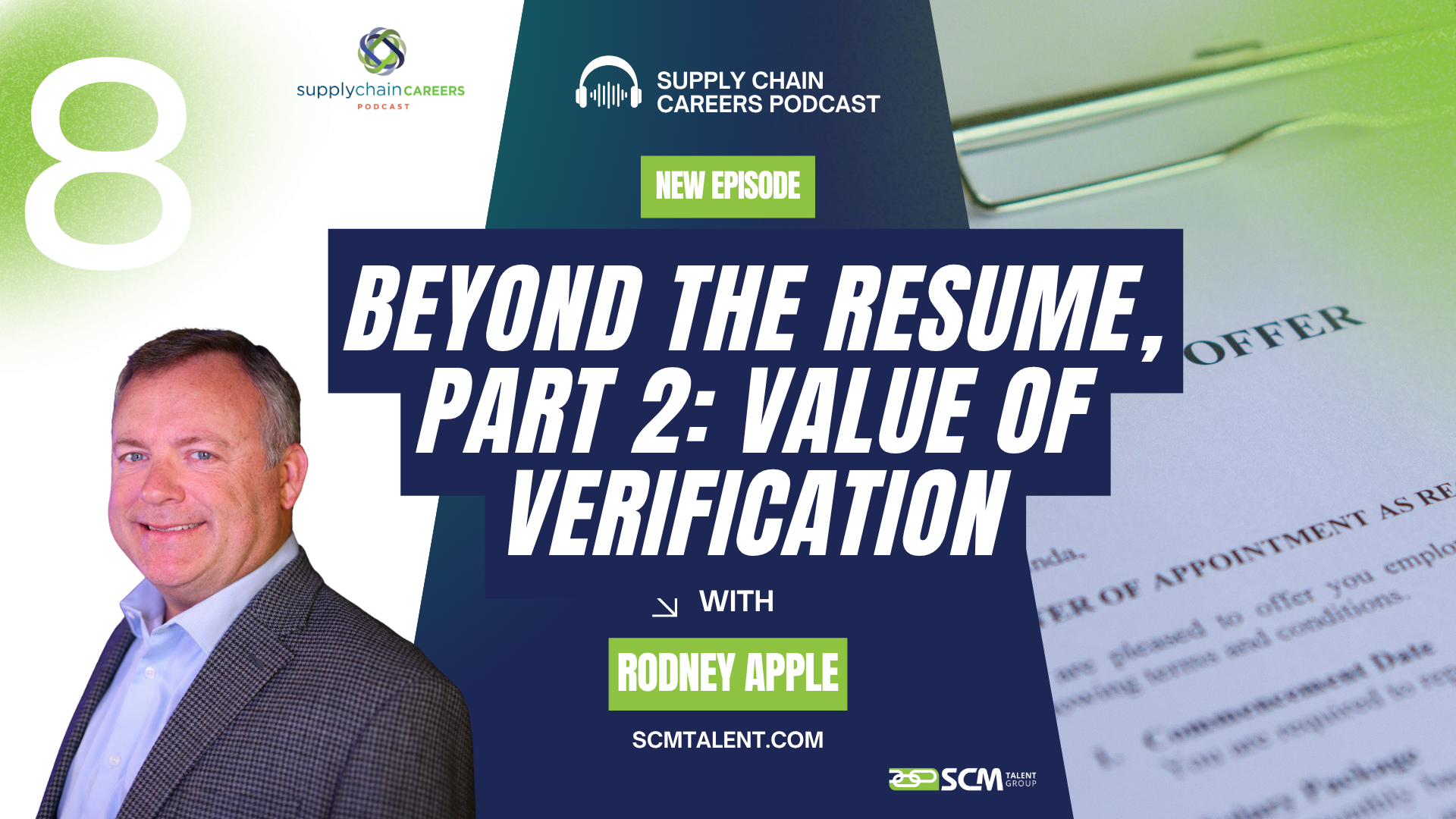
Beyond the Resume, Part 2: Value of Verification. Transcript
Rodney Apple: [00:00:00] Welcome back to the Supply Chain Careers podcast. This is our Catalyst series, and today it’s a two-part series. This part two is going to cover the importance of reference checking from both the job seeker or candidate’s perspective, as well as the employer perspective.
If you haven’t seen part one yet, we do encourage you to start there. It’s basically on how to structure and develop a career management portfolio, especially in the age of AI, Chris. We talked about this in part one where the differentiation between resumes is becoming more challenging with AI rewriting resumes and customizing them around every single job that you apply to.
So it’s making it more difficult from the employer’s lens for the resumes to stand out, right? And then same thing with interview preparation. It’s a wonderful tool for prepping but people are getting better at interviewing. And so what are all the things that you can do to help stand [00:01:00] out amongst the pack when all things are equal?
When you look at the person’s background, skills, experience, accomplishment, what are these additional things that you can do as a job seeker to stand out amongst the pack and get that that push in, in, to- towards the altar so you can get get that, that coveted offer?
Chris Gaffney: Yeah, I think, today, I think the value and importance of references is underestimated by both the employer or hiring manager and the candidate.
And, the, the intent of our series is to allow you to differentiate as a candidate. And for the employers listening, we want you to have confidence that your process improves your hit rate, your chance that an employee is not just the right person for this role, but somebody who can grow in your career.
Rodney Apple: Yeah, and I think what prompted this series, Chris, is I had to conduct some references on a search that I’m leading, [00:02:00] and it was down to two candidates, and they were both solid, could have probably picked either one. And the client asked for references, so I went back to these two candidates, got the reference list, and I was a little bit surprised to see the differences in just what came back from an email.
One had basically name, company, and a phone number. The others had a lot more information the context, the reporting structure, relationship, Full contact information, right? And so that’s part one. As I got to calling and checking on the references I also noticed, differences as well, and it actually made the difference for the employer when it came down to the hiring decision.
The quality of references the, the, the reporting relationships for one was much stronger than the other. And then addressing gaps or opportunities with the references, validating accomplishments. It just flowed naturally for one candidate. As I spoke, we [00:03:00] spoke to four of her past supervisors.
The other had some, some non-relevant references that were more peer-based or stakeholder-based, and just didn’t get that level of validation. I don’t always see references push the decision, strongly and one, one over the other, but clearly this is a, a great example of how it did, and we love to talk about that so you can set yourself up for success as the as the candidate.
But also on the employer side, making sure that you’re getting the right references and you’re asking the right questions is equally important
Chris Gaffney: so Rodney, why do references matter, right?
And let’s talk about this for both the, the job seeker, and then I’m gonna let you talk about it from the employer perspective, and then check me on my side. But if I’m a job seeker, I want to provide as many kind of sources of evidence of why I’m a compelling candidate, right? I have provided a resume, I’ve filled out an application, I’ve [00:04:00] done a pre-screening with HR, I’ve gotten in front of potentially multiple members of the team at the company.
That company has the ability to look at my footprint online. But again, in the world of AI, that’s not enough. And the ability to get a, either a live reference or, with a recruiter, have the recruiter have the opportunity to talk to people in your circle basically just seals the deal, right? It is a validation beyond what you’ve given them, from a third party and from a compelling standpoint, multiple third parties that tells the same story.
So I think it’s a big deal, and again, consistent with our theme for this series is it’s a big differentiator.
Rodney Apple: It sure can be. I- if you’re an employer and you find yourself in the position of you, you’ve got two, three finalists as I mentioned earlier I, I’m working on a big search right now for a Fortune [00:05:00] 500 company, and we’re down to three finalists.
And we’re– I just got the n- note today that two have made the cut, and, they’re gonna debrief and then we’re gonna check references. So companies are still checking references, and I think from the employer’s perspective it is validating what you’ve been told in an interview situation. We’re trying to avoid that regretful hire that I’m sure you and I both have made over the years.
I know I have certainly made my fair share, unfortunately. We’re also gonna look at where do we meet this candidate? How do they like to be led? Are there any buttons that need to be pushed, for lack of a better term? And then you can think about onboarding too. You can get some really good insights that can help formulate or tailor an onboarding experience around that candidate’s potential needs and wants and developmental opportunities.
Chris Gaffney: Super. All right. So if we’re gonna dig into this and our candidates are now attuned to this there’s a right way and a [00:06:00] wrong way to do this. So if you think about common mistakes that job seekers might fall them- fall into when they’re trying to think about references they provide, what’s the first thing that comes to mind for you?
Rodney Apple: Not putting any thought to, to the types of references that I would say are applicable to the types of jobs that you’re interviewing for. Many people think that, “Okay, I just need to give you three names of people that I’ve worked for, worked with. They’re gonna say good things about me.” That’s all you need, and that can’t be…
that, that is, right? And a lot of employers, on the other side take this exercise as box checking. It’s another task I’ve gotta complete for the process. I’m gonna validate employment dates. They’re gonna get very transactional, surface level details. But from the job seeker’s perspective, to tie this all back together you’ve gotta know what, through your experience, not just on the job description, what have you been told in the interview situation?
If you’ve asked great questions, what are the things [00:07:00] that keep you up at night? What are the core objectives? What does success look like within a year, within two years? S- then you should start thinking about your references. Who’s gonna be able to validate my ability to close these gaps or add value in certain areas?
So you should strategically think about it. It should not be a static list. Have a dynamic list of references. So that’s one. I would say also providing the context. Don’t just give a name and a phone number. Give a name, a phone number, a email, and provide the re- reporting relationship at a bare minimum.
Any additional context that you can explain, “Hey, this particular reference can validate my ability to do A, B, and C,” which hopefully will align with the job description’s objectives and what that employer is looking for. Not bothering to give the reference a head up is another common mistake. I’ve seen candidates give me a list, and I can tell that I’ve caught someone off guard.
So I think it’s important before you get that offer, when you’re getting requested for references, just validate the [00:08:00] person is willing to speak on your behalf. Another mistake is, and this kind of goes hand in hand with not validating the reference, is make sure that person’s gonna say something positive, right?
So you should, if it’s a new reference in particular, you should ask that person, “Hey, I’m being considered for a job to do X, Y, and Z. We worked together, and I’m hoping you could speak positively about my ability and my experience doing A, B, and C.” Right? You’ve gotta have that validation. I’m now thinking of an example where I had to check references on a candidate, and it was a big leadership role.
Materials manager is what it was, and the person gave a, a reference of a peer that ran the accounting department, which is different than materials management. But they needed a really good leader to turn this team around and this person said, “I just can’t vouch for the leadership experience.
Person likes to sit at their desk. They’re not out on the floor.” And of course, the client, in a plant setting, they want people out on the floor engaging the [00:09:00] associates. So they were about to move in this candidate’s direction, and then they rescinded the offer. I haven’t seen that happen too many times, but that’s just proof that it can happen
Chris, is there anything you’d like to add to these common mistakes job seekers make with references?
Chris Gaffney: Yeah, the first one is it’s like a, a famous Confucius saying, “The best time to plant a tree was 100 years ago.
The next best time is today.” And so I think you have to have an honest self-assessment if you’re one of our listeners and a potential job seeker, is how well have I maintained my network over time? And when I worked with these people, was I a positive employee? Was I a positive peer? Was I a constructive supplier relationship person?
Was I a supportive customer relationship person? And be honest about the fact that if I called all these people blind, would they all say, “I’m thrilled to hear from you. I loved working with you. You [00:10:00] set the standard”? Or did you burn every bridge you ever crossed? And, I think, we’ll probably come back to that, but I think it gets back to the importance of nurturing the work relationships you have, because that widens your potential for high-quality references.
So I think, if you’re, if you haven’t been great at that, then you’ve got work to do. By the same token, if you think you’re going to be in the market, then it’s time to check in with folks and say, “Haven’t caught up with you in a while. Love to check in.” Because what you don’t want is a crucial reference be someone who thinks well of you but hadn’t heard from you in five years.
Rodney Apple: That’s a really good point, Chris. And I would add, and this goes right to your point, that maintaining the references is extremely important. You don’t wanna be in a situation, because sometimes it comes down to perception. We were talking about this earlier before we hopped on the podcast, that y- you were [00:11:00] describing someone where employer asked for references, and they’re like, “How many do you need, and what type of references are you looking for?
I can give you A, I can give you a B.” It’s just having that confidence, “Sure I’ll get right back to you,” validating what they need. Whereas another candidate may scramble and say, “Ooh, oh, let me think on this. I’m gonna, I’m gonna have to get back to you. I’m gonna have to dig around and see what I can come up with.”
That right there could rule rule you out if you can’t confidently convey that, “I’ve got references, I’ve got the receipts, and I’m happy to provide them.”
Chris Gaffney: Yeah, absolutely. And I think that jumps into, what can be a tricky reference situation is n- not every prior experience may be great.
And if they wanna talk to a current manager or a very recent manager And you didn’t have a great relationship with them, you’ve got to think about that. And y- you may be able to say, “Hey, listen that situation was not a great work environment for a [00:12:00] variety of reasons. This was my accountability, this was theirs, but I’ve worked for nine people in my career, and I can give you the other eight.”
That allows you to counterbalance what may have been a, an uncomfortable situation. That’s right. Things happen. Sometimes you sign up to work for a certain boss and a couple weeks later you find out, oh, here’s my new boss, and you guys have friction. You just don’t get along. So these things happen.
Rodney Apple: We’re not looking for perfection from the employer’s perspective. We are looking for you to be transparent, and we’re also looking for you to, how did you speak to that reference? You don’t wanna speak negatively towards the person. Just keep it short, keep it sweet. “This is what happened. While I can’t give you this person as a reference I’m happy to give you, a peer in another department or a stakeholder so address it proactively. Don’t wait for it to happen by the employer. “Why can’t you give me the reference from your past employer?” They’re gonna just start maybe having perceptions [00:13:00] that you didn’t do a good job or something like that.
Hey, Chris, what, we talked about not bad-mouthing a former employer or boss.
But when it comes to the employer’s side, which we’re getting ready to get into, I certainly appreciate when candidates are transparent and they address this proactively. Any further thoughts on that dynamic?
Chris Gaffney: Yep when we’re on either side of this coin, we want a fit, right? We want someone who’s capable.
And my hope as a job seeker is that they understand that we’re not perfect, right? But they also value someone being comfortable giving the whole story. So I advocate for the job seeker to be transparent and to be authentic and to have confidence that this is the right– if this is the right place for them to work, it will be appreciated as well.
Rodney Apple: That’s right. You certainly don’t wanna do the opposite and hide it, and then all of a sudden it comes out, at the 11th hour that here’s why I can’t give this person a [00:14:00] reference.” So it’s just best to address it head-on and proactively, and it’ll save you headaches on the back end. Yeah.
Chris Gaffney: Yep.
Rodney Apple: Let’s talk about some common mistakes because I see employers making these mistakes over and over again. Treating it, as I said earlier, like it’s just another checkbox in the hiring process, so they’re gonna treat it very transactional. That could lead to using a cookie cutter form. Tell me about the employment dates.
What was this person’s title? On a scale of one to five, how did they rank with their communication? These are very surface-level questions. My recommendation is to go back in and put some serious effort into this. It should link right back to the job, the desired job outcomes. What are those deliverables and objectives that you want this person to solve for, those key skills, those, those key traits when it comes to leadership.
Like getting your hands dirty, getting out on the floor as we just talked about. Working with the associa- the associates, listening to them. If [00:15:00] that’s important in the job it’s mission critical, it’s a minimum requirement why don’t you ask for examples from the references of how that person did this?
A- again, you’re validating what is critical to the job and instead of just doing some objective like one to five rating, right? Let’s see not specifying the reference types. Most people are gonna go straight to, “I wanna speak to your last three supervisors.” It all depends on the context of the job, because some jobs, if they’re, especially if they’re not leadership roles, there’s still leadership skills that you’re gonna need to vet, like around the communication and stakeholder engagement and influence and change and things like that, problem-solving.
Employers need to identify what are those reference types, and how many do you need? Just be clear in the ask, and then you’re gonna get the kind of references that you look for. It makes it a lot easier on the candidate, and it prevents them from giving an inadequate reference. Again, cookie cutter questions, cookie cutter forms.
We tailor our assessment process around every single search [00:16:00] looking for, again, validation of this, of those core skills, experiences, accomplishments, quantifying the results. Same thing on the reference side. You’re looking to validate that, and if you can val- validate that, and you’ve got this high level of confidence, you’re gonna make a more informed decision and hopefully avoid that regrettable hiring mistake, right?
And then, the valuable insights just you’re gonna get some good information on what you could need to potentially meet this person where they’re at from a development perspective as well as translating that into a formal onboarding program, which sometimes can be, critical for getting someone to stick in the very beginning and having a pleasant onboarding experience.
Anything to add there, Chris?
Chris Gaffney: Yeah. I think f- for me, some of it is where this fits in the process, right? In, in many cases, when we’re hiring, we’re trying to backfill somebody, so we have some time urgency, and we might have gone through lots of candidates, and we’re down to a final two, and we think we [00:17:00] like the one.
And in some cases, we’re, we may be hoping not to get information that goes counter to the fact that this person has risen to the top of the heap. So I would caution on that. I would potentially suggest that you do the a- the reference check almost a step before you’ve kinda gotten to that final internal agreement because you may get it out of sequence.
So that’s the first thing that, that I would say, and I think it goes hand-in-hand with what you said, is when somebody’s sourcing a job, they would love to have a personal reference “Hey, we know this person because they’ve worked with a key client or key customer.” When you don’t have that, ’cause that brings you a lot of comfort- Right
you need to use the reference checking process to build that, corroboration to what you’ve seen. I think the other thing that I would say is if it’s a critical hire I would potentially have the HR person cover the references, but I might, if it’s really [00:18:00] important, also have the hiring manager directly involved in the reference discussion.
Because if it’s a senior leader, it’s like, “Hey, we’re having a great discussion with this person. We’re at the final step. We’re really trying to make the right decision. You’ve worked with this person before. You’re an advocate for them. This is about a mutual fit. Help me with a few of these questions that might give both of us confidence that this is the potential to be a long-term role.”
And if this reference cares about you, they’re gonna be forthright and authentic and provide the right level of information to help that process get to the right conclusion.
Rodney Apple: Exactly. I agree 100%. And I’ll also say, and I’ve, I’ve– this is from a, a hiring mistake where I’ve– I had that strong referral.
This person hit the president’s club at a prior firm year after year recruited in our space likable, and I had a lot of trust and respect for that person’s boss as well. But it just goes to show that, not everything is equal. Just because you work for a [00:19:00] competitor, which this person did, doesn’t mean you’re gonna fit.
They had a different business model. It doesn’t mean you’re gonna fit right in from A to B, and all things are equal. You cannot trust a referral, even if you know someone, and you’re hearing great things. I would say, let’s just do that extra validation step because you just, you never know what you’re gonna get.
And while that probably doesn’t happen very often, if it’s, to your point, a critical role especially in a small company like ours where one mistake can compound and add all kinds of problems you absolutely wanna go the extra mile and get these validation points.
Chris Gaffney: Absolutely.
Rodney Apple: . Let’s segue over to how to properly conduct a reference. As I’ve touched on already I, you can have a form and a template, but it shouldn’t be a scripted form or template where, And we do the same thing with our podcast, right? We don’t wanna just be reading word for word off of a script.
It’s, it should be [00:20:00] well thought out and it should tie right back to the role when it comes to those functional, technical leadership competencies that you’re looking for. And surely you’re trying to s- do something to add value, or maybe it’s cl- close a gap on your team in terms of capabilities.
So you wanna kinda make that the crux of the reference, right? And then you’re gonna throw on those ancillary things, like maybe personality traits, and how do they get along with others, and how do they lead, or how do they like to be led? So all of these facets come into play. And again, you can use a template, but I highly encourage you to customize it around those attributes.
Performance, right? Past performance is usually, not always, an indicator of future success, and so understanding the strengths, understanding the accomplishments quantifying those results I think is equally important. What else? Key strengths, right? And what else would you add, Chris?
Areas to develop and improve, of course is a, a no-brainer. You’ve gotta ask that, because it’s not all about the positives, it’s understanding where [00:21:00] they may have limitations and gaps.
Chris Gaffney: Yeah, I think, basics for me, I also wanna understand, how long did you work with this person?
So we can get a sense of the durability of the relationship. But beyond that, I’m probably gonna ask the questions around the edges, right? How does this person perform under stress? In, in any work environment, I’ve never seen the perfect cross-functional environment, so how do they work with cross-functional stakeholders, even in situations where w- we may have had misalignment of goals?
How did they respond to a challenge, right? Where we’ve disappointed a customer, or we’ve had a significant issue in a plant or whatever that we’ve gotta recover performance from. So I wanna ask those stressor kind of questions to get a sense of how they perform in that situation.
From an execution standpoint, do they run to the fire? But do their values and principles and the way they work with others hold up under stress?
Rodney Apple: Exactly. One other thing that I don’t think a lot of [00:22:00] employers do I, I find myself doing it often to include when we’re hiring internally, is before I get into the questions, I am letting the the reference know “Hey, I’m considering, Jane Doe here for- A role within, whether it’s my company or a client’s, I like to get into, I won’t typically name the employer, but I will n- go through here’s the title and here are the core objectives.
Here are the things that are most important that we’re looking for. And so when you think about your answers, if you can touch on these things, that would be great, ’cause I w- I would love to have that context. So without giving them the answers to the questions you’re gonna ask, you’re at least framing it up with, “Here’s what we’re trying to solve for.
Here are the most important skills, experience, competencies, and I’d love for you to speak to their accomplishments in this area.” So you’re framing it up and I think that’ll help guide the reference to give you the information you need without, again, giving them the exact answers.
Chris Gaffney: Yeah, and if you’re a job seeker, this goes back to our prior question.
If you’re [00:23:00] warming your references or getting the commitment of someone to provide a reference, you might run these questions with them and say, “Hey, if you’re asked this, give me the honest feedback. I don’t work with you anymore. You can tell me the good, the bad, and the ugly, but how would you answer these questions?”
And then that may give you comfort. It may give you things you can use in an interview, or it m- also have you may say, “This person won’t be the first person on my list.”
Rodney Apple: Yeah, have that same conversation with your references. I’m being considered for this job, at this company or type of company, and here’s what they’re looking for.
We did this together at our past employer, and I’m hoping you can speak positively about your experience managing me or working with me. Yeah. Absolutely. Great add. That’s a, it’s such a great add to do that as the employer, but also to do that as the job seeker.
Chris Gaffney: Excellent.
Rodney Apple: So Chris, we’ve covered the foundation when it comes to reference, references, right? From the job seeker perspective as well as the employer.
But what are some advanced reference [00:24:00] strategies that may apply to both the job seeker as well as the employer that we haven’t talked about?
Chris Gaffney: Yeah, you said it before. I’d love to be able to say, to a potential employer “I’m fortunate to still be in contact with everyone, who I’ve ever worked for, and I’m confident that you could talk to any of them.”
So that’s, that’s the, the strong move. But then when you add onto that, and I would say, “I have also been fortunate to have a number of people on my team who have, have advanced to positions of senior leadership. So if you’d like to talk to people who’ve worked for me to understand how I lead, I also have a list of folks that you could talk to.”
And now that many of them are VPs or chief supply chain officers, you’d get a lot of credibility out of that. But then I think on top of that if you’ve been fortunate to have long customer relationships such that you have personal contacts at key customers for me, it– we worked with McDonald’s for many years, and I would say the person I work with at McDonald’s [00:25:00] now leads their global logistics function.
Happy for you to talk to them.” And then I think it’s just as important at suppliers, service partners, right? We worked, with C.H. Robinson for many years as a third-party logistics provider. And I’m still fortunate to have a number of folks there who would be a great reference for me in terms of how we did business with them, how we treated them as a supplier and had accountability, for both excellent service delivery, but excellent cost delivery.
So I think when you can provide that, breadth of references, you send a message in and of itself. Whether they ever choose to call those folks, you would say, “This person does business in a certain way.” And if that’s important to them, that they want high quality relationships, they believe in, end-to-end supply chain partnerships and that type of thing, then you’ve got the right person and they may be a great fit for you.
Rodney Apple: Exactly. Yeah, and there’s also what we call in the recruiting world backdoor references. It’s a [00:26:00] big world in supply chain, but it’s also a very small world.
And so sometimes, you do what that Kevin Bacon exercise, like the first, second, third, fourth degrees of connection points. Oftentimes you may know someone that knows this person. And reaching out to get that perspective is something that a lot of employers a- and hiring managers do.
And again- I’m not condoning the exercise but we certainly see this happen, and I’ve seen it off and on throughout my career. And I think it goes back to something you said earlier, Chris, which is, maintaining references, which is really maintaining relationships.
Because you just never know when someone’s gonna reach out and do one of these behind the scenes references. Could be to a customer, could be to a common supplier that you’ve had. Those things happen behind closed doors. And again, I’m not condoning the exercise from the employer perspective, but just know, like on the job seeker side, that people may be checking you out from multiple perspectives that go way beyond your reference list, and it just goes back to the critical [00:27:00] importance of maintaining these relationships over time and not burning any bridges as well.
Chris Gaffney: Yeah, I think, I think we’ve made a good case here that if this wasn’t hot on your list there are a lot of reasons, whether you’re on either side of this this equation, to invest some, some time and effort in terms of freshening up your approach to references
Rodney Apple: Exactly. Yeah. Quality sometimes matters over quantity.
The transparency of addressing what could be a negative reference or could be something that might be said that’s not in your favor. Keep it transparent, keep it honest. That’s the best policy, and it can go a very long way.
Chris Gaffney: Absolutely. I think the thing that I like that you said is y- we wanna be thinking positively here.
The, the job seeker is setting themselves up to get the job. The hiring manager is setting themselves up to commit to a relationship with an employee can, that can last a long time. So we want the reference process to be, one last step [00:28:00] that validates that’s the right thing, not only on the hiring decision, but sets that employee up to come in with a tailored onboarding approach based on all the context that’s been given that allows them to have a great start in a new company.
I
Rodney Apple: agree 100%, yeah. And we’re also trying to avoid that regret- regrettable hiring mistake. And, you nowadays, again, with resumes looking polished from AI, and interviewers are becoming more polished, the, the references now are probably more important than ever. And going back to part one of the series, all of the other accolades that you can build and showcase over time that weren’t developed, written by AI, are now more important than ever.
And that’s why we wanted to highlight these tactics and strategies because if you’re out there in the job market right now it’s, again, it’s not the most robust, and it hasn’t been in the last several years. You’ve gotta do everything possible to stand out amongst a highly competitive [00:29:00] workforce as it relates to not just su- supply chain, but really all functions.
Chris Gaffney: Yeah. I think, we’ve said it before, and I’ll say it again, this is just one more step in studying for the A, right? If you want the best employee to come into your organization, this is a step that needs to be in your process. And if you are seeking that job of a lifetime, this is one more step that you need to prepare for to, really put your best foot forward.
Rodney Apple: That’s right. And lastly, if you don’t take it serious as the job seeker, it can set you back, again, when all things are equal. And likewise as the employer if you’re going with the person that was the most polished, had the best resume, interviewed the best but did not take the time to validate what they said is accurate you’re gonna open yourself to some risk and exposure that could cause some pretty serious problems down the road.
Ask me how I know. I think we all, if you’ve been around the block, you’re gonna have plenty of war stories and regrets, right?
Chris Gaffney: Absolutely.
Rodney Apple: Thanks again for joining us today on the Supply Chain Careers podcast, our Catalyst series. [00:30:00] This is part two of a two-part series, and we strongly encourage you to go back and listen to part one if you haven’t.
If you find this episode valuable and you think of others that could benefit from these episodes, please give us a like, share send it to your network because our hope is that this can help someone, whether they’re an employer, whether they’re a job seeker get that job and avoid those regrettable career mistakes.
If you’re looking for additional career advice or hiring advice within the supply chain sector, head on over to scmtalentgroup.com and you’ll find a plethorph- plethora of information and insights that you can use to help advance your career or your organization