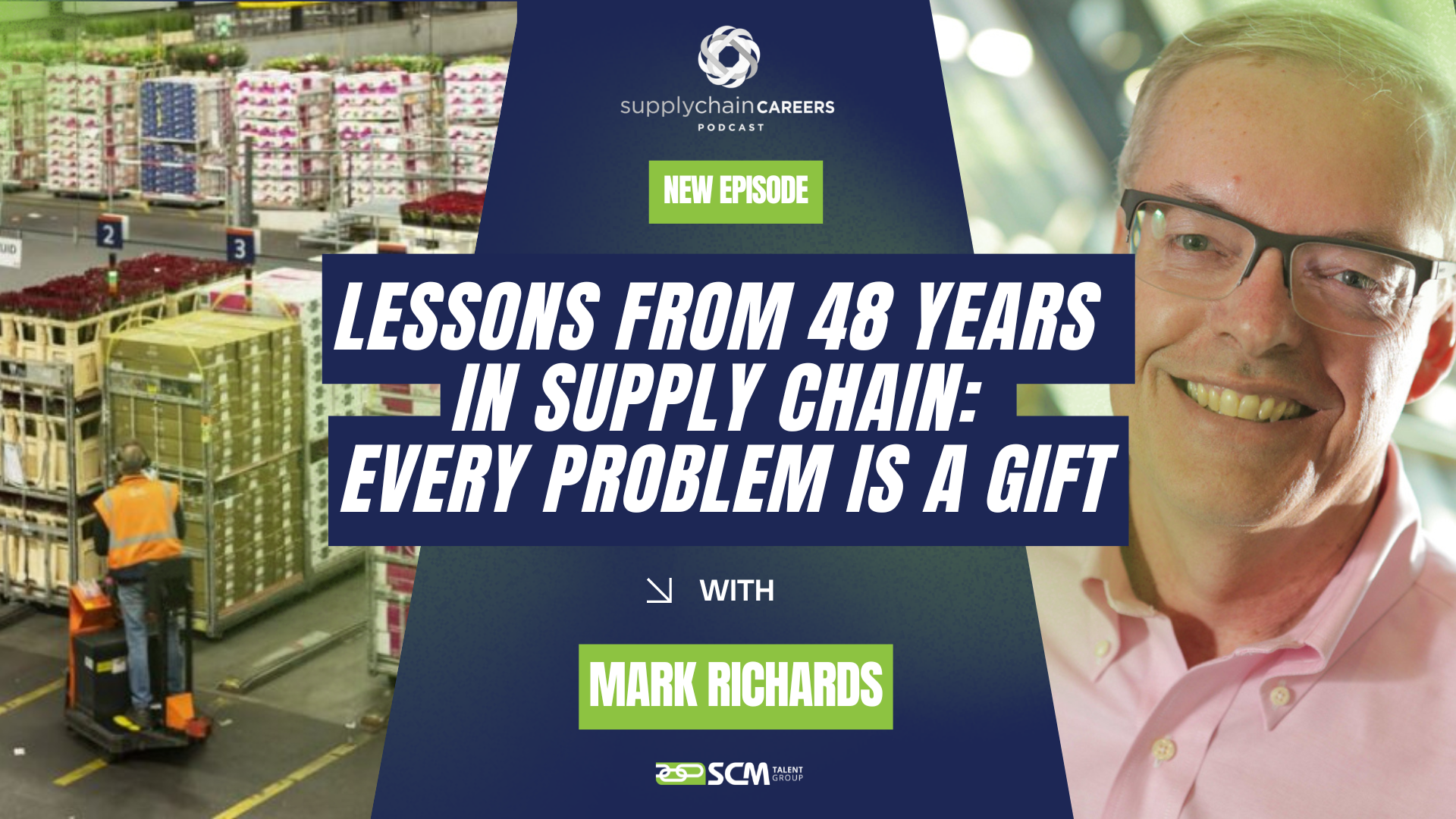
Mike Ogle: [00:00:00] Mark, we’re happy to have you with us today. Welcome to the Supply Chain Careers podcast.
Mark Richards: Thank you, Mike. It’s a pleasure to be here and great to see you again.
It’s been so many years.
Mike Ogle: Yeah, absolutely. Looking back on your career. What were some of the influences that made you aware of supply chains in the first place? Be, probably be before it was really coming on strong as the words supply chain. And what led you to pursuing a career in the industry?
Mark Richards: Yeah i’m surprised you you and I haven’t talked about this before, but it was my father my father was director of distribution at Nabisco. And like you said, it wasn’t called supply chain then it was distribution. And so I grew up. And the the business so to speak.
Remember just being a kid and he’d take me to the warehouse and we’d walk around, I’d ride on a forklift, and so that was my introduction, but I never intended to get into the profession. And it was, I grew up in the age where you didn’t want to do what your dad did. [00:01:00] You’re gonna be different.
And so had zero intention of being in the business and actually ran into a gentleman, Ken Ackerman, at a a work conference. I was attending Miami of Ohio at the time. This was at Ohio State. I was looking for my dad, I just said, Hey, can you help me find Rich Richards? And next thing I know, Ken’s saying so what are you doing?
Would you like to interview and I can help you? And that sort of thing. My dad certainly Ken Ackerman meeting him at that time. And as I mentioned, I was at Miami and I was the grad assistant for Tom Spa who a lot of people in the profession remember him. And so great influences from some gentlemen.
Chris Gaffney: It, it’s interesting, mark. I’ll make a couple connections. I think I took my first child to an operation when he was six months old. When I was working night shift at Frito-Lay. And then I do remember taking my boys to a regional warehouse and it rubbed off well on, on one of them. So we’ll leave it that.
I would also say I’ve been surprised in [00:02:00] my, similar time in the field as you, the number of folks in the supply chain logistics field who are from Ohio. I think it’s more than average, and I don’t know why, but we’re happy to have another Ohioan on with us today. You mentioned Nabisco, you worked at Nabisco, you’ve worked at Gillette.
You’ve had a stellar time at Associated Warehouses, Inc AWI love to have you help our audience who’s always thinking about how to navigate their career life. What were those experiences like, and what about the transitions that got you from one to another? That may be informative for our audience.
Mark Richards: The first one as I mentioned right into Ken Ackerman at the conference and what turned into an offer to have me practice interviewing ended up with a offer for a job. And I knew that the company that he was running at the time is called Distribution Centers, had a a reputation for being really [00:03:00] focused on development.
And so I was a management trainee when I went there and saw it as a way to start my career and really focus more on the development part. At the time I thought third party warehousing, we called it public warehousing back then. I’ll do this for about six months. I’ll learn it all and then I’ll go on to something else.
And here we are. But that’s the main reason I started with him was because of the opportunity for development. I think that’s really important as you’re looking for your. First, second, third position. And then the transition to Nabisco. As I mentioned, my father worked at Nabisco. He was with the retail division, and this was an opportunity with the food service division.
So I would be in a different operating unit than my father. And the way that it was structured, they had four offices around the country. Each office operated like a small business, and to me that was really [00:04:00] intriguing. They were using third party services, so it’s good to have that background as I went into that.
And Nabisco, I think the main reason was that small business opportunity as well as. My father worked there for 40 years, treated him well, why not? Made the move from Ohio to Chicago where I said I would never live because it was too cold. But it was a great great opportunity.
After that went to Weber Logistics that was on the West Coast. And at the time, this was about two years into my career at Nabisco they merged with standard brands. And then you might be familiar with the book Barbarians at the Gate if you’re not. We were living through that and it got pretty interesting to put it nicely.
So I started looking for an opportunity and went out to visit Nick Weber. Picked me up at LAX, took me to Hollywood, and the rest was history. I said, wow. Didn’t know there was a place like this. And [00:05:00] again, an opportunity to get back on the third party side, which I really enjoyed. And being a new environment opportunity to run a division that he had just created.
Again, like a small business. Then Oral B and Gillette, this was one of those things where when it first came along, I didn’t even know who Oral B was. And had a headhunter reach out to me. And I never say never. It’s typically, yes, let’s talk. And so I talked to them, met the the president of the company and the person I’d be reporting to.
Amazing culture. I was still just a kid, I was probably about 28 years old and this was an opportunity to go in a role where I would be responsible for what we now call supply chain for the country. Big job for a young guy. So I saw it as an opportunity to again, grow. And then finally, or a WI was oral B was amazing.
Loved them, but the people that were running a WI at the [00:06:00] time said that they were looking for a new model. Reached out to my father, asked him if he’d be interested. He said, sure, but I can’t do it myself. What about Mark? And many of them knew me because I was either a customer or potential customer, and it was one of those.
If I don’t do this, I’ll always say, why not? And what if, and I felt I could go back to the corporate world if I really wanted to, but it was an opportunity to finally have that small family business that I’d always dreamed on, dreamed of.
Mike Ogle: Yeah, I really like that. Never say never side of things and want to explore that just to just a little bit further because of the opportunity to be able to learn about other aspects of things that you might not have been aware of and meet other people and the connections.
It’s always great to be able to build those aspects of your career out.
Mark Richards: Definitely. Yeah. It’s, as I’ve always been a joiner, right? And believed in, in networking and attending [00:07:00] professional conferences and events helping other people. And, what goes around comes around.
You just the network is so valuable. If I didn’t, participate as much as I did with C-S-C-M-P and work and some other associations. I just, I wouldn’t be where I’m at today.
Mike Ogle: All right, mark, you’ve had a lot of interest and experience, obviously in third party services. So for somebody who’s curious about that part of supply chain, what is really different about it and what have you learned about how students or.
Practicing industry professionals, how should they prepare themselves for successful careers in services, outsourcing, cover a little bit of the hard skills, but certainly soft skills as well. ’cause those are incredibly important.
Mark Richards: Okay. The first part, what’s different? When you are working for a third party, you get exposed to dozens of companies.
So for [00:08:00] me that makes it very interesting because what happening in, say, the automotive sector. Is different from what in the chemical sector or the food sector or electronics. So the variety for me is very appealing and part of what has drawn me back to that ultimately that world.
And then, as far as the skills. We were talking about earlier hard skills ai, understanding how to apply AI and having an analytical. Mind. Because when you get down to it, a lot of logistics, supply chain is math, right? Being able to see all the things that are happening, analyze that, and be able to not only analyze it, but create a picture of here’s where we’re at, here’s where we want to go.
How do we do that? And then the the other thing from a soft standpoint I think the key is really listening. Especially on the third party side. [00:09:00] Don’t don’t go to your client and or a prospect and just start talking, and saying how great your services are and all the good things you can do.
You need to listen. We even saw that at a recent conference that we’re at where was talking to a salesperson that was pitching us and they didn’t listen. They just. Went into their pitch. So listening and related to that communications you need to be able to convey your your vision to people and hopefully inspire them through that vision takes skills with with communications leadership.
Again, inspiration being able to earn trust. And then I’d say, I’m not sure this is a skill, but it’s certainly something that you can develop. And that’s just being humble, right? When you’re humble, when you’re not puffed up, I think people really respect that and they’re drawn to that. And at the end of the day, even with ai, [00:10:00] robotics, et cetera, it’s people that make it happen.
Chris Gaffney: Mark. When I was at Coke we evolved from being very asset heavy to much more engagement with third parties, and that was for transportation, contract packaging, contract manufacturing, and clearly all aspects of warehouse and fulfillment. It was not easy for us because we weren’t comfortable with it.
But what I also saw was we didn’t necessarily have the best skills in terms of being a great customer. So I’m curious if you can talk about what does it look like to be a great provider, and then as you see that range of customers, customers behaving well and customers behaving poorly. What does it look like to be a great customer of a, of a third party?
Mark Richards: Okay, let me start with that ’cause I’m pretty passionate about that. Having been on both sides of the equation what I found was that when I was a shipper or a customer of a third party, that when I respected them, [00:11:00] as much as I wanted them to respect me, when I was transparent, when I share, or when I dealt with them like they were part of our company.
Things went well. And the other thing was appreciation, right? As an example, we had a a program that we put in place at Oral B distribution Center of the year that we were evaluating all of the third party providers that were using at the time. And we, very simple. If you earn this recognition we gave them a year supply of Oral B toothbrushes.
We took ’em out to dinner. So I would fly to wherever and take the team out to dinner. We gave them, I think at the time it was $5,000, and said, spend this any way you want. If you want to get a microwave, if you want to get something that you’d put on the floor to make it more comfortable. Whatever, here’s $5,000 for you, the people.
And and then we [00:12:00] gave him a jacket that said, oral B distribution Center of the Year. You would be amazed at how people responded to just being recognized and appreciated. And one of the things that we did, and I think this is really critical, is at least once a quarter, myself or someone from my team would be at that facility not to go and beat up, not to go up and.
Talk about all the things that are wrong, but to go out and and again, let them know how much we appreciate them and keeping them in the loop with how our business was changing, how our needs were changing, so there were no surprises. One story I seems like just yesterday, it’s been a long time, and I share it frequently, is when I went into a facility this was July. It was in Memphis. So you know what it was like from a weather standpoint. Walk in and here’s one of the people that was handling our account on a forklift wearing a tie. [00:13:00] And I’ll just call him Smitty and say, Smitty, what are you doing? He said we knew that you were gonna be here.
We really appreciate the business. It’s outta respect. So again, treat people the way you want to be treated, and it’s amazing what you can accomplish. I won’t say forget the contracts. We all need agreements, but just be a good person, right? So that’s how you can be a good customer.
On the third party side I think it’s it gets back to what I was sharing earlier. Listen, you need to be a really good listener. And oftentimes people in the third party world will get frustrated because it seems like a client is always bringing up problems. Their issues are why you exist.
Every problem, everything you share is a gift. And I think it’s really critical and not just do what you’re told to do, but be proactive, and always be thinking about how can I serve this customer better? And even beyond that, how can I better serve my [00:14:00] customers customer? What can I do that’s going to make coke or it’ll be whomever a preferred client.
And all this is just going the extra mile. One of the first people I worked for was a colonel in the military before he was in logistics. And he would always say, mark don’t wait for me to ask you to do something and don’t just do what I ask you to do. Go that extra mile. And that was an important lesson for me.
Chris Gaffney: We’ve done hundreds of these and I always love to hear the golden nuggets and I really feel like that’s one that I would really call out to our folks because it’s probably a little bit of a refinement of anything we’ve heard. So I appreciate you given that one is your fine point there and closing point on that one.
Mark, thanks.
Mike Ogle: Ab, absolutely. You know this, sometimes people look at the industry as, oh it could be a little bit boring until we got to the point where everybody learned what supply chain was all about. It was never
Mark Richards: boring,
Mike Ogle: [00:15:00] nothing like a good pandemic. But there’s been plenty of other kinds of cycles that it goes through over the years.
Little disruptions that you have here and there, and sometimes it’s just things that happen cyclically in the industry and then sometimes, there are things that there are trends, there are new things going on, and that’s kinda like where I’d like to go right now is trying to understand where things you might be going and AI is one of those, but you know a little beyond that as well.
But I would like to have some of your thoughts there, but what are some of the trends in technology and business practices in general that you end up seeing have a, having a huge influence on people’s careers over the next five years or so?
Mark Richards: You stole my thunder by saying ai ’cause that was gonna be the first thing I mentioned especially after being at the the conference earlier this week that was pretty much focused on that robotics.
I think that, as far as the trends, we are [00:16:00] all becoming. More focused on instant gratification, right? And I want what I want in the way that I want it right now. As far as the trend, and, and this has been going on for a long time, but I think it, it gets heightened almost every day where you need to be able to be very agile.
Very flexible, and you need to be able to provide a service that is individualized. I remember another professor that we all know Don Bowersocks talked about the supply chain is the ability to serve the the community of one, right? Or the customer of one. And his whole point was again, that.
It’s not just, this is what we do and we hope it works for you. You need to understand, again, what the needs are and be able to accommodate that on an individual basis. So [00:17:00] to me that’s one of the biggest trends and just the we’ve talked about soft skills a lot. I think as we embrace and implement more and more technology, those soft skills are gonna become even more critical.
So practice the soft skills. I don’t wanna sound like an old grumpy guy, but get off the text and talk to somebody, face to face.
Chris Gaffney: Totally agree with that. Mark. You’re in an interesting perspective that your dad was in the field, and so you can say you were given the gift of exposure to a field that a lot of people don’t understand now, as you look at, a career in supply chain today and looking forward, and whether it’s people in your own family or.
Children of friends and coworkers how do you excite them about a career in supply chain, but at the same time also give them the right coaching around saying, Hey, this is, this is a great field, there’s twists and turns and things [00:18:00] that might frustrate you. How do you have that balanced discussion with them, and how do you think about it in, today forward?
Mark Richards: Yeah. Love that question. Actually I don’t think I’ve mentioned it yet, but we have three sons and two of them now work with me. And they began their career on third party side for about 15 years before they joined me and. When I look at that one of the things that they mentioned to me is that as they have attended different conferences or different events with me, they notice that dad’s having a good time.
Dad really enjoys this and he has some amazing relationships and I think that drew them to it and it has drawn me to it and continues to. It’s an exciting profession. Like we’ve said earlier, no two days are the same. And from a more how do I put this macro standpoint, I’ll say, or maybe a philoso philosophical standpoint.[00:19:00]
When I was more involved with C-S-C-M-P and had the opportunity to travel around the world on behalf of C-S-C-M-P, what I noticed was that the quality of life in the countries that I visited was directly related to their supply chain expertise. I’ll say, countries that that were behind from a supply chain execution standpoint, quality of life, not as great others.
You could see where supply chain did have a direct impact on quality of life. So to me, that’s gratifying. To be in a profession we can really make a difference. It’s, it’s not as, but the lawn use to say kicking boxes and lick labels you’re really you can change the world.
And one of the things that being in this profession has given me the opportunity to do was, I was involved in creating American Logistics Aid Network where you know that’s what we do. There’s a tragedy and we bring the [00:20:00] expertise and the resources and the supply chain to help people after a natural disaster and get the community back to a stable environment more quickly.
So helping people doesn’t get much better than that.
Mike Ogle: Yeah, a lot of that work when we were at those meetings, usually at, whether it was work conferences or C-S-C-M-P and get together at those meetings after. The conference had ended, af after the final closure of everything. And we actually had Kathy Fulton on as one of our guests fairly early on in the podcast.
So I encourage our listeners to, to give a listen there as well and make sure that they’re getting in that kind of game to be able to help people when they’re down because those kinds of things come around. Certainly.
Mark Richards: Yeah.
Chris Gaffney: So Mark, I have an unscripted question for you. So you could take it and run with it or not?
In my view, having been on the logistics and [00:21:00] distribution side for the majority of my career, I feel like we have progressed a lot in this country and we are pretty good at it. At the same time, we’ve seen manufacturing struggle in the us do you have any lessons from, how we have progressed from a maturity, from a distribution, fulfillment, logistics side that might guide people who are trying to bring manufacturing back into the us?
Mark Richards: Interesting question. As far as bringing it back to the us. Manufacturing is gonna go where they have the best resources from a employee labor standpoint from a resource standpoint. So right now, I think and this has been going on for a long time. There’s more and more people in our country. That don’t wanna do the things that you need to do in a manufacturing [00:22:00] location similar to, what we see with drivers people don’t want to be in a truck.
And there is a large segment, I think, of our population that’s exactly what they should do and they could have a very fulfilling life with that. But I think we’ve all become. And I’ll include myself become where we feel we’re entitled. I think in my career, right? I, like I said earlier, I thought I’d know everything there was to know about third party warehousing or public warehousing in six months, and then I’d go onto a real job.
Let’s be humble. Let’s be thankful for the opportunity. And be the best of that we can be at whatever we do, whether it’s, turning a screw or building a rocket. So I think that’s one of our biggest stumbling blocks right now is that people don’t seem, and I don’t want to put it on them, but they don’t seem to have the desire to just be good at whatever.
And they, they [00:23:00] want everything right now, and they want it without the effort.
Chris Gaffney: I appreciate you taking a run at that for sure. Mark. Thank you. This is great, Zach. Oh, I’ve got one
Mike Ogle: left.
Chris Gaffney: Alright. I’ll let you go. Go do that and then I’ll come in around you.
Mike Ogle: Okay. All right. And mark those, there was some great advice in that question and I’d like to do something that we talk with everybody that comes on this program being able to close with some examples of some of the best.
Supply chain, career advice even just life advice and business and trying to do work with people. But advice that you’ve received over the years that made a difference to you and at the same time then a couple of your own that you’ve learned along the way that you like to share.
Mark Richards: Sure. I’m not sure that I. Have authored something that’s unique. So let me start with some lessons that that I was taught early [00:24:00] on. First one that, always strikes me and I still use it today with our kids, our sons. And that is perception is reality. And that to me is a situation where, I’ll just take you back to when this occurred, was working at a third party.
I just finished my master’s degree. I know everything. I was told not to take a truck unless there was an appointment, a truck came in, didn’t have an appointment. So I turned him away and then I hear my boss on the intercom saying, mark, come to my office. And the reason he had asked me to come to his office was the customer called and was very irate.
And I said that’s his problem. And to my boss, yeah, that was not the right thing to say. And whether it was, whether I was following instructions or not, perception is reality. And that [00:25:00] customer’s perception was that Mark turned away, my my product and and shouldn’t have.
Perception’s reality. Regardless of how you feel about it, you need to consider what that person’s perception is. And then I talked about this earlier. The the notion of just go the extra mile. If someone asks you to do this, just do a little bit more. And we all see that when we go to a restaurant or go to a retailer it’s amazing.
The food may not be so great, but if the service is amazing and you feel like that person has gone the extra mile, you leave pretty happy. So go the extra mile. And then some that are I think a little bit one that’s a little bit different it’s a movie, Jerry McGuire. Full of quotes full of lessons.
And one of ’em is the fortune is in the follow up. And that’s something that I try to instill in, in my sons. With the business that we now have. [00:26:00] It’s amazing how many people reach out. You reach back, but then there’s no follow up, right? So how does that make you feel? Again, we were at a conference earlier this week, spoke to someone that is wanting to sell us some services.
They followed up the day after the conference that left an impression on me and made me feel like they would be a good good partner. And then the last one and I’ve weaved this in throughout our sharing today is just a golden rule. Treat people the way that you want to be treated.
Yeah, be humble. Don’t think you’re better than you are and treat people with respect in the way that you want to be treated. Nothing original, but all good, I think.
Chris Gaffney: No. Excellent. Mark, thank you so much for this. Insights are great. I take ’em, and I know if I can get something, our audience could get something out of it.
As we wrap, I, I know beyond what you do for your own business, you are a [00:27:00] resource, you speak, you write how can people follow your work reach out to you if they wanna tap into this wisdom beyond what we’ve talked about today.
Mark Richards: Sure. One of the things that my sons give me a hard time about is another phrase I use.
I’ll talk to anybody. Because you just never know, right? So the best way to get ahold of me is just email, and that’s [email protected]. I answer every email. And then we’re obviously on LinkedIn. Or I’m on LinkedIn. It’s another place. Our website, aw logistics.com.
Chris Gaffney: Perfect. No, this was fantastic. We appreciate it. This is why we do these sessions. There’s just so much to be shared.
Mark Richards: I appreciate the opportunity. It’s great to visit with both of you and happy to help any way I can.